Americans overdosing on salt - Author Michael Moss talks about our addiction to salt, and how the food industry develops our taste for it.
From Amazon:
"From a Pulitzer Prize–winning investigative reporter at The New York Times comes the explosive story of the rise of the processed food industry and its link to the emerging obesity epidemic. Michael Moss reveals how companies use salt, sugar, and fat to addict us and, more important, how we can fight back.
Every year, the average American eats 33 pounds of cheese (triple what we ate in 1970) and 70 pounds of sugar (about twenty-two teaspoons a day). We ingest 8,500 milligrams of salt a day, double the recommended amount, and almost none of that comes from the shakers on our table. It comes from processed food. It’s no wonder, then, that one in three adults, and one in five kids, is clinically obese. It’s no wonder that twenty-six million Americans have diabetes, the processed food industry in the U.S. accounts for $1 trillion a year in sales, and the total economic cost of this health crisis is approaching $300 billion a year.
In Salt Sugar Fat, Pulitzer Prize–winning investigative reporter Michael Moss shows how we got here. Featuring examples from some of the most recognizable (and profitable) companies and brands of the last half century—including Kraft, Coca-Cola, Lunchables, Kellogg, Nestlé, Oreos, Cargill, Capri Sun, and many more—Moss’s explosive, empowering narrative is grounded in meticulous, often eye-opening research.
Moss takes us inside the labs where food scientists use cutting-edge technology to calculate the “bliss point” of sugary beverages or enhance the “mouthfeel” of fat by manipulating its chemical structure. He unearths marketing campaigns designed—in a technique adapted from tobacco companies—to redirect concerns about the health risks of their products: Dial back on one ingredient, pump up the other two, and tout the new line as “fat-free” or “low-salt.” He talks to concerned executives who confess that they could never produce truly healthy alternatives to their products even if serious regulation became a reality. Simply put: The industry itself would cease to exist without salt, sugar, and fat. Just as millions of “heavy users”—as the companies refer to their most ardent customers—are addicted to this seductive trio, so too are the companies that peddle them. You will never look at a nutrition label the same way again."
Showing posts with label CNN. Show all posts
Showing posts with label CNN. Show all posts
Monday, March 25, 2013

Monday, April 16, 2012
Battling depression with "battery-powered brains" - CNN report on deep brain stimulation (DBS)
CNN reports on treating severe depression with electrodes inside the brain:
The procedure -- called deep brain stimulation, or DBS -- targets a small brain structure known as Area 25, the "ringleader" for the brain circuits that control our moods.
Area 25 is relatively overactive in depressed patients. One hypothesis is that in patients who do not improve with treatments for depression, Area 25 is somehow stuck in overdrive.
DBS had been used since 1997 as a treatment for movement disorders, including essential tremor, Parkinson's disease and dystonia.
References:
Treating depression with electrodes inside the brain. CNN, 2012.
The procedure -- called deep brain stimulation, or DBS -- targets a small brain structure known as Area 25, the "ringleader" for the brain circuits that control our moods.
Area 25 is relatively overactive in depressed patients. One hypothesis is that in patients who do not improve with treatments for depression, Area 25 is somehow stuck in overdrive.
DBS had been used since 1997 as a treatment for movement disorders, including essential tremor, Parkinson's disease and dystonia.
References:
Treating depression with electrodes inside the brain. CNN, 2012.
Wednesday, February 22, 2012
What are the 8 germiest places in the mall?
The 8 germiest places in the mall, according to CNN, are:
1. Restroom sinks
2. Food court tables
3. Escalator handrails
4. ATM keypads
5. Toy stores
6. Fitting rooms
7. Gadget shops
8. Makeup samples
The filthiest area in a restroom (and therefore in the whole mall) isn't the toilet handle or the doorknob - it's the sink. The sink area is a moist environment, so bacteria can survive longer there.
Researchers found food, E. coli, urine, mucus, feces, and blood on escalator handrails. Where there is mucus, you may also find cold and flu viruses.
Each key on an ATM contains, on average, 1,200 germs. Protect yourself: "Knuckle" ATM buttons.
How some hotels clean drinking glasses (video):
References:
The 8 germiest places in the mall. CNN.
12 Germiest Places in America According to Health Magazine
1. Restroom sinks
2. Food court tables
3. Escalator handrails
4. ATM keypads
5. Toy stores
6. Fitting rooms
7. Gadget shops
8. Makeup samples
The filthiest area in a restroom (and therefore in the whole mall) isn't the toilet handle or the doorknob - it's the sink. The sink area is a moist environment, so bacteria can survive longer there.
Researchers found food, E. coli, urine, mucus, feces, and blood on escalator handrails. Where there is mucus, you may also find cold and flu viruses.
Each key on an ATM contains, on average, 1,200 germs. Protect yourself: "Knuckle" ATM buttons.
How some hotels clean drinking glasses (video):
References:
The 8 germiest places in the mall. CNN.
12 Germiest Places in America According to Health Magazine
Wednesday, September 21, 2011
Wednesday, June 15, 2011
A microscopic look at hotel hygiene makes a microbiologist travel with an impervious mattress cover
From CNN:
The microbiologist Philip Tierno doesn't feel comfortable staying in hotels. He knows too much. He travels with an impervious mattress and pillow cover to protect against the unseen debris that guests leave behind. When humans sleep they shed about 1.5 million cells an hour.
While the covers were developed for allergy sufferers, Tierno encourages everyone to use them at home and on the road.
And definitely ditch the bedspread, he advises. Hotel bedspreads became a hot topic when one featuring bodily fluids from several sources was introduced in boxer Mike Tyson's 1992 rape trial.
How hotels clean drinking glasses
An Atlanta TV station used hidden cameras to monitor how the drinking glasses in hotel rooms were cleaned. In one case, a housekeeper appeared to clean a toilet and the glasses wearing the same gloves. In multiple hotels, the glasses were rinsed in the sink and dried for the next guests, in violation of health codes.
The Health Magazine lists the 12 germiest places in America or the so called "dirty dozen":
A microscopic look at hotel hygiene, CNN, 2011.
The microbiologist Philip Tierno doesn't feel comfortable staying in hotels. He knows too much. He travels with an impervious mattress and pillow cover to protect against the unseen debris that guests leave behind. When humans sleep they shed about 1.5 million cells an hour.
While the covers were developed for allergy sufferers, Tierno encourages everyone to use them at home and on the road.
And definitely ditch the bedspread, he advises. Hotel bedspreads became a hot topic when one featuring bodily fluids from several sources was introduced in boxer Mike Tyson's 1992 rape trial.
How hotels clean drinking glasses
An Atlanta TV station used hidden cameras to monitor how the drinking glasses in hotel rooms were cleaned. In one case, a housekeeper appeared to clean a toilet and the glasses wearing the same gloves. In multiple hotels, the glasses were rinsed in the sink and dried for the next guests, in violation of health codes.
The Health Magazine lists the 12 germiest places in America or the so called "dirty dozen":
- Kitchen sink
- Airplane bathroom
- A load of wet laundry
- Public drinking fountain
- Shopping cart handle
- ATM buttons
- Playgrounds
- Bathtub
- Office phone
- Hotel-room remote
A microscopic look at hotel hygiene, CNN, 2011.
Sunday, May 22, 2011
Cell phones and your brain - CNN video
From CNN:
Do cell phones cause brain cancer? It may be too early to say for sure. The latency period or time between exposure and recognition of a tumor is around 20 years, sometimes longer. And, cell phone use in the U.S. has been popular for only around 15 years. Back in 1996, there were 34 million cell phone users. Today there are 9-10 times as many.
Interphone is a multinational study designed to try to answer this question. The data showed people who used a cell phone 10 years or more doubled the risk of developing a glioma, a type of brain tumor.
References:
Cell phones, brain tumors and a wired earpiece. CNN.
Cell phones and your brain. CNN.
Mobile phones may increase cancer risk - list of DOs and DONT's of mobile phone use (scroll down the page). Daily Mail, 2011.
How much radiation does your phone emit? Comprehensive chart by CNN http://goo.gl/l0l5q
Saturday, April 2, 2011
Headache? It could be that blade in skull (CNN video)
CNN: "I've got these stabbing pains" - Man complains about migraine, finds he has had a knife in his brain for 4 years.
Related reading:
Friday, January 28, 2011
5 ways your cell phone can save your life
From CNN:
1. Program your cell phone so people can find you
2. Put your "in case of emergency" contact into your cell phone
3. Put your medical information on your cell phone
4. Get an app that teaches you first aid and CPR
5. Find help nearby
References:
Wednesday, December 29, 2010
President Obama has been smoking for 30 years and managed to quit - and so can you
The White House says President Obama has kicked the habit and stopped smoking. "It's been probably about nine months since he last smoked a cigarette," says Robert Gibbs, the President's press secretary, in an interview with CNN. Mr. Obama, like a lot of smokers, has quit before and started back up again. This time may be different. Gibbs says this is the longest he's known the President to go without a cigarette. He quit by chewing Nicorette gum and exercising a lot of will power.
References:
Stop smoking: Follow the President's example. CNN.
The Presidents Club | Photos: Oval Office Secrets from Truman to Obama | TIME, 2012.
Thursday, October 21, 2010
New CPR Guidelines - Hands Only - Use "CAB" Instead of "ABC" While Singing "Stayin' Alive"
The American Heart Association is adopting new cardiopulmonary Resuscitation (CPR) guidelines that do away with mouth to mouth resuscitation and focus on chest compressions. Do fast, forceful compressions; the beat of "Stayin' Alive" is the right pace - 100 beats per minute. Queen's "Another one bites the dust" was rejected as an alternative song choice.
Currently, this recommendation only applies to laymen CPR. The professional rescuers (EMTs, doctors, etc.) should use the previous approach with a compression-breathing (ventilation) ratio of 30:2.
However, “chest compression only” CPR is recommended if the rescuer is not trained (for example, in dispatcher assisted CPR) or is not willing to give rescue breaths. The aim is now to compress the chest to a depth of 5-6 cm (rather than 4-5 cm). This recommendation is based on several studies showing that deeper compressions were associated with improved short term outcomes.
Dr. Sanjay Gupta shows Matthew McConaughey the new way of doing CPR on Larry King Live.
Bee Gees - Stayin' Alive.
References:
New CPR is spelled C-A-B. CNN.
New international guidelines on resuscitation. BMJ, 2010.
Related reading:
Dangers of unrecognized heart disease: Husband dies while giving wife CPR (both found dead, age 60, 59) http://goo.gl/LZ39U
British Heart Foundation is urging people to forget "mouth-to-mouth" during CPR: 'no kissing, just hard CPR'. BBC, 2011.
British Heart Foundation is urging people to forget "mouth-to-mouth" during CPR: 'no kissing, just hard CPR'. BBC, 2011.
Saturday, October 9, 2010
From migrant worker to brain surgeon at Johns Hopkins
Dr. Alfredo Quiñones-Hinojosa is the Director of the Brain Tumor Stem Cell Laboratory at Johns Hopkins University School of Medicine.
Twenty years ago, Dr. Quinones-Hinojosa hopped a border fence from Mexico into the United States and became a migrant farm worker, living in the fields in a broken-down camper he bought for $300.
When told he would probably be a farm worker for the rest of his life, he signed up for English classes at a community college, where one of his teachers encouraged him to apply to UC-Berkeley. There, he developed a passion for science, and showed remarkable aptitude.
He went on to Harvard Medical School and graduated with honors, followed by a residency in neurosurgery at UC-San Francisco, where he completed a postdoctoral fellowship in developmental and stem cell biology.
References:
Dr. Alfredo Quinones-Hinojosa. BigThink.com.
Thursday, September 2, 2010
Doctor's family killed by kidnappers, he sues the police for slow response
A sad and terrible story.
Tuesday, April 27, 2010
The men behind famous eponymous diseases
From CNN:
"Having a disease named after you is a decidedly mixed bag. On the one hand, your scientific developments are forever commemorated. On the other hand, though, you're stuck with the knowledge that no patient will ever be happy upon hearing your name."
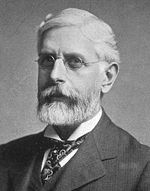
Daniel Elmer Salmon (1850 – 1914) was a veterinary surgeon. He earned the first D.V.M. degree awarded in the United States, and spent his career studying animal diseases for the U.S. Department of Agriculture. He gave his name to the Salmonella genus of bacteria, which were discovered by an assistant, and named in his honor. Image source: Wikipedia, public domain.
New medical conditions that are being discovered are not named after scientists or physicians anymore. The eponymous system is non-descriptive and generally confusing.
References:
"Having a disease named after you is a decidedly mixed bag. On the one hand, your scientific developments are forever commemorated. On the other hand, though, you're stuck with the knowledge that no patient will ever be happy upon hearing your name."
Daniel Elmer Salmon (1850 – 1914) was a veterinary surgeon. He earned the first D.V.M. degree awarded in the United States, and spent his career studying animal diseases for the U.S. Department of Agriculture. He gave his name to the Salmonella genus of bacteria, which were discovered by an assistant, and named in his honor. Image source: Wikipedia, public domain.
New medical conditions that are being discovered are not named after scientists or physicians anymore. The eponymous system is non-descriptive and generally confusing.
References:
Friday, April 2, 2010
Concussions dangerous to teen brains - a hard to watch CNN video
"4 million sports and recreation-related concussions occur each year. The vast majority are suffered at the high school level, but few schools have rules governing how concussion is treated -- and few coaches are trained to identify it."
References:
Concussions extra dangerous to teen brains. CNN, 2010.
Monday, March 22, 2010
Rock star Ozzy Osbourne to CNN: "Between drugs and STDs, I'm lucky to be alive today"
"Ozzy Osbourne, the former front man of rock group Black Sabbath, says that after decades of living a life of drugs and sex, he's lucky to be alive today.
Osbourne described how he often played a dangerous game when it came to using drugs and having promiscuous sex. "With the drugs, it nearly killed me on a daily basis -- I did a lot of heavy drug taking for a long time and I survived it by the grace of God.
Answering a viewer's question on whether he realized his power to change people's lives, Osbourne replied with shock. "When you're on the inside looking, you don't see it that way," Osbourne said. "But I suppose you're right. I do -- I do have the power to change people's lives."
References:
Ozzy Osbourne: I'm living on borrowed time. CNN.
"Researchers studying Ozzy Osbourne's DNA found that the singer is descendant of Neanderthals" http://goo.gl/7Fa8
Related:
Related:
Monday, January 25, 2010
Subscribe to:
Posts (Atom)