"The Parallax Effect of Long Hair" is a talk by Ian Gillian, Singer & Song writer with Deep Purple, given at The ICD Annual Conference on Cultural Diplomacy 2012 (Berlin, December 13th - 16th, 2012), The Power of the Arts and Culture to Promote Democracy and Global Peace:
Here is the back story, explained by Gillan: The Magic Bus http://www.gillan.com/anecdotage-45.html
Here, Gillan briefly reflects on the talk:
"When the director asked for the title and a copy of the speech I told him it would be entitled 'The Parallax Effect on Long Hair' and that it would be off the cuff, so to speak.
Basically it's about perception or how things are viewed differently, depending on where you're standing.
I was a little nervous to start with as it was unscripted and I'd never spoken publicly before, apart from the usual gibberish delivered on stage each night with DP before being gloriously interrupted by a drumist not known for his patience. But I did enjoy it and may do another, one day."
References:
ICD Mediacenter | Selection http://bit.ly/USLnf9
Gillan.com http://bit.ly/16diIEH
Showing posts with label psychology. Show all posts
Showing posts with label psychology. Show all posts
Saturday, January 26, 2013

Monday, January 21, 2013
Seasonal affective disorder (SAD)
 What is seasonal affective disorder?
Seasonal affective disorder is a combination of biologic and mood disturbances with a seasonal pattern. It typically occurs in the autumn (fall) and winter, with remission in the spring or summer.
How common is seasonal affective disorder?
5% of the U.S. population experiences seasonal affective disorder. Because the symptoms are seasonal, they are present for 40% of the year. Although the condition is seasonally limited, patients may have associated depression which would last longer.
What is the treatment for seasonal affective disorder?
Light therapy is well tolerated. Most patients improve within 1-2 weeks. To avoid relapse, light therapy should continue through the end of the winter season until spontaneous remission of symptoms in the spring or summer.
Antidepressant medications and cognitive behavior therapy are as effective as light therapy.
How to prevent seasonal affective disorder?
Light treatment may be used as prophylaxis before the subsequent autumn and winter seasons.
There are many devices available on Amazon, for example:
References:
Seasonal affective disorder. Kurlansik SL, Ibay AD. Am Family Physician, Dec 2012.
Image sources: Record breaking snowfall March 2008 at Aubrey, Texas, Wikipedia, public domain

Wednesday, January 2, 2013
This year, pick just ONE resolution that will make you happier
From Christine Carter, Ph.D. who blogs at Raising Happiness:
"This year, pick just one resolution that research shows will make you happier:
1. Spend more time with friends
2. Everyday, find a way to give something to somebody. My favorite happiness booster is to give thanks
3. Get more sleep and exercise"
Here is a simple book on the topic that I like:
References:
3 New Year’s Resolutions that Will Make You Happier | Greater Good
"This year, pick just one resolution that research shows will make you happier:
1. Spend more time with friends
2. Everyday, find a way to give something to somebody. My favorite happiness booster is to give thanks
3. Get more sleep and exercise"
Here is a simple book on the topic that I like:
References:
3 New Year’s Resolutions that Will Make You Happier | Greater Good
Monday, December 31, 2012
Put down your phone - "Disconnect to connect" (video)
Here is a widely shared commercial from Thailand that is a part of a series of related videos on YouTube http://buff.ly/T8EoO8:
Wednesday, December 26, 2012
A Best Friend Will Always Wait for You
Julian Burrett: "Watson the dog stands by while the boy does a quick assessment of the puddle situation. Could this be the cutest video ever? FAQs: Watson is a 12 year old Shar Pei." http://buff.ly/X2Jpr9
Monday, December 17, 2012
Physician Communication PEARLS from Cleveland Clinic
The video features my former colleagues and hospital medicine stars Drs. Moises Auron and Vj Velez:
Some key messages:
- Establish rapport and plan an encounter with the patient
- Elicit the patient perspective using FIFE (function, ideas, fears and
expectations)
- Apply PEARLS (partnership, empathy, acknowledgment, respect,
legitimation and support) to convey empathy
- Incorporate the patient into decision making and education using ART
(ask, respond, tell)
References:
Relationship-Centered Communication for Physicians (PDF) from Cleveland Clinic Academy
Some key messages:
- Establish rapport and plan an encounter with the patient
- Elicit the patient perspective using FIFE (function, ideas, fears and
expectations)
- Apply PEARLS (partnership, empathy, acknowledgment, respect,
legitimation and support) to convey empathy
- Incorporate the patient into decision making and education using ART
(ask, respond, tell)
References:
Relationship-Centered Communication for Physicians (PDF) from Cleveland Clinic Academy
Monday, August 20, 2012
The link between stress and heart disease
In this video from the Cleveland Clinic, Steven Nissen, MD, talks about the important lesson war has taught us about stress and its effect on the heart. One of the best ways to manage stress is regular exercise.
Tips for managing stress (watch the 2-minute BBC video embedded below)
- Take a few deep breaths
- Get plenty of exercise
- Socialize - don't stress alone, talk to someone and have a laugh
- Get out - go to the park
Read more: http://www.bbc.co.uk/scotland/brainsmart
Participation in sport is associated with a with a 20—40% reduction in all-cause mortality compared with non-participation. Exercise might also be considered as a fifth vital sign, according to the Lancet: http://goo.gl/gyxYf
If nothing else helps, consider this: Chewing gum may reduce stress and improve memory
Tips for managing stress (watch the 2-minute BBC video embedded below)
- Take a few deep breaths
- Get plenty of exercise
- Socialize - don't stress alone, talk to someone and have a laugh
- Get out - go to the park
Read more: http://www.bbc.co.uk/scotland/brainsmart
Participation in sport is associated with a with a 20—40% reduction in all-cause mortality compared with non-participation. Exercise might also be considered as a fifth vital sign, according to the Lancet: http://goo.gl/gyxYf
If nothing else helps, consider this: Chewing gum may reduce stress and improve memory
Friday, August 10, 2012
Searching for a fundamental 'particle' of mental health

The equivalent of the "Standard Model" of mental health — Higgs plays an essential part in the "Standard Model" of physics — is a world in which "people are not penalized for their illnesses but rather than an array of tools from which to choose and which they can use to become mentally healthy," Roskes writes.
Though those tools have not yet been identified, there are paths down which researchers are going to find them, including molecular and pharmaceutical research; psychotherapies and rehabilitation. Research has led to pharmaceutical approaches, "not perfect, but far preferable to a world without them," he writes. It has led to cognitive therapy to treat depression, anxiety and, in some cases, psychosis. It has also led to advances in rehabilitation of mental illnesses and developmental disabilities like autism.
Like the search for the Higgs particle, finding its equivalent in the world of mental health is worth the search, Roskes concludes. (Read more)
Thursday, August 2, 2012
Munchausen's syndrome - NHS video
From the NHS Choices YouTube channel: A psychiatrist explains the motivation behind Munchausen's syndrome, also known as factitious illness, where someone pretends to be ill or causes symptoms in themselves. This can include inflicting wounds or tampering with blood and urine samples. He also explains the importance of getting treatment and describes another form of the condition where a person fabricates an illness in someone in their care (Munchausen's syndrome by proxy):
Comments from Twitter:
Julie Meadows-Keefe @esq140: Fascinatingly & disturbingly real.
Comments from Twitter:
Julie Meadows-Keefe @esq140: Fascinatingly & disturbingly real.
Monday, July 23, 2012
Unipolar depression in adolescence is common worldwide but often unrecognized
 Unipolar depressive disorder in adolescence is common worldwide but often unrecognised. The incidence, notably in girls, rises sharply after puberty and, by the end of adolescence, the 1 year prevalence rate exceeds 4%.
 The burden of depression is highest in low-income and middle-income countries. Depression is associated with morbidity, and heightens suicide risk.
The strongest risk factors for depression in adolescents are:
- family history of depression
- exposure to psychosocial stress
Factors that interact to increase risk through hormonal and perturbed neural pathways include:
- inherited risks
- developmental factors
- sex hormones
- psychosocial adversity
References:
Depression in adolescence. Prof Anita Thapar et al. The Lancet, Volume 379, Issue 9820, Pages 1056 - 1067, 17 March 2012.
Image source: OpenClipArt.org
Wednesday, June 13, 2012
88-year-old George H.W. Bush: "Maybe they’ll come out with a new drug that makes memory come roaring back"
The former president George H.W. Bush wrote a poem for his grandkids:
By the way, the 88-year-old former president said he was not done skydiving. His goal: to jump again when he is 90.
References:
'If you need me I'll be there': George HW Bush moved to tears during interview with granddaughter Jenna about his family and growing old | Daily Mail Online http://goo.gl/noCt0
"So I can add to the report on getting older.
Who knows, maybe they’ll come out with a new drug that makes legs bend easier,
Joints hurt less, drives go further, memory come roaring back,
And all fears about falling off fishing rocks go away.
Remember the old song: I’ll be there ready when you are.
Well I’ll be there ready when you are
There’s so much excitement ahead, so many grandkids to watch grow.
If you need me I’m here."
By the way, the 88-year-old former president said he was not done skydiving. His goal: to jump again when he is 90.
References:
'If you need me I'll be there': George HW Bush moved to tears during interview with granddaughter Jenna about his family and growing old | Daily Mail Online http://goo.gl/noCt0
Wednesday, May 9, 2012
Diary-Writing Has Psychological Benefits - Journal of Happiness Studies
 Writing has long been used as a coping strategy and has been applied to improve psychological well-being. One study found that suicidal poets used more first-person singular pronouns (I, me, my) than the control group of poets.
This study from Taiwan, published in the Journal of Happiness Studies, investigated the psychological displacement paradigm in diary-writing (PDPD) and its supposed psychological benefits.
Study participants were randomly assigned to write about their recent negative life experiences two times a week for 2 weeks in PDPD group (diary-writing), or comparison group (no diary-writing).
The diary-writing group (PDPD) showed a decrease in negative emotion and an increase in positive emotion immediately after each writing session (short term effect).
They also had an increase in psychological well-being for at least 2 weeks (long term effect).
References:
The Psychological Displacement Paradigm in Diary-Writing (PDPD) and its Psychological Benefits. Jen-Ho Chang, Chin-Lan Huang and Yi-Cheng Lin. JOURNAL OF HAPPINESS STUDIES 2012, DOI: 10.1007/s10902-012-9321-y
Comments from Google Plus and Twitter:
Lin W: I guess blog writing might have the same effect?
Ves Dimov, M.D.: It depends on the type of blogging you do, but yes, blogging can be a positive experience too.
Dr. Amal Hasan @DrFloona: Diary-Writing Has Psychological Benefits bit.ly/wwMDmr” Until someone else reads it
Dean Giustini @giustini: Diary-Writing Has Psychological Benefits bit.ly/wwMDmr [Isn't this why we blog Ves?]
@DrVes: Well, I'm not sure. I don't blog about "negative experiences". Blog = archive for me
Monday, May 7, 2012
The Diet Factor in Attention-Deficit/Hyperactivity Disorder - State-of-the-Art Review Article in Pediatrics
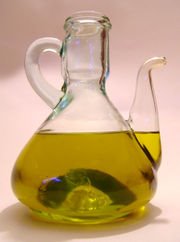 Diets that were tried in attempt to reduce symptoms associated with attention-deficit/hyperactivity disorder (ADHD) include:
- sugar-restricted
- additive/preservative-free
- oligoantigenic/elimination
- fatty acid supplements
Omega−3 supplement is the latest dietary treatment with positive reports of efficacy. Interest in the additive-free diet of the 1970s is occasionally revived.
Provocative reports have drawn attention to the ADHD-associated “Western-style” diet, high in fat and refined sugars, and the ADHD-free “healthy” diet, containing fiber, folate, and omega-3 fatty acids.
Indications for dietary therapy include:
- medication failure
- parental or patient preference
- iron deficiency
- change from an ADHD-linked Western diet to an ADHD-free healthy diet, when appropriate
In practice, additive-free and oligoantigenic/elimination diets are time-consuming and disruptive to the household; they are indicated only in selected patients.
Iron and zinc are supplemented in patients with known deficiencies; they may also enhance the effectiveness of stimulant therapy.
In patients failing to respond or with parents opposed to medication, omega-3 supplements may warrant a trial.
References:
The Diet Factor in Attention-Deficit/Hyperactivity Disorder. J. Gordon Millichap, MD and Michelle M. Yee, CPNP. PEDIATRICS Vol. 129 No. 2 February 1, 2012, pp. 330 -337, (doi: 10.1542/peds.2011-2199)
Image source: Olive oil, Wikipedia
Tuesday, April 24, 2012
Unfaithfulness in men may be associated with higher risk of cardiovascular events
 The authors of this study from Italy performed an extensive Medline search for “unfaithfulness,”“extramarital affairs,”“infidelity,” and “men.”
 How common is unfaithfulness in men?
As expected the results were variable. Some surveys reported that 1.5–4% of married men had extramarital coitus in any given year, others that 23.2% of men have cheated during their current relationship.
Lifetime prevalence of unfaithfulness was between 15% and 50%.
What are the factors related to unfaithfulness?
Men with extramarital affairs more frequently have a dysfunctional primary relationship.
Parenthood and conflicts within the family are associated with a higher risk of having an affair.
Unfaithful men display a higher androgenization, larger testis volume, higher sexual desire, and better sexual functioning.
What are the clinical implications of unfaithfulness in men?
Some studies have suggested that having an extramarital affair could have a negative impact on cardiac morbidity and mortality. Unfaithfulness in men seems to be associated with a higher risk of major cardiovascular events.
References
Fisher AD, Bandini E, Rastrelli G, Corona G, Monami M, Mannucci E, and Maggi M. Sexual and cardiovascular correlates of male unfaithfulness. J Sex Med, 2012.
Image source: OpenClipart.org, public domain.
Monday, April 9, 2012
"Wonder drug" dogs are the only animals that look at right side of human face where emotions are expressed
 People who have dogs as pets are much less likely to have a heart attack. If they do have a heart attack, they are 2-3 times more likely to survive it.
Mitochondrial genetics studies have shown conclusively that dogs have descended from wolves. Dogs' genes are 99.8% the same as the wolf genes, yet dogs behave in a fundamentally different way.
Over more than 100,000 years dogs have evolved to recognize human emotions. It has been a collaborative process all along. Humans are able to recognize 6 types of dog barks expressing emotions and "intentions" such as fear, excitement, aggression and so on. Dogs are the only animals that specifically look at the right side of the human face where emotions are expressed (see the NOVA video and website below).
Dogs follow directions while chimpanzees, the apes evolutionary closest to humans, do not. The smartest dog can learn 300 different words which is the vocabulary size of a 2-year-old child.
The "400 mnemonic":
400 million dogs worldwide
400 breeds of dogs have been developed by humans
According to a Cleveland Clinic psychologist, "dogs could be called wonder drugs":
"Dogs can provide people with many things. Protection, friendship, and unconditional love top the list, but they may also provide health benefits, too."
How smart are dogs, and what makes them such ideal companions? Dogs Decoded: Nova. Netflix.
Comments from Twitter:
Heidi Allen @dreamingspires: I want one!
References:
Dogs Decoded transcript and more. NOVA.
Image source: Yellow Labrador Retriever, Wikipedia, GNU Free Documentation License.

Saturday, March 31, 2012
Vincent van Gogh: "I'd like to show by my work what such an eccentric, such a nobody, has in his heart"
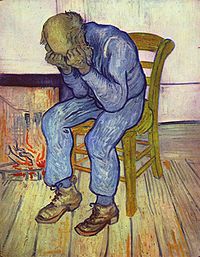
How a genius feels: "I'm a nonentity, an eccentric, an unpleasant person"
March 30th is the birthday of Vincent van Gogh, born in Holland in 1853, a famous painter and also great letter-writer. His letters were lively, engaging, and passionate; they also frequently reflect his struggles with bipolar disorder.
He wrote: "What am I in the eyes of most people — a nonentity, an eccentric, or an unpleasant person — somebody who has no position in society and will never have; in short, the lowest of the low. All right, then — even if that were absolutely true, then I should one day like to show by my work what such an eccentric, such a nobody, has in his heart."
He wrote thousands of letters to his brother Theo over the course of his life. Theo's widow published the van Gogh's letters to her husband in 1913.
Doctors' Day in a high-risk profession: suicide rate of U.S. doctors is one per day
This quote serves as a good reminder how people with depression may have an altered perception of themselves. March 30 is also National Doctors' Day in the U.S. Other countries celebrate Doctors' Day on different dates.
More than a quarter of primary care doctors reported being "burnt out." The United States loses the equivalent of at least one entire medical school class (approximately 400 physicians) each year to suicide.
In other words, 300-400 doctors in the United States kill themselves every year, or roughly 1 per day. Male doctors have suicide rates 1.4 times that of the general population, while female doctors have twice the rate of depression and 2.3 times the suicide rate when compared with women who are not physicians.
A conversation could save a life: "Are you OK?" Day
Hugh Jackman shows his support for R U OK?Day, a national day of action in Australia that aims to prevent suicide by encouraging people to connect with colleagues, friends and loved ones and ask simply: "Are you OK?" This may help your medical colleagues too:
References
Writer's Almanac. NPR, 2012.
High-risk profession: Suicide rate of U.S. doctors is one per day
Help for Today's Tense, Frustrated Doctors. Medscape, 2009.
http://www.medscape.com/viewarticle/710904
Doctors have higher rates of suicide than the general population: 40% higher for male doctors, 130% for female doctors http://goo.gl/ckTm
R U OK? Day
Image source: Vincent van Gogh's 1890 painting At Eternity's Gate. Wikipedia, public domain.

Tuesday, February 14, 2012
100-year-old doctor, still practicing, shares longevity secret: "Fall in love and get married"
Even though he recently turned 100, Dr. Engleman still sees arthritis patients regularly at the University of California San Francisco (UCSF). He has some rather unconventional longevity secrets to share:
"I think exercise is mostly overrated. And the use of vitamins, forget it. And I don't encourage a lot of doctors.
Fall in love and get married. Sex is to be encouraged. Children are a priority."
His two sons are physicians. His daugher, a lawyer, is a married to a doctor, and their son is a physician.
From NBC’s Nightly News:
The extended 17-minute version of the report is embedded below:
References:
100-year-old doctor still practicing at UCSF, shares unconventional longevity secrets
Comments from Twitter:
Mauna @MissMauna: How many times? RT @DrVes: 100-year-old doc, still practicing, shares longevity secret: "Fall in love and get married" goo.gl/fb/cw0ge
Jamie Carracher @JamieCa: That might be the hardest doctor's orders to follow of them all!
Michelle Kane @mishysmosh: I'm doomed.
"I think exercise is mostly overrated. And the use of vitamins, forget it. And I don't encourage a lot of doctors.
Fall in love and get married. Sex is to be encouraged. Children are a priority."
His two sons are physicians. His daugher, a lawyer, is a married to a doctor, and their son is a physician.
From NBC’s Nightly News:
Visit msnbc.com for breaking news, world news, and news about the economy
The extended 17-minute version of the report is embedded below:
Visit msnbc.com for breaking news, world news, and news about the economy
References:
100-year-old doctor still practicing at UCSF, shares unconventional longevity secrets
Comments from Twitter:
Mauna @MissMauna: How many times? RT @DrVes: 100-year-old doc, still practicing, shares longevity secret: "Fall in love and get married" goo.gl/fb/cw0ge
Jamie Carracher @JamieCa: That might be the hardest doctor's orders to follow of them all!
Michelle Kane @mishysmosh: I'm doomed.
Tuesday, February 7, 2012
Drug abuse is changing fast: Old drugs are falling from favor, new ones are growing
In recent years, hundreds of new drugs have appeared on the recreational drugs market in Europe and the U.S. New psychoactive substances, mainly stimulants and cannabinoids from China sold on the internet, proliferate too quickly for anyone to keep track of them. Websites such as Erowid.org create lists of those drugs.
It is all part of the rapid diversification of recreational drugs, fuelled by chemical ingenuity and by new distribution possibilities opened up by the internet.
New drugs of misuse, including ketamine, gamma-hydroxybutyrate (GHB), and a range of synthetic stimulants, have become part of global recreational drug culture. Use in combination with other substances (especially alcohol) is common and increases the associated health risks.
"A to Z" list of substances
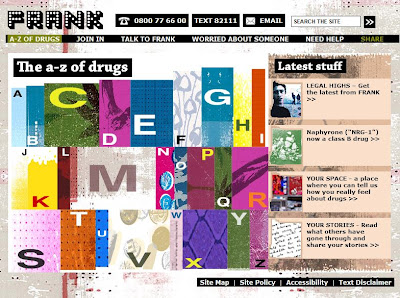
"Talk to Frank" is a British government-funded website for drug abuse prevention and treatment tips for the general public available at http://talktofrank.com
The "A to Z" list of substances explains appearance and use, effects, chances of getting hooked, health risks and the UK law. It also includes information on peer pressure, etc.
References:
Drug use and abuse. The Economist, 2011.
New recreational drugs and the primary care approach to patients who use them. BMJ, 2012.
Comments from Facebook:
Pierrette Mimi Poinsett: And alcohol and tobacco remain the two most abused drugs eclipsing all the others combined.
It is all part of the rapid diversification of recreational drugs, fuelled by chemical ingenuity and by new distribution possibilities opened up by the internet.
New drugs of misuse, including ketamine, gamma-hydroxybutyrate (GHB), and a range of synthetic stimulants, have become part of global recreational drug culture. Use in combination with other substances (especially alcohol) is common and increases the associated health risks.
"A to Z" list of substances
"Talk to Frank" is a British government-funded website for drug abuse prevention and treatment tips for the general public available at http://talktofrank.com
The "A to Z" list of substances explains appearance and use, effects, chances of getting hooked, health risks and the UK law. It also includes information on peer pressure, etc.
References:
Drug use and abuse. The Economist, 2011.
New recreational drugs and the primary care approach to patients who use them. BMJ, 2012.
Comments from Facebook:
Pierrette Mimi Poinsett: And alcohol and tobacco remain the two most abused drugs eclipsing all the others combined.
Friday, January 13, 2012
Premenstrual syndrome and premenstrual dysphoric disorder (review)
Premenstrual syndromePremenstrual syndrome is defined as recurrent psychological and physical symptoms that occur during the luteal phase of menses and resolve with menstruation. It affects 20-30% of premenopausal women.
Premenstrual dysphoric disorder
Premenstrual dysphoric disorder includes affective or somatic symptoms that cause severe dysfunction in social or occupational activity. It affects 3-8% of premenopausal women.
Proposed etiologies (causative factors) include:
- increased sensitivity to normal cycling levels of estrogen and progesterone
- increased aldosterone and plasma renin activity
- neurotransmitter abnormalities, particularly serotonin
The Daily Record of Severity of Problems is one tool with which women may self-report premenstrual symptoms.
Symptom relief is the goal, and there is limited evidence for the use of:
- calcium
- vitamin D
- vitamin B6 supplementation
Serotonergic antidepressants (SSRIs) (citalopram, escitalopram, fluoxetine, sertraline, venlafaxine) are first-line pharmacologic therapy.
References:
Premenstrual syndrome and premenstrual dysphoric disorder. Biggs WS, Demuth RH. Am Fam Physician. 2011 Oct 15;84(8):918-24.
Image source: OpenClipArt.org, public domain.
Tuesday, December 13, 2011
Factors that Promote Positive Adaptation to Stress and Adversity
The phenomenon of resilience reflects positive adaptation despite contexts of risk, adversity, or trauma.
Factors that promote positive adaptation to stress and adversity include the following:
- self-esteem
- optimism
- internal control
- coping aimed at acceptance
- coping aimed at seeking emotional support
- social contacts
Tips for managing stress (2-minute BBC video):
- Take a few deep breaths
- Get plenty of exercise
- Socialize - don't stress alone, talk to someone and have a laugh
- Get out - go to the park
Read more: http://www.bbc.co.uk/scotland/brainsmart
References:
Psychological and Social Factors that Promote Positive Adaptation to Stress and Adversity in the Adult Life Cycle. M. Guadalupe Jiménez Ambriz, María Izal and Ignacio Montorio. Journal of Happiness Studies, 2011.
Factors that promote positive adaptation to stress and adversity include the following:
- self-esteem
- optimism
- internal control
- coping aimed at acceptance
- coping aimed at seeking emotional support
- social contacts
Tips for managing stress (2-minute BBC video):
- Take a few deep breaths
- Get plenty of exercise
- Socialize - don't stress alone, talk to someone and have a laugh
- Get out - go to the park
Read more: http://www.bbc.co.uk/scotland/brainsmart
References:
Psychological and Social Factors that Promote Positive Adaptation to Stress and Adversity in the Adult Life Cycle. M. Guadalupe Jiménez Ambriz, María Izal and Ignacio Montorio. Journal of Happiness Studies, 2011.
Subscribe to:
Posts (Atom)