Plasma research for combating bacteria: A spin-off of space research may help solve a huge medical problem. It turns out that plasma, a form of ionized gas may help to heal chronic wounds by killing off multidrug resistant bacteria and stimulating tissue growth. Here is a video from Deutsche Welle:
Comments from Twitter:
Dr John Weiner @AllergyNet: Nice video. That’s why there is physics in physician MT @DrVes Gas plasma: disinfectant for wounds? bit.ly/V6JgXx
Showing posts with label Infectious Diseases. Show all posts
Showing posts with label Infectious Diseases. Show all posts
Tuesday, February 26, 2013

Thursday, August 16, 2012
Guidelines for Management of Acute Bacterial Sinusitis by Infectious Diseases Society of America
A bacterial cause accounts for 2%-10% of acute rhinosinusitis cases.
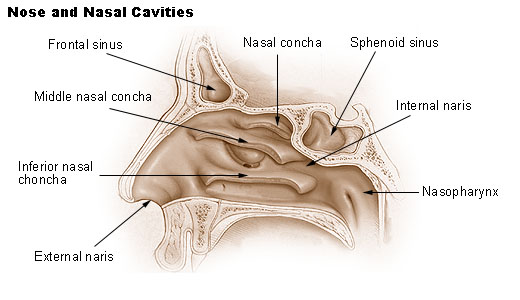
Nose and nasal cavities. Image source: Wikipedia, public domain.
Recommendations for Management of Acute Bacterial Sinusitis by the Infectious Diseases Society of America (IDSA):
Bacterial rather than viral rhinosinusitis should be diagnosed when any of the following occurs:
- persistent symptoms lasting at least 10 days, without improvement
- symptoms or high fever and purulent nasal discharge or facial pain for 3–4 days at illness onset
- worsening symptoms after an initial respiratory infection, lasting 5–6 days, has started to improve.
Empirical therapy should be started as soon as acute bacterial rhinosinusitis is diagnosed clinically.
Amoxicillin-clavulanate, instead of amoxicillin alone, is recommended for both children and adults.
Macrolides and trimethoprim-sulfamethoxazole are not recommended as empirical therapy, because of high rates of antimicrobial resistance.
References:
Algorithm for the management of acute bacterial rhinosinusitis (figure)
Guideline Issued for Managing Acute Bacterial Rhinosinusitis - Physician's First Watch http://bit.ly/TGn6aM
IDSA Clinical Practice Guideline for Acute Bacterial Rhinosinusitis in Children and Adults http://bit.ly/TGnaHB
Nose and nasal cavities. Image source: Wikipedia, public domain.

Recommendations for Management of Acute Bacterial Sinusitis by the Infectious Diseases Society of America (IDSA):
Bacterial rather than viral rhinosinusitis should be diagnosed when any of the following occurs:
- persistent symptoms lasting at least 10 days, without improvement
- symptoms or high fever and purulent nasal discharge or facial pain for 3–4 days at illness onset
- worsening symptoms after an initial respiratory infection, lasting 5–6 days, has started to improve.
Empirical therapy should be started as soon as acute bacterial rhinosinusitis is diagnosed clinically.
Amoxicillin-clavulanate, instead of amoxicillin alone, is recommended for both children and adults.
Macrolides and trimethoprim-sulfamethoxazole are not recommended as empirical therapy, because of high rates of antimicrobial resistance.
References:
Algorithm for the management of acute bacterial rhinosinusitis (figure)
Guideline Issued for Managing Acute Bacterial Rhinosinusitis - Physician's First Watch http://bit.ly/TGn6aM
IDSA Clinical Practice Guideline for Acute Bacterial Rhinosinusitis in Children and Adults http://bit.ly/TGnaHB
Wednesday, April 4, 2012
Mosquito biting activity increases 500 times during a full moon phase, and they prefer blondes with smelly feet
Mosquitoes appear to prefer blonde people with smelly feet. Did you see the moon last night? Got mosquito spray? Mosquito biting activity increases 500 times during a full moon phase! There are more striking facts in this video excerpt from National Geographic.
The video is part of the Amazing Animals YouTube playlist by National Geographic:
Medical Geek Humor on Twitter
The tweets below are part of the series Medical Geek Humor on Twitter - they recall a TED moment from 2009:
@loic Bill Gates released mosquitoes at #TED we're all leaving the room and getting sick
@stevewhitaker Don't worry about the buggy mosquitos Gates released at #ted. Microsoft's working on a patch that's due out next year.
 AllergyNotes Releasing mosquitoes by Bill Gates into a startled crowd at TED described as "an amazing TED moment" http://is.gd/iu0o
AllergyNotes Gates spreads malaria message with mosquitoes http://tinyurl.com/cxwo2e
 pyknosis Nice to hear Bill Gates picked up a hobby during his retirement: entomology. http://is.gd/izJn (Not surprised he likes the blood-suckers.)
pyknosis Don't get me wrong. Not saying B Gates is a bad person. He's not. He just created and championed software that can suck the life out of you.
pyknosis BTW, now that I understand the context, I think this is a winner of a tweet: http://is.gd/izK5
Comments from Twitter:
Vijay @scanman: Mosquitoes are mini-vampires
Tariq @ucisee: Mosquito biting activity increases 500 times during a full moon phase - "appear to pref blonde with smelly feet."
Kathy Mackey @mkmackey: Ha! No one likes full moon!
The video is part of the Amazing Animals YouTube playlist by National Geographic:
Medical Geek Humor on Twitter
The tweets below are part of the series Medical Geek Humor on Twitter - they recall a TED moment from 2009:
@loic Bill Gates released mosquitoes at #TED we're all leaving the room and getting sick
@stevewhitaker Don't worry about the buggy mosquitos Gates released at #ted. Microsoft's working on a patch that's due out next year.
AllergyNotes Releasing mosquitoes by Bill Gates into a startled crowd at TED described as "an amazing TED moment" http://is.gd/iu0o AllergyNotes Gates spreads malaria message with mosquitoes http://tinyurl.com/cxwo2e pyknosis Nice to hear Bill Gates picked up a hobby during his retirement: entomology. http://is.gd/izJn (Not surprised he likes the blood-suckers.) pyknosis Don't get me wrong. Not saying B Gates is a bad person. He's not. He just created and championed software that can suck the life out of you. pyknosis BTW, now that I understand the context, I think this is a winner of a tweet: http://is.gd/izK5 Comments from Twitter:
Vijay @scanman: Mosquitoes are mini-vampires
Tariq @ucisee: Mosquito biting activity increases 500 times during a full moon phase - "appear to pref blonde with smelly feet."
Kathy Mackey @mkmackey: Ha! No one likes full moon!
Tuesday, March 6, 2012
Antibiotics prescribed during 21% of pediatric ambulatory visits; 50% were broad-spectrum
 Antibiotics are commonly prescribed for children with conditions for which they provide no benefit, including viral respiratory infections.
 The researchers used the National Ambulatory and National Hospital Ambulatory Medical Care surveys from 2006 to 2008, which are representative of ambulatory care visits in the United States.
Antibiotics were prescribed during 21% of pediatric ambulatory visits; 50% were broad-spectrum, most commonly macrolides. Respiratory conditions accounted for >70% of visits in which antibiotics were prescribed.
The authors concluded that broad-spectrum antibiotic prescribing in ambulatory pediatrics is extremely common and frequently inappropriate.
Cough is one of the common reasons for unnecessary antibiotic prescription. As you can see from the diagram below, the differential diagnosis of chronic cough is broad and includes asthma and other conditions in which antibiotics are ineffective:
Differential diagnosis of cough, a simple mnemonic is GREAT BAD CAT TOM. Click here to enlarge the image: (GERD (reflux), Laryngopharyngeal Reflux (LPR), Rhinitis (both allergic and non-allergic) with post-nasal drip (upper airway cough syndrome), Embolism, e.g. PE in adults, Asthma, TB (tuberculosis), Bronchitis, pneumonia, pertussis, Aspiration, e.g foreign body in children, Drugs, e.g. ACE inhibitor, CF in children, Cardiogenic, e.g. mitral stenosis in adults, Achalasia in adults, Thyroid enlargement, e.g. goiter, "Thoughts" (psychogenic), Other causes, Malignancy, e.g. lung cancer in adults).
References:
Antibiotic Prescribing in Ambulatory Pediatrics in the United States. Adam L. Hersh, MD, PhDa, Daniel J. Shapiro, BAb, Andrew T. Pavia, MDa, Samir S. Shah, MD, MSCE. Pediatrics Vol. 128 No. 6 December 1, 2011, pp. 1053 -1061, (doi: 10.1542/peds.2011-1337).
Image source: Wikipedia, GNU Free Documentation License.

Wednesday, February 22, 2012
What are the 8 germiest places in the mall?
The 8 germiest places in the mall, according to CNN, are:
1. Restroom sinks
2. Food court tables
3. Escalator handrails
4. ATM keypads
5. Toy stores
6. Fitting rooms
7. Gadget shops
8. Makeup samples
The filthiest area in a restroom (and therefore in the whole mall) isn't the toilet handle or the doorknob - it's the sink. The sink area is a moist environment, so bacteria can survive longer there.
Researchers found food, E. coli, urine, mucus, feces, and blood on escalator handrails. Where there is mucus, you may also find cold and flu viruses.
Each key on an ATM contains, on average, 1,200 germs. Protect yourself: "Knuckle" ATM buttons.
How some hotels clean drinking glasses (video):
References:
The 8 germiest places in the mall. CNN.
12 Germiest Places in America According to Health Magazine
1. Restroom sinks
2. Food court tables
3. Escalator handrails
4. ATM keypads
5. Toy stores
6. Fitting rooms
7. Gadget shops
8. Makeup samples
The filthiest area in a restroom (and therefore in the whole mall) isn't the toilet handle or the doorknob - it's the sink. The sink area is a moist environment, so bacteria can survive longer there.
Researchers found food, E. coli, urine, mucus, feces, and blood on escalator handrails. Where there is mucus, you may also find cold and flu viruses.
Each key on an ATM contains, on average, 1,200 germs. Protect yourself: "Knuckle" ATM buttons.
How some hotels clean drinking glasses (video):
References:
The 8 germiest places in the mall. CNN.
12 Germiest Places in America According to Health Magazine
Thursday, January 12, 2012
Scabies - NHS patient education video
From the NHS Choices YouTube channel: Scabies is a contagious skin infection which itches intensely. A GP talks about the causes, symptoms and treatment.
From the memorable medical textbooks of the past: Medical textbooks were not always as dreary and as bland as they are now, according to BMJ.
Some examples of lively, first person didactic tone come from J L Burton’s Essentials of Dermatology: "The simultaneous occurrence of scabies in a doctor and a nurse may mean that they have shared nothing more exciting than a patient with Norwegian scabies."
References:
Memorable medical textbooks of the past
Friday, December 23, 2011
George Michael, still breathless after pneumonia and tracheotomy, plans a show for his doctors (video)
Video: George Michael: This has been the worst month of my life. ShowBiz411.
A thin and visibly weak George Michael (48) told reporters outside his home in London that he wasn't supposed to speak for very long and was still recovering from a tracheotomy: "I got streptococca-something... It's a form of pneumonia and they spent three weeks keeping me alive basically," Michael said of the doctors in the Austrian hospital where the singer has been receiving treatment since he fell ill in November.
He added that he also wanted to hold a special show for the Austrian doctors who treated him. "I've spent the last 10 days since I woke up literally thanking people for saving my life."
References:
Gaunt George Michael says "fortunate to be here". Reuters, 2011.
Monday, December 12, 2011
Acute pyelonephritis in women (2011 review)
 This is a 2011 review from the official journal of the AAFP, American Family Physician:
Acute pyelonephritis is a bacterial infection of the renal pelvis and kidney most often seen in young women.
Symptoms of acute pyelonephritis
Most patients have fever, although it may be absent early in the illness. Flank pain is nearly universal.
Tests for acute pyelonephritis
A positive urinalysis confirms the diagnosis.
Urine culture should be obtained in all patients to guide antibiotic therapy if the patient does not respond to initial empiric antibiotic regimens.
Escherichia coli is the most common pathogen in acute pyelonephritis. In the past decade, there has been an increasing rate of E. coli resistance to extended-spectrum beta-lactam antibiotics.
Imaging, usually with contrast-enhanced CT is not necessary unless there is:
- no improvement in the patient's symptoms
- symptom recurrence after initial improvement
Treatment of acute pyelonephritis
Outpatient treatment is appropriate for most patients.
Oral fluoroquinolone is the initial outpatient therapy if the rate of fluoroquinolone resistance in the community is less than 10%. If the resistance rate exceeds 10%, an initial IV dose of ceftriaxone or gentamicin should be given, followed by an oral fluoroquinolone regimen.
Oral beta-lactam antibiotics and trimethoprim/sulfamethoxazole (TMP-SMX (Bactrim) are inappropriate for therapy because of high resistance rates.
References:
Diagnosis and treatment of acute pyelonephritis in women. Colgan R, Williams M, Johnson JR. Am Fam Physician. 2011 Sep 1;84(5):519-26.
Nephrology Cases
Tuesday, November 15, 2011
DRACO drug effective against most viruses (Double-stranded RNA Activated Caspase Oligomerizer)
"New drug could cure nearly any viral infection", proclaimed the media. The drug works by targeting a type of RNA (dsRNA) produced only in cells that have been infected by viruses. “In theory, it should work against all viruses."
Currently there are relatively few antiviral therapeutics, and most which do exist are highly pathogen-specific.
The MIT researchers developed a new broad-spectrum antiviral approach, called Double-stranded RNA (dsRNA) Activated Caspase Oligomerizer (DRACO).
DRACO selectively induces apoptosis in cells containing viral dsRNA, rapidly killing infected cells without harming uninfected cells.
The drugs were nontoxic to mammalian cells and effective against 15 different viruses, including dengue flavivirus, arenaviruses, bunyavirus, and H1N1 influenza. Dengue fever has invaded Florida and there are no effective antiviral agents to treat dengue infection at this time, according to a recent NEJM review (http://goo.gl/0gEXH).
DRACOs have the potential to be effective therapeutics or prophylactics for numerous clinical and priority viruses, due to:
- broad-spectrum sensitivity of the dsRNA detection domain
- potent activity of the apoptosis induction domain
NPR Video: How a Flu Virus Invades Your Body: "It starts very simply. A virus, just one, latches on to one of your cells and fools that cell into making lots more. Lots, lots more, like a million new viruses. This animation shows you how viruses trick healthy cells to join the dark side".
References:
New drug could cure nearly any viral infection. MIT News.
Rider TH, Zook CE, Boettcher TL, Wick ST, Pancoast JS, et al. (2011) Broad-Spectrum Antiviral Therapeutics. PLoS ONE 6(7): e22572. doi:10.1371/journal.pone.0022572
Currently there are relatively few antiviral therapeutics, and most which do exist are highly pathogen-specific.
The MIT researchers developed a new broad-spectrum antiviral approach, called Double-stranded RNA (dsRNA) Activated Caspase Oligomerizer (DRACO).
DRACO selectively induces apoptosis in cells containing viral dsRNA, rapidly killing infected cells without harming uninfected cells.
The drugs were nontoxic to mammalian cells and effective against 15 different viruses, including dengue flavivirus, arenaviruses, bunyavirus, and H1N1 influenza. Dengue fever has invaded Florida and there are no effective antiviral agents to treat dengue infection at this time, according to a recent NEJM review (http://goo.gl/0gEXH).
DRACOs have the potential to be effective therapeutics or prophylactics for numerous clinical and priority viruses, due to:
- broad-spectrum sensitivity of the dsRNA detection domain
- potent activity of the apoptosis induction domain
NPR Video: How a Flu Virus Invades Your Body: "It starts very simply. A virus, just one, latches on to one of your cells and fools that cell into making lots more. Lots, lots more, like a million new viruses. This animation shows you how viruses trick healthy cells to join the dark side".
References:
New drug could cure nearly any viral infection. MIT News.
Rider TH, Zook CE, Boettcher TL, Wick ST, Pancoast JS, et al. (2011) Broad-Spectrum Antiviral Therapeutics. PLoS ONE 6(7): e22572. doi:10.1371/journal.pone.0022572
Subscribe to:
Posts (Atom)