In Germany, as the number of seniors is increasing, the number of younger people is decreasing, and there are not enough caregivers. Scientists are examining a possible role for robots in the care for the elderly.
Showing posts with label Geriatrics. Show all posts
Showing posts with label Geriatrics. Show all posts
Thursday, March 14, 2013

Monday, December 3, 2012
The longevity of a rock singer
Here is Ian Gillan (age 67) from Deep Purple in a recent interview:
You have been screaming rock music for over 40 years. How do you do it?
I think it’s quite natural, I do a lot of it, and so I keep myself fairly fit. My mates who were singers they quit to enjoy their success or raise families and they didn’t continue. Then they tried to come back years later but it was very difficult because vocal cords, unlike guitar strings, are unforgiving, you can’t change them. So I think I’ve been singing all my life, and therefore I’m pretty much fit, so to speak. Most things are within my scope, I sing pretty naturally so it’s not a strain, never has been.
Here is Deep Purple with Maybe I'm a Leo, Mainz, Germany, July 2011:
This is the same band 40 years ago, in 1972:
I have been to two concerts of Deep Purple, the last one was in June 2011 and it was quite impressive. The audience age ranged from 5 to 75 and everyone rose to their feet to the sound of Smoke on the Water.
Here is Mick Jagger on staying fit: "You watch what you eat, you exercise, you have a bit of fun. You keep on going forward. Don’t stop. Do what makes you happy. Don’t look at the clouds of tomorrow through the sunshine of today. That’s it."
References:
Deep Purple but no blues: US legends top Dubai jazz festival line-up | Al Bawaba http://buff.ly/V520RZ
Mick Jagger's new supergroup with Joss Stone and Dave Stewart. DailyMail.
Redefining age 65 - when your job description is "rockstar"
You have been screaming rock music for over 40 years. How do you do it?
I think it’s quite natural, I do a lot of it, and so I keep myself fairly fit. My mates who were singers they quit to enjoy their success or raise families and they didn’t continue. Then they tried to come back years later but it was very difficult because vocal cords, unlike guitar strings, are unforgiving, you can’t change them. So I think I’ve been singing all my life, and therefore I’m pretty much fit, so to speak. Most things are within my scope, I sing pretty naturally so it’s not a strain, never has been.
Here is Deep Purple with Maybe I'm a Leo, Mainz, Germany, July 2011:
This is the same band 40 years ago, in 1972:
I have been to two concerts of Deep Purple, the last one was in June 2011 and it was quite impressive. The audience age ranged from 5 to 75 and everyone rose to their feet to the sound of Smoke on the Water.
Here is Mick Jagger on staying fit: "You watch what you eat, you exercise, you have a bit of fun. You keep on going forward. Don’t stop. Do what makes you happy. Don’t look at the clouds of tomorrow through the sunshine of today. That’s it."
References:
Deep Purple but no blues: US legends top Dubai jazz festival line-up | Al Bawaba http://buff.ly/V520RZ
Mick Jagger's new supergroup with Joss Stone and Dave Stewart. DailyMail.
Redefining age 65 - when your job description is "rockstar"
Wednesday, June 13, 2012
88-year-old George H.W. Bush: "Maybe they’ll come out with a new drug that makes memory come roaring back"
The former president George H.W. Bush wrote a poem for his grandkids:
By the way, the 88-year-old former president said he was not done skydiving. His goal: to jump again when he is 90.
References:
'If you need me I'll be there': George HW Bush moved to tears during interview with granddaughter Jenna about his family and growing old | Daily Mail Online http://goo.gl/noCt0
"So I can add to the report on getting older.
Who knows, maybe they’ll come out with a new drug that makes legs bend easier,
Joints hurt less, drives go further, memory come roaring back,
And all fears about falling off fishing rocks go away.
Remember the old song: I’ll be there ready when you are.
Well I’ll be there ready when you are
There’s so much excitement ahead, so many grandkids to watch grow.
If you need me I’m here."
By the way, the 88-year-old former president said he was not done skydiving. His goal: to jump again when he is 90.
References:
'If you need me I'll be there': George HW Bush moved to tears during interview with granddaughter Jenna about his family and growing old | Daily Mail Online http://goo.gl/noCt0
Tuesday, April 17, 2012
Understanding Healthcare Power of Attorney - Cleveland Clinic video
This is very important: Advance directives are legal documents that provide instructions about who should oversee your medical treatment and what your end-of-life wishes are, in case you are unable to speak for yourself.
Advance directives include:
- Health Care Power of Attorney
- Living Will
Everyone over the age of 18 should consider assigning Health Care Power of Attorney to someone.
Advance directives include:
- Health Care Power of Attorney
- Living Will
Everyone over the age of 18 should consider assigning Health Care Power of Attorney to someone.
Wednesday, April 11, 2012
87% of people older than 50 took one or more drug, according to Australian survey
 A postal survey included a random sample of 4,500 Australians aged ≥ 50 years between in 2009-2010 and the response rate was 37%.
 Medications use was very common, 87% of participants took one or more drug (called medicines in Australia) and 43% took five or more in the previous 24 hours.
Complementary medicines were used by 46% of participants.
The most commonly used medications were:
- antihypertensive agents, 43% of participants
- natural marine and animal products including fish oil and glucosamine, 32%
- lipid-lowering agents, 30%
Doctors recommended 79% of all medications and 93% of conventional medications.
Much medicines use was to prevent future disease by influencing risk factors.
In a 2011 study, 4 medication classes were linked to 67% of drug-related hospitalizations:
- warfarin, 33%
- insulins, 14%
- oral antiplatelet agents, 13%
- oral hypoglycemic agents, 11%
High-risk medications were implicated in only 1.2% of hospitalizations.
50% of these hospitalizations were among adults 80 years of age or older. 65% of hospitalizations were due to unintentional overdoses.
Classification of adverse reactions to drugs: "SOAP III" mnemonic (click to enlarge the image):
Adverse drug reactions (ADRs) affect 10–20% of hospitalized patients and 25% of outpatients.
Rule of 10s in ADR:
10% of patients develop ADR
10% of these are due to allergy
10% of these lead to anaphylaxis
10% of these lead to death
References:
A national census of medicines use: a 24-hour snapshot of Australians aged 50 years and older. Tessa K Morgan, Margaret Williamson, Marie Pirotta, Kay Stewart, Stephen P Myers and Joanne Barnes. MJA 2012; 196 (1): 50-53, doi: 10.5694/mja11.10698
4 medication classes linked to 67% of drug-related hospitalizations
Image source: Wikipedia, public domain.
Monday, January 16, 2012
Evaluation of suspected dementia: 2-visit approach is effective
Prevalence of dementia will increase as the U.S. and the world population ages. The text below is based on a recent review in the journal Am Fam Physician:
Risk factors for dementia include:
- age
- family history of dementia
- apolipoprotein E4 genotype
- cardiovascular comorbidities
- chronic anticholinergic use
- lower educational level
A two-visit approach is time-effective for primary care physicians.
During the first visit, the physician should administer a screening test such as:
- verbal fluency test
- Mini-Cognitive Assessment Instrument
- Sweet 16
The tests above have relatively high sensitivity and specificity for detecting dementia, and can be completed in as little as 60 seconds (Note by editor: this one-minute time estimate sounds too optimistic, it usually takes considerably longer).
If the screening test result is abnormal or another disease is suspected, laboratory and imaging tests should be ordered, and the patient should return for additional cognitive testing.
A second visit should include:
- Mini-Mental State Examination
- Geriatric Depression Scale
- verbal fluency
- clock drawing tests
For patients with dementia, the following characteristics are useful for identifying
patients at increased risk for unsafe driving:
- Clinical Dementia Rating scale (Level A)
- caregiver’s rating of a patient’s driving ability as marginal or unsafe (Level B)
- history of crashes or traffic citations (Level C)
- reduced driving mileage or self-reported situational avoidance (Level C)
- Mini-Mental State Examination scores of 24 or less (Level C)
- aggressive or impulsive personality characteristics (Level C)

Evaluation of driving risk in dementia (click to enlarge the image).
References:
Evaluation of suspected dementia. Simmons BB, Hartmann B, Dejoseph D. Am Fam Physician. 2011 Oct 15;84(8):895-902.
Risk factors for dementia include:
- age
- family history of dementia
- apolipoprotein E4 genotype
- cardiovascular comorbidities
- chronic anticholinergic use
- lower educational level
A two-visit approach is time-effective for primary care physicians.
During the first visit, the physician should administer a screening test such as:
- verbal fluency test
- Mini-Cognitive Assessment Instrument
- Sweet 16
The tests above have relatively high sensitivity and specificity for detecting dementia, and can be completed in as little as 60 seconds (Note by editor: this one-minute time estimate sounds too optimistic, it usually takes considerably longer).
If the screening test result is abnormal or another disease is suspected, laboratory and imaging tests should be ordered, and the patient should return for additional cognitive testing.
A second visit should include:
- Mini-Mental State Examination
- Geriatric Depression Scale
- verbal fluency
- clock drawing tests
For patients with dementia, the following characteristics are useful for identifying
patients at increased risk for unsafe driving:
- Clinical Dementia Rating scale (Level A)
- caregiver’s rating of a patient’s driving ability as marginal or unsafe (Level B)
- history of crashes or traffic citations (Level C)
- reduced driving mileage or self-reported situational avoidance (Level C)
- Mini-Mental State Examination scores of 24 or less (Level C)
- aggressive or impulsive personality characteristics (Level C)
Evaluation of driving risk in dementia (click to enlarge the image).
References:
Evaluation of suspected dementia. Simmons BB, Hartmann B, Dejoseph D. Am Fam Physician. 2011 Oct 15;84(8):895-902.
Tuesday, January 10, 2012
Depression treatment is as effective in older (over 65) as in younger adults
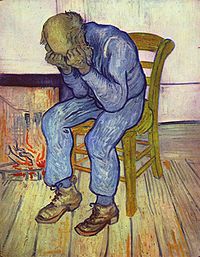 Depression in later life, traditionally defined as age older than 65, is associated with disability, increased mortality, and poorer outcomes.
 Compared to younger adults with depression:
- cognitive and functional impairment and anxiety are more common in older adults
- older adults with depression are at increased risk of suicide
Depression is associated with cognitive impairment and an increased risk of dementia.
A selective serotonin reuptake inhibitor (SSRI) should be the first line pharmacological treatment for depression for most older adults.
Psychological and drug treatment is as effective in older as in younger adults
References:
Depression in older adults. Rodda et al. BMJ, 2011.
Image source: Vincent van Gogh's 1890 painting At Eternity's Gate. Wikipedia, public domain.

Wednesday, October 26, 2011
Interesting Correlation: Fast Food Founders and Longevity
Jay Parkinson noted an interesting correlation between Fast Food Founders and Longevity:
- Ray Kroc (McDonald’s) died at age 82
- Jimmy Dean died at age 81
- Taco Bell founder Glen Bell died at 86
- Sonic founder Troy Smith died at 87
- Hardee’s founder Wilber Hardee died at 89
- Baskin-Robbins founder Irvine Robbins died at 90
- Carl’s Jr. founder Carl Karcher died at 90
- Frozen french fry mogul J.R. Simplot died at 99
- Murray Handwerker, credited with making Nathan’s Famous Hot Dogs into a well-known national chain, died at 89
"Fake foods are more affordable. It's enticing people to eat more because they think they're saving money when they're really just buying heart disease." 10 Questions for Jillian Michaels. TIME, 2010.
Comments from Google Plus (Jul 27, 2011):
Maf Lewis - I'm going to guess that most of them were American, rich and therefor some of the few that could get good healthcare in the USA.
Neil Mehta - Good point +Maf Lewis
In addition they probably did not eat the fare their restaurants dished out?
Ves Dimov - I would assume they didn't eat the items on their restaurants' menu regularly.
One McDonald's CEO was famous for eating at least one product of its company daily. Unfortunately, he died at 44, from metastatic colon cancer. This does not prove causation, of course.
http://en.wikipedia.org/wiki/Charlie_Bell
Mr Bell oversaw McDonald's "I'm lovin' it" advertising campaign and introduced successes such as McCafe.
http://news.bbc.co.uk/2/hi/business/4180627.stm
Robert Silge - +Maf Lewis They clearly were both rich and American, and we could add male and white, but stating that they are among the "few" that could get good healthcare is grossly overstating it.
Maf Lewis - +Robert Silge As there are around 25%-30% uninsured Americans and another 20%-30% who have significant restrictions on their health insurance, I would say that Americans that get good healthcare (as compared to other countries of similar wealth per capita) would be in the minority - hence the few. Even if my figure are way off, the difference between health care of the top few % in the USA and the rest is enormous.
Robert Silge - +Maf Lewis Define "significant restrictions". Every system of organized healthcare has significant restrictions on how you can get healthcare. A complete lack of restrictions would be unfettered capitalism, where you can get whatever you want if you can pay for it.
Look at the literature. There is an association between socioeconomic status and longevity in any society. It is admittedly more pronounced in the US than in some countries. Some western countries are worse still.
Ves Dimov - Lifespan and social status: Why your boss will probably live longer than you
http://goo.gl/DQJRR
Maf Lewis - +Robert Silge - I agree it's hard to define and be accurate with some of these points, but for me significant restrictions would mean that you have a limit by the amount insurance will pay out for a specific illness, or pre-existing conditions, or other small print such as your activities are deemed dangerous sports (climbing on a roof to fix and ariel), or even having insurance investigators look into your case to see if there is a loophole that will enable them to not fund treatment- something I and my family came across first hand in my 6 years living in the USA.
I would confidently say that general healthcare in the USA is substandard to that of France, UK, Germany, Australia New Zealand etc, but for the top few % it is possibly the best in the world... actually it's best for the top few % in any country who can go anywhere in the world and get anything done...
The USA has the highest standard of living but one of the lowest life expectancies of the top 10 richest (per capita) countries.. why? Healthcare.
Maf Lewis - I absolutely agree about social status/health in all countries. I think it's just a bigger gap in the USA, as with educations, income, everything.
Robert Silge - Yes, it is bigger in the USA than in other countries. This article is horribly out of date (as in, it looks at WEST Germany), so take it for what it's worth, but the relationship between income and lifespan was least pronounced in Sweden and Norway, worst in the US and UK (and W. Germany, but let's ignore that all together). http://www.bmj.com/content/304/6820/165.full.pdf
Are there more uninsured and under-insured than I would like? Absolutely. But I think you're looking at this upside down. Our ability to take care of the bottom of our society is undeniably poor. But the middle elements of society get good care. And I'm not even saying that this is the way things ought to be. But it's the way things are, and to say a minority of patients get good healthcare is inaccurate to me. I would fundamentally disagree that FEW people in the US get "good healthcare".
Maf Lewis - Ok, all good points Robert. Maybe if I said that the average person in the USA doesn't get as good health care as the top 10 richest countries (per capita)?
Maybe I'm bias because of my direct experience with health care in the USA (6 years), Australia (1 year), UK (30 years), France (on and off 20 years). Always the USA was more limited and slower.
Robert Silge - Well you certainly have more direct experience than I, and no one can argue with that. I think it would be accurate to say that the highs are higher and the lows are lower in the US. That probably applies to a whole host of aspects of life here. For better or worse it's what we do.
Maf Lewis - True, but my direct experience could a series of both good and bag luck;) I'm sure there are horror and hero stories in all counties.
Yes I think the extreme highs and lows do apply to most things, and in a weird way it's both the worst and also the best of the USA.
Maf Lewis - Just to make it clear (if I hadn't already) it's not the health care professionals in the USA that are the problem here, but the insurance industry, and healthcare for profit in general.
- Ray Kroc (McDonald’s) died at age 82
- Jimmy Dean died at age 81
- Taco Bell founder Glen Bell died at 86
- Sonic founder Troy Smith died at 87
- Hardee’s founder Wilber Hardee died at 89
- Baskin-Robbins founder Irvine Robbins died at 90
- Carl’s Jr. founder Carl Karcher died at 90
- Frozen french fry mogul J.R. Simplot died at 99
- Murray Handwerker, credited with making Nathan’s Famous Hot Dogs into a well-known national chain, died at 89
"Fake foods are more affordable. It's enticing people to eat more because they think they're saving money when they're really just buying heart disease." 10 Questions for Jillian Michaels. TIME, 2010.
Comments from Google Plus (Jul 27, 2011):
Maf Lewis - I'm going to guess that most of them were American, rich and therefor some of the few that could get good healthcare in the USA.
Neil Mehta - Good point +Maf Lewis
In addition they probably did not eat the fare their restaurants dished out?
Ves Dimov - I would assume they didn't eat the items on their restaurants' menu regularly.
One McDonald's CEO was famous for eating at least one product of its company daily. Unfortunately, he died at 44, from metastatic colon cancer. This does not prove causation, of course.
http://en.wikipedia.org/wiki/Charlie_Bell
Mr Bell oversaw McDonald's "I'm lovin' it" advertising campaign and introduced successes such as McCafe.
http://news.bbc.co.uk/2/hi/business/4180627.stm
Robert Silge - +Maf Lewis They clearly were both rich and American, and we could add male and white, but stating that they are among the "few" that could get good healthcare is grossly overstating it.
Maf Lewis - +Robert Silge As there are around 25%-30% uninsured Americans and another 20%-30% who have significant restrictions on their health insurance, I would say that Americans that get good healthcare (as compared to other countries of similar wealth per capita) would be in the minority - hence the few. Even if my figure are way off, the difference between health care of the top few % in the USA and the rest is enormous.
Robert Silge - +Maf Lewis Define "significant restrictions". Every system of organized healthcare has significant restrictions on how you can get healthcare. A complete lack of restrictions would be unfettered capitalism, where you can get whatever you want if you can pay for it.
Look at the literature. There is an association between socioeconomic status and longevity in any society. It is admittedly more pronounced in the US than in some countries. Some western countries are worse still.
Ves Dimov - Lifespan and social status: Why your boss will probably live longer than you
http://goo.gl/DQJRR
Maf Lewis - +Robert Silge - I agree it's hard to define and be accurate with some of these points, but for me significant restrictions would mean that you have a limit by the amount insurance will pay out for a specific illness, or pre-existing conditions, or other small print such as your activities are deemed dangerous sports (climbing on a roof to fix and ariel), or even having insurance investigators look into your case to see if there is a loophole that will enable them to not fund treatment- something I and my family came across first hand in my 6 years living in the USA.
I would confidently say that general healthcare in the USA is substandard to that of France, UK, Germany, Australia New Zealand etc, but for the top few % it is possibly the best in the world... actually it's best for the top few % in any country who can go anywhere in the world and get anything done...
The USA has the highest standard of living but one of the lowest life expectancies of the top 10 richest (per capita) countries.. why? Healthcare.
Maf Lewis - I absolutely agree about social status/health in all countries. I think it's just a bigger gap in the USA, as with educations, income, everything.
Robert Silge - Yes, it is bigger in the USA than in other countries. This article is horribly out of date (as in, it looks at WEST Germany), so take it for what it's worth, but the relationship between income and lifespan was least pronounced in Sweden and Norway, worst in the US and UK (and W. Germany, but let's ignore that all together). http://www.bmj.com/content/304/6820/165.full.pdf
Are there more uninsured and under-insured than I would like? Absolutely. But I think you're looking at this upside down. Our ability to take care of the bottom of our society is undeniably poor. But the middle elements of society get good care. And I'm not even saying that this is the way things ought to be. But it's the way things are, and to say a minority of patients get good healthcare is inaccurate to me. I would fundamentally disagree that FEW people in the US get "good healthcare".
Maf Lewis - Ok, all good points Robert. Maybe if I said that the average person in the USA doesn't get as good health care as the top 10 richest countries (per capita)?
Maybe I'm bias because of my direct experience with health care in the USA (6 years), Australia (1 year), UK (30 years), France (on and off 20 years). Always the USA was more limited and slower.
Robert Silge - Well you certainly have more direct experience than I, and no one can argue with that. I think it would be accurate to say that the highs are higher and the lows are lower in the US. That probably applies to a whole host of aspects of life here. For better or worse it's what we do.
Maf Lewis - True, but my direct experience could a series of both good and bag luck;) I'm sure there are horror and hero stories in all counties.
Yes I think the extreme highs and lows do apply to most things, and in a weird way it's both the worst and also the best of the USA.
Maf Lewis - Just to make it clear (if I hadn't already) it's not the health care professionals in the USA that are the problem here, but the insurance industry, and healthcare for profit in general.
Monday, August 29, 2011
AMA Guide to Assessing and Counseling Older Drivers
Motor vehicle injuries are a leading cause of injury-related deaths in the older population (persons 65 years and older). Per mile driven, the fatality rate for drivers 85 years and older is 9 times higher than the rate for drivers 25 to 69 years old.
Physicians play an important role in the safe mobility of their older patients. The AMA encourages physicians to make driver safety a routine part of their geriatric medical services and the guide is freely available as PDF documents here:
AMA Physician's Guide to Assessing and Counseling Older Drivers
For example, dementia is just one of the risks that older drivers face:
Evaluation of driving risk in dementia (click to enlarge the image).
For patients with dementia, the following characteristics are useful for identifying
patients at increased risk for unsafe driving:
- Clinical Dementia Rating scale (Level A)
- caregiver’s rating of a patient’s driving ability as marginal or unsafe (Level B)
- history of crashes or traffic citations (Level C)
- reduced driving mileage or self-reported situational avoidance (Level C)
- Mini-Mental State Examination scores of 24 or less (Level C)
- aggressive or impulsive personality characteristics (Level C)
References:
AMA Physician's Guide to Assessing and Counseling Older Drivers
Evaluation of driving risk in dementia - practice parameter update
Physicians play an important role in the safe mobility of their older patients. The AMA encourages physicians to make driver safety a routine part of their geriatric medical services and the guide is freely available as PDF documents here:
AMA Physician's Guide to Assessing and Counseling Older Drivers
For example, dementia is just one of the risks that older drivers face:
Evaluation of driving risk in dementia (click to enlarge the image).
For patients with dementia, the following characteristics are useful for identifying
patients at increased risk for unsafe driving:
- Clinical Dementia Rating scale (Level A)
- caregiver’s rating of a patient’s driving ability as marginal or unsafe (Level B)
- history of crashes or traffic citations (Level C)
- reduced driving mileage or self-reported situational avoidance (Level C)
- Mini-Mental State Examination scores of 24 or less (Level C)
- aggressive or impulsive personality characteristics (Level C)
References:
AMA Physician's Guide to Assessing and Counseling Older Drivers
Evaluation of driving risk in dementia - practice parameter update
Sunday, July 31, 2011
Redefining age 66 - when your job description is "rockstar"
Deep Purple and Orchestra - Maybe I'm a Leo, Mainz, Germany, July 2011:
Ian Gillan, 65, is best known as the lead singer and lyricist for Deep Purple. Roger Glover, 65, is the bassist and songwriter for the group. Ian Paice, 63, is the drummer. He is the only founding member of the band who never stopped performing with the group, and the only member to appear on every album the band has released during the last 43 years (Deep Purple was founded in 1968).
This is the same group almost 40 years ago, in 1972:
I have attended two concerts of Deep Purple, the last one was in June 2011 and it was quite impressive. The audience age ranged from 5 to 75 and everyone rose to their feet to the sound of Smoke on the Water.
From Time-Colonist, Vancouver, Canada:
Welsh-born Roger Glover, now a 66-year-old grandfather, says "when you're on stage, you're still the 19-year-old boy you once were, in thrall with the music. I probably enjoy it more than I did before."
Back in the early 1970s, Deep Purple toured relentlessly. In 1972 alone, the band undertook six tours of North America and a tour of Japan — and wrote an album. Overwork sapped their joy, with the band folding (albeit temporarily) in 1976.
"Now, every night I step on stage I value it immensely. [Performing] is something very few people get to experience, therefore I can't take it for granted," Glover said.
"That's the only time when there's no distractions. There's no phone calls, there's no computers, there's no family, there's no children. There's nothing except for your music and the audience. . . . It's a lovely moment in time, and you're so in the moment. You brain is whizzing along at light speed, because you react to what the others are playing. It's a moving, liquid thing. You keep it together as possible, and also as expressive as possible."
Older and greyer, Glover nonetheless remains slim and trim. Asked whether he maintains a fitness regime, he laughed. He is, after all, still a rock 'n' roll star.
"I'm not really an exercise person. I should be," he said. "I work out on stage. Two hours every night is like two hours in a gym. It is physical."
How long can the group go on? According to Ian Gillan: “People like to do stuff that they’re good at, that they enjoy, that they get something out of. So while it’s fun and we’re all getting older and bits are dropping off here and there, it’s still great. I think there probably will be another album.”
References:
Videos from Deep Purple at Ravinia Festival 2011, 3 part series.
Deep Purple – review, The Guardian, 2011.
"During the monster-rocking ““Smoke on the Water” the middle-aged man in front of me inserted a pair of earplugs and started singing as if for all his life" http://goo.gl/OaWCa
Jon Lord says thank you for Classic Rock Innovator Award, 2011, http://goo.gl/aAFRG
Deep Purple live: 66-year-old vocalist, a plastic cast on his foot, seems to build up steam as the night goes on http://goo.gl/roZzH
Legendary UK Deep Purple band soldiers on: "We haven’t eaten for 2 days, we look at each other, and "it’s the glamour that keeps us going" http://goo.gl/N4SGV
Deep Purple not for the faint of heart. Time-Colonist, Vancouver, Canada, 02, 2012.
Ian Gillan on his vocal style: http://www.youtube.com/watch?v=NBk95Lfgb_A#t=31m10s
Comments from Facebook:
Deep Purple shows shades of youth - British hard rock group are still on the road after 40 years, a feat in itself - Toronto, 2012
I've seen Deep Purple in concert twice (2000 and 2012), Ian Gillan once, in the 1990s. Amazing energy.
They're the basis of my "How to be a Twitter rockstar" talk for physicians... :)
Ian Gillan, 65, is best known as the lead singer and lyricist for Deep Purple. Roger Glover, 65, is the bassist and songwriter for the group. Ian Paice, 63, is the drummer. He is the only founding member of the band who never stopped performing with the group, and the only member to appear on every album the band has released during the last 43 years (Deep Purple was founded in 1968).
This is the same group almost 40 years ago, in 1972:
I have attended two concerts of Deep Purple, the last one was in June 2011 and it was quite impressive. The audience age ranged from 5 to 75 and everyone rose to their feet to the sound of Smoke on the Water.
From Time-Colonist, Vancouver, Canada:
Welsh-born Roger Glover, now a 66-year-old grandfather, says "when you're on stage, you're still the 19-year-old boy you once were, in thrall with the music. I probably enjoy it more than I did before."
Back in the early 1970s, Deep Purple toured relentlessly. In 1972 alone, the band undertook six tours of North America and a tour of Japan — and wrote an album. Overwork sapped their joy, with the band folding (albeit temporarily) in 1976.
"Now, every night I step on stage I value it immensely. [Performing] is something very few people get to experience, therefore I can't take it for granted," Glover said.
"That's the only time when there's no distractions. There's no phone calls, there's no computers, there's no family, there's no children. There's nothing except for your music and the audience. . . . It's a lovely moment in time, and you're so in the moment. You brain is whizzing along at light speed, because you react to what the others are playing. It's a moving, liquid thing. You keep it together as possible, and also as expressive as possible."
Older and greyer, Glover nonetheless remains slim and trim. Asked whether he maintains a fitness regime, he laughed. He is, after all, still a rock 'n' roll star.
"I'm not really an exercise person. I should be," he said. "I work out on stage. Two hours every night is like two hours in a gym. It is physical."
How long can the group go on? According to Ian Gillan: “People like to do stuff that they’re good at, that they enjoy, that they get something out of. So while it’s fun and we’re all getting older and bits are dropping off here and there, it’s still great. I think there probably will be another album.”
References:
Videos from Deep Purple at Ravinia Festival 2011, 3 part series.
Deep Purple – review, The Guardian, 2011.
"During the monster-rocking ““Smoke on the Water” the middle-aged man in front of me inserted a pair of earplugs and started singing as if for all his life" http://goo.gl/OaWCa
Jon Lord says thank you for Classic Rock Innovator Award, 2011, http://goo.gl/aAFRG
Deep Purple live: 66-year-old vocalist, a plastic cast on his foot, seems to build up steam as the night goes on http://goo.gl/roZzH
Legendary UK Deep Purple band soldiers on: "We haven’t eaten for 2 days, we look at each other, and "it’s the glamour that keeps us going" http://goo.gl/N4SGV
Deep Purple not for the faint of heart. Time-Colonist, Vancouver, Canada, 02, 2012.
Ian Gillan on his vocal style: http://www.youtube.com/watch?v=NBk95Lfgb_A#t=31m10s
Comments from Facebook:
Deep Purple shows shades of youth - British hard rock group are still on the road after 40 years, a feat in itself - Toronto, 2012
I've seen Deep Purple in concert twice (2000 and 2012), Ian Gillan once, in the 1990s. Amazing energy.
They're the basis of my "How to be a Twitter rockstar" talk for physicians... :)
Saturday, July 30, 2011
100-year-old doctor still practicing at UCSF, shares unconventional longevity secrets
Even though he recently turned 100, Dr. Ephraim Engleman still sees arthritis patients regularly at the University of California San Francisco (UCSF). He has some rather unconventional longevity secrets to share:
"I think exercise is mostly overrated. And the use of vitamins, forget it. And I don't encourage a lot of doctors.
Fall in love and get married. Sex is to be encouraged. Children are a priority."
His two sons are physicians. His daugher, a lawyer, is a married to a doctor, and their son is a physician.
From NBC’s Nightly News:
The extended 17-minute version of the report is embedded below:
Comments from Twitter:
@theRealAnubis: Hum...If he was right, 1/2 of the world population would reach 100 yrs.... For what I see about his case, money is the biggest ally..
"I think exercise is mostly overrated. And the use of vitamins, forget it. And I don't encourage a lot of doctors.
Fall in love and get married. Sex is to be encouraged. Children are a priority."
His two sons are physicians. His daugher, a lawyer, is a married to a doctor, and their son is a physician.
From NBC’s Nightly News:
Visit msnbc.com for breaking news, world news, and news about the economy
The extended 17-minute version of the report is embedded below:
Visit msnbc.com for breaking news, world news, and news about the economy
Comments from Twitter:
@theRealAnubis: Hum...If he was right, 1/2 of the world population would reach 100 yrs.... For what I see about his case, money is the biggest ally..
Wednesday, October 27, 2010
Tom Jones at 70: "I will sing as long as I possibly can. My enemy is time"
He's sold over 150 million records, but Sir Tom Jones has confessed that he dreads the day that he can no longer sing.
The 70-year-old veteran -- whose latest album 'Praise and Blame' is a meditative collection of gospel and blues songs dealing with spirituality and mortality -- was speaking to CBS News when he revealed his fear.
"I dread the day. Time is my enemy. Time will catch up with me vocally. And I dread that,' he said. "I dread to think about life without singing because I can express myself, it's a great release, it's a wonderful feeling to get on stage and pour all this stuff out and for people to go, 'Yeah!'''
From the comments on the YouTube video:
catcando75: I grew up listening to this man who belted out a song like no other & always did it in skin tight pants! His voice was clear & crisp yet deep & raspy. When you watched him you knew he loved every note because he wore it like a banner on his face. He pushed tv limits without a pause, his charisma was strong. This is a man so in love with music he knows no boundaries...
References:
Tom Jones: Time Is My Enemy. CBS.
'Time is my enemy': Tom Jones confesses to US TV network CBS that he 'dreads' the thought of retirement. Daily Mail.
Wednesday, July 28, 2010
Evaluation of driving risk in dementia - practice parameter update
For patients with dementia, the following characteristics are useful for identifying
patients at increased risk for unsafe driving:
- Clinical Dementia Rating scale (Level A)
- caregiver’s rating of a patient’s driving ability as marginal or unsafe (Level B)
- history of crashes or traffic citations (Level C)
- reduced driving mileage or self-reported situational avoidance (Level C)
- Mini-Mental State Examination scores of 24 or less (Level C)
- aggressive or impulsive personality characteristics (Level C)
Evaluation of driving risk in dementia (click to enlarge the image).
The following characteristics are not useful for identifying patients at increased risk for unsafe driving:
- patient’s self-rating of safe driving ability (Level A)
- lack of situational avoidance (Level C)
patients at increased risk for unsafe driving:
- Clinical Dementia Rating scale (Level A)
- caregiver’s rating of a patient’s driving ability as marginal or unsafe (Level B)
- history of crashes or traffic citations (Level C)
- reduced driving mileage or self-reported situational avoidance (Level C)
- Mini-Mental State Examination scores of 24 or less (Level C)
- aggressive or impulsive personality characteristics (Level C)
Evaluation of driving risk in dementia (click to enlarge the image).
The following characteristics are not useful for identifying patients at increased risk for unsafe driving:
- patient’s self-rating of safe driving ability (Level A)
- lack of situational avoidance (Level C)
References:
Practice Parameter update: Evaluation and management of driving risk in dementia. Neurology 2010;74:1316–1324 (PDF)
Practice Parameter update: Evaluation and management of driving risk in dementia. Neurology 2010;74:1316–1324 (PDF)
Wednesday, July 7, 2010
Pediatrician retires at 89, enjoys seeing 40-50 patients a day, will become an artist

"No," said Dr. Segal, "I need to keep practicing until I get it right."
"You took care of my baby for me."
"Wonderful. How old is your baby now?"
"He's 58."
Dr. Segal laughed when he recounted this story. But, then, Segal laughs a lot. Maybe that's how he practiced medicine for more than six decades. Because he found pleasure in his work. So many people are in a hurry to retire so they can start having fun. Segal never understood the reason to wait.
He had fun going to the office every day, had fun saying hello to children and making them well.
Segal got an art degree from Memphis State. When World War II broke out, there wasn't much demand for artists. So Segal went to medical school.
Six decades later, he's not one of those doctors who will tell you how much better things used to be. Sitting in his office during his last week of work, Segal mostly wanted to talk about how good we have it now."
References:
Geoff Calkins: Retiring Dr. Segal didn't wait to have fun — he worked at it. Scripps Interactive Newspapers Group, 2010.
Geoff Calkins: Retiring Dr. Segal didn't wait to have fun — he worked at it. Scripps Interactive Newspapers Group, 2010.
Image source: Wikipedia, GNU Free Documentation License.

Wednesday, June 2, 2010
Health Benefits of Pets - Mayo Clinic Video
May 10, 2010 — Health Benefits of Pets.
People will do a lot for their pets - see below:
- Somebody found a solution: Smokers are motivated to quit to protect their pets from secondhand smoke http://is.gd/iZ58
- "Do it for Fido: smokers may quit smoking because of their pet" http://is.gd/iZtQ
Thursday, May 20, 2010
Sign of the times
One more sign of the increasing geriatric population - in 2009 the adult size diapers outnumbered the baby diapers at the U.S. waste sites for the first time.

From Twitter:
@drwalker_rph Who counted the diapers???
From Twitter:
@drwalker_rph Who counted the diapers???
Saturday, May 8, 2010
Video: A life cycle in 90 seconds
From the British tabloid Daily Mail:
"Sometimes we forget just how short and precious our time on this planet really is. It's for this reason that John Lewis's new television ad seems to have struck an uncharacteristic chord.
You won't find many people admitting to crying over the usual flood of formulaic adverts on our screens - yet this 'moving' ad has got Britain talking - and sobbing into their breakfast bowls.
At 91 seconds long, and costing £6 million, the ad shows the the life cycle of a woman from birth to old-age - infancy, a girl's birthday party, a clumsy kiss in a university corridor, marriage, pregnancy, parenthood and the path into old age."
Wednesday, February 10, 2010
How to live to be 100 - The Secret of the "Blue Zones"
"To find the path to long life and health, Dan Buettner and team study the world's "Blue Zones," communities whose elders live with vim and vigor to record-setting age. At TEDxTC, he shares the 9 common diet and lifestyle habits that keep them spry past age 100."
A Blue Zone is a region of the world where people commonly live active lives past the age of 100 years.
Five Blue Zones have been identified by Buettner:
- Sardinia, Italy
- The islands of Okinawa, Japan
- Loma Linda, California
- Nicoya Peninsula, Costa Rica
- Icaria, Greece


References:
Dan Buettner: How to live to be 100+
Blue Zone. Wikipedia.
Uncovering secrets to a longer life. CNN.
Maps:
View Larger Map
View Larger Map
View Larger Map
View Larger Map
View Larger Map
Thursday, October 15, 2009
Happiest men are ages 60 to 69, while least happy are ages 20 to 29
From CNN:
"As you get older, if you're wise, you avoid all stress. Older people are better able to recognize what will bother them, and better able to negotiate their environment."
References:
More happiness may come with age, studies say. CNN.
Life satisfaction differences (graph)
"As you get older, if you're wise, you avoid all stress. Older people are better able to recognize what will bother them, and better able to negotiate their environment."
References:
More happiness may come with age, studies say. CNN.
Life satisfaction differences (graph)
Thursday, July 16, 2009
Secrets of longevity from a Greek island or How to outlive your doctor
Greece - The Secret of the Aged (deutschewelleenglish):
From CNN:
"Since at least the sixth century B.C., Icaria was known to the ancient Greeks and Romans as a health destination -- largely for its hot springs believed to relieve pain, joint problems and skin ailments.
For much of the ensuing two millenniums, people here lived in relative isolation. The people here evolved a unique diet that we believe is a more heart-protective version of the Mediterranean diet. We're doing pharmacological analyses of dozens of herbal teas and unique honey produced by bees that draw pollen of thyme, fir and erica. We think we'll find anti-cancer, anti-oxidant and probiotic properties in these locally produced products.
We also know that people here have a vastly different character than the rest of the Mediterranean. They have volcanic tempers that quickly subside. Despite living on harsh, steep terrain, they're known for relentless optimism and three-day parties. They don't get stressed by deadlines. They go to bed well after midnight, sleep late and take naps. Anecdotally, we know that most people over 90 are sexually active.
Do these people possess the true secret to longevity? We're not sure yet, but we'll certainly distill a few clues about living longer, better."
References:
Commentary: How to outlive your doctor. CNN.
Sex + Sleep = Long, healthy life? CNN.
AC360 transcript. CNN.
The island of (almost) eternal life: Ikaria, Greece http://buff.ly/11oVrl3
From CNN:
"Since at least the sixth century B.C., Icaria was known to the ancient Greeks and Romans as a health destination -- largely for its hot springs believed to relieve pain, joint problems and skin ailments.
For much of the ensuing two millenniums, people here lived in relative isolation. The people here evolved a unique diet that we believe is a more heart-protective version of the Mediterranean diet. We're doing pharmacological analyses of dozens of herbal teas and unique honey produced by bees that draw pollen of thyme, fir and erica. We think we'll find anti-cancer, anti-oxidant and probiotic properties in these locally produced products.
We also know that people here have a vastly different character than the rest of the Mediterranean. They have volcanic tempers that quickly subside. Despite living on harsh, steep terrain, they're known for relentless optimism and three-day parties. They don't get stressed by deadlines. They go to bed well after midnight, sleep late and take naps. Anecdotally, we know that most people over 90 are sexually active.
Do these people possess the true secret to longevity? We're not sure yet, but we'll certainly distill a few clues about living longer, better."
References:
Commentary: How to outlive your doctor. CNN.
Sex + Sleep = Long, healthy life? CNN.
AC360 transcript. CNN.
The island of (almost) eternal life: Ikaria, Greece http://buff.ly/11oVrl3
Subscribe to:
Posts (Atom)