"Steve Backshall risks being strangled by a Boa Constrictor snake as he demonstrates their lethal killing technique - on himself! Incredible clip from Deadly 60 series 2."
Source: Strangled by a Boa Constrictor - Deadly 60 - BBC - YouTube http://bit.ly/XCfXhK
Showing posts with label Animals. Show all posts
Showing posts with label Animals. Show all posts
Wednesday, April 10, 2013

Wednesday, December 26, 2012
A Best Friend Will Always Wait for You
Julian Burrett: "Watson the dog stands by while the boy does a quick assessment of the puddle situation. Could this be the cutest video ever? FAQs: Watson is a 12 year old Shar Pei." http://buff.ly/X2Jpr9
Wednesday, June 2, 2010
Health Benefits of Pets - Mayo Clinic Video
May 10, 2010 — Health Benefits of Pets.
People will do a lot for their pets - see below:
- Somebody found a solution: Smokers are motivated to quit to protect their pets from secondhand smoke http://is.gd/iZ58
- "Do it for Fido: smokers may quit smoking because of their pet" http://is.gd/iZtQ
Tuesday, April 13, 2010
Australian grandmother beats off attacking shark - BBC
From BBC:
"An Australian grandmother has survived a shark attack by repeatedly punching and kicking the animal after it "ripped off" part of her body.
Surgeon Mark Flanagan said: "We can estimate that she lost about 40 per cent of her blood volume from the degree of shock that she had when she came in, and the fact that we required to give her several units of blood."
Mrs Trumbull said she was happy to be alive."
Shark Tunnel and Aquarium at Omaha Zoo, Nebraska.
"An Australian grandmother has survived a shark attack by repeatedly punching and kicking the animal after it "ripped off" part of her body.
Surgeon Mark Flanagan said: "We can estimate that she lost about 40 per cent of her blood volume from the degree of shock that she had when she came in, and the fact that we required to give her several units of blood."
Mrs Trumbull said she was happy to be alive."
Shark Tunnel and Aquarium at Omaha Zoo, Nebraska.
Saturday, June 27, 2009
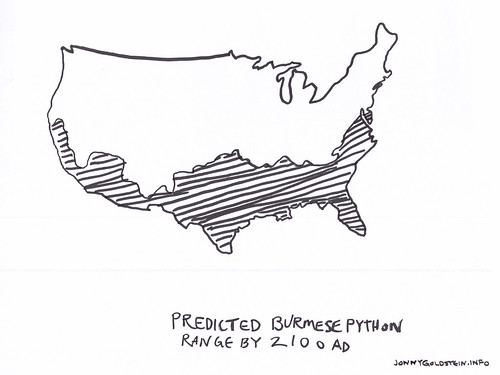
Visual notes: "Burmese Python's Consuming Florida"
By Jonny Goldstein, used under a Creative Commons license:

"The Burmese Python is native to Southeast Asia. Now it is thriving in Florida, due to pet owners who set them free. They have found the climate very agreeable and are now battling it out with alligators at the top of the food chain."

NBC Video: Pythons on the loose in Florida
Related reading:
It's Open Season On Florida's Pythons. NPR, 2009.
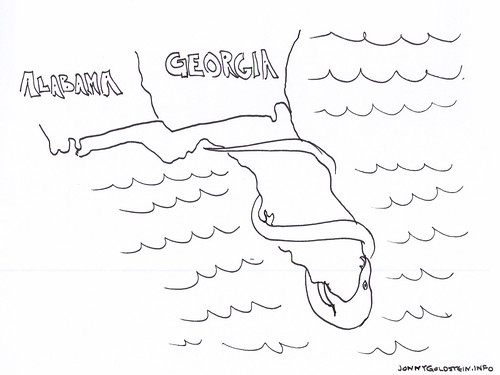
"The Burmese Python is native to Southeast Asia. Now it is thriving in Florida, due to pet owners who set them free. They have found the climate very agreeable and are now battling it out with alligators at the top of the food chain."
Visit msnbc.com for Breaking News, World News, and News about the Economy
NBC Video: Pythons on the loose in Florida
Related reading:
It's Open Season On Florida's Pythons. NPR, 2009.
Hunters and Tourists Stalk Pythons in Florida http://nyti.ms/cbtBBh
The day may come when doctors literally prescribe snake oil for heart disease - NYTimes,2011.
The day may come when doctors literally prescribe snake oil for heart disease - NYTimes,2011.
Thursday, June 4, 2009
Funny science video: Cockatoo Dances to the Beat
Cockatoo Dances to the Beat
The movie shows three excerpts of videos analyzed in this experiment. Each excerpt is at a tempo different from the original song (Everybody, by the Backstreet Boys; 108.7 beats per minute [bpm]). The excerpts include synchronized bouts, periods during which Snowball bobs his head in synchrony with the musical beat for at least 12 consecutive bobs.
Current Biology 19(10), published online April 30, 2009.
Consider subscribing to the Cell Press YouTube channel.
Friday, February 13, 2009
Video: Horror story - Candiru, the Toothpick Fish
See the BBC video on YouTube (embedding disabled by request):
"The Candiru fish, or Toothpick fish, is a natural parasite commonly found living inside Amazonian Catfish. Watch this short video from BBC wildlife show 'Weird Nature' to learn how this small fish has become a horror story in its own right when introduced to humans."

Candiru, also known as canero or toothpick fish, are parasitic freshwater catfish found in the Amazon River. They have a reputation among the natives as the most feared fish in its waters, even over piranha. They are eel-shaped and translucent, making them almost impossible to see in the water. Candiru grow to a size of 6 inches (~15 cm) in length and have barbels around the head, together with short, backward pointing spines on the gill covers.
The Candirú lies in wait at the river's murky bottom, searching for its next host by sampling/sniffing the water for expelled chemicals, such as urea and ammonia from the gills of other fish. Once having detected a fish in the vicinity, with a burst of speed the Candirú darts towards the gill cavity and lodges itself in place with its spines. Then, with usually fatal consequences for its victim, the Candirú begins to gnaw a hole towards a major blood vessel and gorges itself for no more than a few minutes. It will then dislodge itself and sink back to the river bed in order to digest its food and wait for its next meal.
This fish is also known to attack humans and animals and swim into an orifice (the vagina, anus, or even the penis—and deep into the urethra). Because of spines protruding from the fish, it is almost impossible to remove except through surgery. It locates its human targets when people urinate near the fish.
Parasites - Candiru fish.
References:
Candiru, from Wikipedia, the free encyclopedia.
Image source: Candiru, Vandellia cirrhosa, Wikipedia, public domain.
"The Candiru fish, or Toothpick fish, is a natural parasite commonly found living inside Amazonian Catfish. Watch this short video from BBC wildlife show 'Weird Nature' to learn how this small fish has become a horror story in its own right when introduced to humans."

Candiru, also known as canero or toothpick fish, are parasitic freshwater catfish found in the Amazon River. They have a reputation among the natives as the most feared fish in its waters, even over piranha. They are eel-shaped and translucent, making them almost impossible to see in the water. Candiru grow to a size of 6 inches (~15 cm) in length and have barbels around the head, together with short, backward pointing spines on the gill covers.
The Candirú lies in wait at the river's murky bottom, searching for its next host by sampling/sniffing the water for expelled chemicals, such as urea and ammonia from the gills of other fish. Once having detected a fish in the vicinity, with a burst of speed the Candirú darts towards the gill cavity and lodges itself in place with its spines. Then, with usually fatal consequences for its victim, the Candirú begins to gnaw a hole towards a major blood vessel and gorges itself for no more than a few minutes. It will then dislodge itself and sink back to the river bed in order to digest its food and wait for its next meal.
This fish is also known to attack humans and animals and swim into an orifice (the vagina, anus, or even the penis—and deep into the urethra). Because of spines protruding from the fish, it is almost impossible to remove except through surgery. It locates its human targets when people urinate near the fish.
Parasites - Candiru fish.
References:
Candiru, from Wikipedia, the free encyclopedia.
Image source: Candiru, Vandellia cirrhosa, Wikipedia, public domain.
Saturday, October 18, 2008
Photos: Giraffes, Hornbill and Cranes in Omaha Zoo
Giraffes, Hornbill and Cranes in Omaha Zoo
Hornbill and Okapi in Omaha Zoo
See more here: Giraffes, Hornbill and Cranes in Omaha Zoo from Hit the Road - See America and the World.
Saturday, April 12, 2008
Video: Dancing Grizzly Cannot Resists a Back Rub
A YouTube user has added a disco tune to the otherwise very scientific video by the U.S. Geological Survey Northern Divide Bear Project:
Dancing Grizzly
Video Description: Grizzly bear vigorously rubbing on a tree regularly used by other bears in Glacier National Park. USGS Northern Divide Bear Project remote video by J.Stetz/A.Macleod. August 12, 2006. Rubbing is a form of chemical communication. DNA analysis of hair collected from natural rub trees is used to identify individual bears and census the population.
There are more videos here:
Use of remote camera systems to investigate efficiency of DNA-based sampling methods. U.S. Geological Survey. In this video the bear looks in the camera first as if it is suspecting something.
Bears are fascinating creatures. I have a posted a number of videos of different Bear Species at Northern Trek in Cleveland Zoo on my travel web site Hit the Road - See America and the World. None of them compares to the U.S. Geological Survey videos, of course.
Polar Bears in Cleveland Zoo
References:
Polar Bears in Cleveland Zoo
Bears at Northern Trek, Cleveland Zoo
Dancing Grizzly
Video Description: Grizzly bear vigorously rubbing on a tree regularly used by other bears in Glacier National Park. USGS Northern Divide Bear Project remote video by J.Stetz/A.Macleod. August 12, 2006. Rubbing is a form of chemical communication. DNA analysis of hair collected from natural rub trees is used to identify individual bears and census the population.
There are more videos here:
Use of remote camera systems to investigate efficiency of DNA-based sampling methods. U.S. Geological Survey. In this video the bear looks in the camera first as if it is suspecting something.
Bears are fascinating creatures. I have a posted a number of videos of different Bear Species at Northern Trek in Cleveland Zoo on my travel web site Hit the Road - See America and the World. None of them compares to the U.S. Geological Survey videos, of course.
Polar Bears in Cleveland Zoo
References:
Polar Bears in Cleveland Zoo
Bears at Northern Trek, Cleveland Zoo
Sunday, March 9, 2008
Wintertime and Rhino Enrichment, Cleveland Style
Rhino Enrichment, Cleveland Style from CMZooTube
Cleveland Metroparks Zoo is home to more than 3,000 animals representing 600 species, including the largest collection of primate species in North America. Top attractions include The RainForest, Northern Trek, Australian Adventure, African Savanna, Waterfowl Lake and the Primate, Cat & Aquatics Building.
I have posted many photos and videos from Cleveland Zoo on the travel blog. The most recent posts are:
Viktor Schreckengost and Elephant Sculptures at Cleveland Zoo
Bactrian Camels at Cleveland Zoo
A mnemonic for the correct name for each camel species is this: "Bactrian" begins with "B", and "Dromedary" begins with "D" -- and "B" on its side has two humps, whilst "D" on its side has only one hump. Source: Wikipedia.
Monday, February 25, 2008
Sea Lion at Cleveland Zoo Dies of Pancreatitis
Huck, one of the Cleveland Zoo two sea lions, enjoyed interacting with visitors, as you can see from the video below at minute 2:01:
Sea Lion at Northern Trek, Cleveland Zoo. See another video here.
The 5-year-old California sea lion, died of of pancreatitis and acute enteritis, according to the zoo press release: "Huck had shown no clinical signs of illness or abnormal behavior until the day he died.
Huck arrived at Cleveland Metroparks Zoo in 2003 from Omaha's Henry Doorly Zoo in Nebraska. He was one of two sea lions residing with five harbor seals in the Northern Trek area of the Zoo."
This post ads to the list of animals with very "human" diseases like:
- Gorillas with CHF
- A tortoise with CAD
References:
Cleveland Metroparks Zoo sea lion dies. The Plain Dealer.
Northern Trek in the Spring at Cleveland Zoo. Hit the Road - See America and the World.
Sea Lion at Northern Trek, Cleveland Zoo. See another video here.
The 5-year-old California sea lion, died of of pancreatitis and acute enteritis, according to the zoo press release: "Huck had shown no clinical signs of illness or abnormal behavior until the day he died.
Huck arrived at Cleveland Metroparks Zoo in 2003 from Omaha's Henry Doorly Zoo in Nebraska. He was one of two sea lions residing with five harbor seals in the Northern Trek area of the Zoo."
This post ads to the list of animals with very "human" diseases like:
- Gorillas with CHF
- A tortoise with CAD
References:
Cleveland Metroparks Zoo sea lion dies. The Plain Dealer.
Northern Trek in the Spring at Cleveland Zoo. Hit the Road - See America and the World.
Thursday, February 14, 2008
Gorillas at Cleveland Zoo have heart disease along with many others at U.S. zoos
 Cleveland Zoo's gorillas Mokolo, 20, and Bebac, 23, were examined at the zoo's veterinary hospital by echocardiogram and were found to have left ventricular hypertrophy and congestive heart failure (CHF), respectively.
According to the Cleveland Zoo press release:
"The zoo is participating in a national study of gorilla health, after previous research found that gorillas in captivity are prone to heart disease.
Mokolo's left side of his heart is enlarged. Bebac's heart is more enlarged, shows impairment and doesn't pump as efficiently as it should, he said.
The gorillas will be placed on beta blockers or ACE inhibitors, drugs familiar to people with high blood pressure and heart disease."
Animals die of heart disease juts like humans do. A 176-year-old tortoise, believed to had been owned by Charles Darwin, died MI and CHF in 2006.
I have a video of Mokolo below and, as you can see, he is the silverback (the boss) in the group of the 2 gorillas at the zoo.
Silverback Gorilla at Cleveland Zoo
Some studies show that depression may lead to worse outcomes in CHF and CAD. If we assume that the older Bebac was somewhat depressed by his inferior status, this could explain his worse cardiovascular condition (past MI?).
References:
Gorillas Undergo Cardiac Exams at Cleveland Metroparks Zoo. Cleveland Zoo.
Cleveland zoo's gorillas have heart disease. The Plain Dealer.
Local and National Coverage of Gorilla Project. The Roar Report.
Related:
Do Gorillas have Personalities? Cleveland Zoo Blog, 08/2008.
176-year-old turtle once owned by Darwin dies of MI and CHF
Image source: Winter Visit to the Cleveland Zoo
Has anyone ever seen a photo of a happy captive gorilla? Flickr.
Updated: 09/22/2008
Thursday, June 21, 2007
Secret to Long Life: Take It Slow, Don’t Have Many Kids and Enjoy Cold Water (If You Are a Whale)
 211 and 115-year-old whales?
According to the NYTimes, the secret to long life is to "Take It Slow, Don’t Have Many Kids and Enjoy Cold Water", that is if you are a whale:
"Eskimo hunters killed a bowhead whale off the coast of Alaska last month and began to chainsaw their way into its blubber. They stopped when the saw hit the tip of an old harpoon lodged deep inside the whale. Historians identified it last week as part of a bomb lance, a harpoon manufactured for only a few years in the late 1800s in New Bedford, Mass. Whalers probably fired it at the bowhead around 1890, when the whale was probably a teenager, and it carried the harpoon for the next 115 years before finally being killed by a modern one."
References:
Take It Slow, Don’t Have Many Kids and Enjoy Cold Water. NYTimes, 06/2007.
Image source: Wikipedia, public domain.
Thursday, June 7, 2007
Sounds of Nature: Audio Layers from Around the World Added to Google Maps and Earth
Click on the map below to hear it:
WildSanctuary.com has an audio layer for Google Maps and Earth with sounds collected from all over the world. You can play them right in the browser by choosing Google Maps at the front page.
According to Google Operating System:
"You can hear the sounds of the Kenyan savannah, a sudden rain in the forest, a mysterious spring chorus of loons and peepers, the bells of Notre Dame de Paris. My favorite is a soundscape from Hawaii, "an aural voyage beginning at a beach along the Maui coast, and descending below the surface into the depths of the sea, before emerging to the shore, once again. The sea pulsates with biological sound."
References:
Sounds in Google Earth. Google Operating System.
Audio Layer Added To Google Earth AND Google Maps. InsideGoogle.
Map via Google Operating System, a Creative Commons License.
WildSanctuary.com has an audio layer for Google Maps and Earth with sounds collected from all over the world. You can play them right in the browser by choosing Google Maps at the front page.
According to Google Operating System:
"You can hear the sounds of the Kenyan savannah, a sudden rain in the forest, a mysterious spring chorus of loons and peepers, the bells of Notre Dame de Paris. My favorite is a soundscape from Hawaii, "an aural voyage beginning at a beach along the Maui coast, and descending below the surface into the depths of the sea, before emerging to the shore, once again. The sea pulsates with biological sound."
References:
Sounds in Google Earth. Google Operating System.
Audio Layer Added To Google Earth AND Google Maps. InsideGoogle.
Map via Google Operating System, a Creative Commons License.
Monday, May 28, 2007
Lion vs. Buffalo vs. Crocodile at Kruger National Park
The Animal of the Day links to a rare video showing buffalo hunting gone wrong for a pack of lions at Kruger National Park. The excited tourists narrate the 8-minute-long video very well. Unbelievably, everything seems to end fine for the buffalo calf...
Battle at Kruger
Related:
You’ve Seen the YouTube Video; Now Try the Documentary. NYTimes, 05/2008.
Updated: 05/10/2008
Battle at Kruger
Related:
You’ve Seen the YouTube Video; Now Try the Documentary. NYTimes, 05/2008.
Updated: 05/10/2008
Friday, May 18, 2007
Columbus Zoo: Manatees, Gorillas and More
Columbus Zoo is one of the 6 great Ohio Zoos. Currently, I have photos and videos from 4 of them: Cleveland, Akron, Toledo and Columbus.
Click to play the video below:
Manatee Coast at Columbus Zoo
This video was shot with a Canon SD 450, a nice little camera which is almost the size of a credit card (only thicker). The background music was added using the new AudioSwap feature of YouTube. I especially like the turtle swimming right in front of the camera every minute or so. The video was edited with Windows Movie Maker, a free program included with every recent Windows version. I would like to point out to my readers that such videos are easy to make and I am looking forward to seeing your own educational or entertaining (preferably both) videos soon.
See more photos and videos here.
Click to play the video below:
Manatee Coast at Columbus Zoo
This video was shot with a Canon SD 450, a nice little camera which is almost the size of a credit card (only thicker). The background music was added using the new AudioSwap feature of YouTube. I especially like the turtle swimming right in front of the camera every minute or so. The video was edited with Windows Movie Maker, a free program included with every recent Windows version. I would like to point out to my readers that such videos are easy to make and I am looking forward to seeing your own educational or entertaining (preferably both) videos soon.
See more photos and videos here.
Saturday, February 3, 2007
Lasix and NSAIDs for Thoroughbred Race Horses
 Barbaro was a young American thoroughbred horse that won the 2006 Kentucky Derby. On May 20, 2006, he ran in the Preakness Stakes as a heavy favorite, but he fractured three bones. Barbaro underwent surgery but he soon developed laminitis in his left rear leg. While his right leg eventually healed, a final risky surgery on it proved futile because the colt soon developed further laminitis in both front legs. It then became clear he could not be saved, and Barbaro was euthanized (source: Wikipedia, image: Godolphin Arabian).
A NY Times article comments on drug use in horse racing and different training styles used on both sides of the Atlantic:
"Horses racing in America are allowed to be injected with various drugs on race day, the most common being Lasix, a powerful diuretic, and phenylbutazone, an anti-inflammatory medication.
“A horse will try his hardest,” Dr. Stewart, head of veterinary regulation for the Hong Kong Jockey Club said, “and if he can’t feel pain he will run through it, increasing the risk of injury.”
Barbaro was running on Lasix in the Preakness, and there is no evidence that this had anything to do with his accident. But his story became a rallying point for improving safety for thoroughbreds."
As an interesting fact, all modern thoroughbreds carry the genetics of three Arabian stallions imported to England from the Middle East in the 17th and 18th centuries: the Darley Arabian, to whom 95% of today's thoroughbred pedigrees trace, the Godolphin Arabian, and the Byerly Turk. (Source: Wikipedia).
References:
I’m Not Barbaro, for Lots of Reasons. NY Times.
Death and Disarray at America’s Racetracks - 24 horses a week die at racetracks around the country - NYTimes, 2012.
Veterinarian Says Goodbye to a Patient. NY Times.
Barbaro from Wikipedia, the free encyclopedia.
Still Caring for Barbaro. NYTimes, 05/2007.
Image source: Wikipedia, public domain.
Wednesday, September 20, 2006
Only 2 Men Have Survived a Stingray Injury to the Heart
 The tragic death of the "Crocodile Hunter" Steve Irwin who was killed by a stingray brought a renewed interest in these somewhat shy sea creatures.
The Medical Journal of Australia describes the 2nd known case of a Survivor of a Stingray Injury to the Heart (PDF, published in 2001):
"Cardiac injuries from stingray barbs are rare, even worldwide, and all but one have been fatal.
Clinical Record
A 33-year-old man was snorkelling at Coogee, a popular Sydney swimming beach, when he was noticed to be in distress."
References:
"Crocodile Hunter" Steve Irwin Killed by Stingray
The Claim: Never Remove a Barb From a Stingray Injury. NYTimes.
Image source: Wikipedia, Creative Commons Attribution ShareAlike 1.0 license, by Dr. Tony Ayling.
Monday, July 3, 2006


Wednesday, June 28, 2006
176-year-old turtle once owned by Darwin dies of MI and CHF
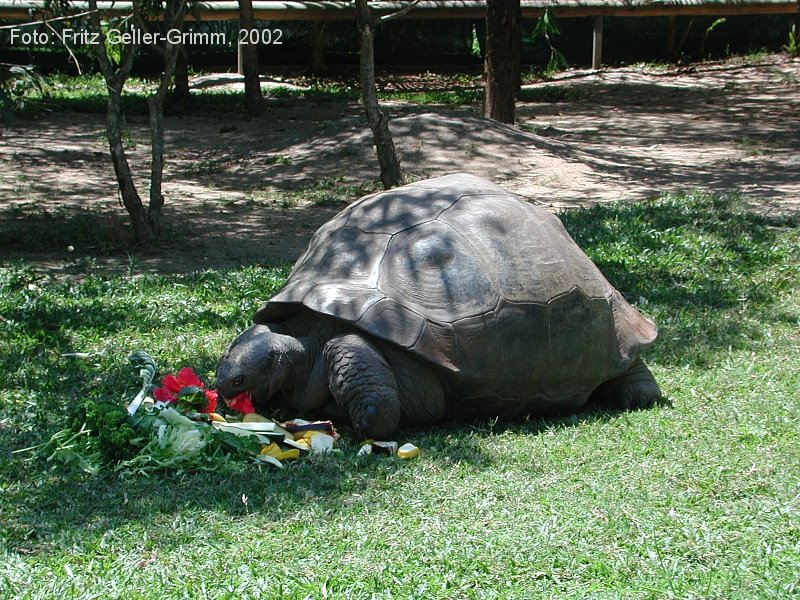 The late Harriet was a 176-year-old tortoise, believed by some to have been owned by Charles Darwin. She died peacefully in a Queensland zoo owned by Steve Irwin, the Crocodile hunter.
According to the zoo veterinarian quoted by CNN:
"Harriet sadly died last night after, thankfully, a very short illness. She'd been sick yesterday with, in effect, heart failure. She had a very fairly acute heart attack and thankfully passed away quietly overnight."
People have heart attack at age 76 (and often much earlier), for Galapagos turtles the risk age seems to be 176...
Read the whole story: 'Darwin's tortoise' dies, age 176. CNN.
Image source: Wikipedia
Related:
Darwin, Britain's Hero, Is Still Controversial In U.S. NPR, 02/2009.
Updated: 02/08/2009
Subscribe to:
Posts (Atom)