Showing posts with label Critical Care. Show all posts
Showing posts with label Critical Care. Show all posts
Friday, December 23, 2011
George Michael, still breathless after pneumonia and tracheotomy, plans a show for his doctors (video)
Video: George Michael: This has been the worst month of my life. ShowBiz411.
A thin and visibly weak George Michael (48) told reporters outside his home in London that he wasn't supposed to speak for very long and was still recovering from a tracheotomy: "I got streptococca-something... It's a form of pneumonia and they spent three weeks keeping me alive basically," Michael said of the doctors in the Austrian hospital where the singer has been receiving treatment since he fell ill in November.
He added that he also wanted to hold a special show for the Austrian doctors who treated him. "I've spent the last 10 days since I woke up literally thanking people for saving my life."
References:
Gaunt George Michael says "fortunate to be here". Reuters, 2011.

Tuesday, February 22, 2011
SHAKE may be common in hospitals: Supplement-associated Hyperammonemia After Cachectic Episode
 High-protein dietary supplements were started for 2 patients, who had a period of anorexia before hospital admission but no history of liver disease. Subsequent altered mental status with ataxia developed in both patients.
Hyperammonemia was noted, while liver function test results remained normal.
Removal of the high-protein dietary supplements led to reversal of symptoms and normalization of the ammonia level.
With the ubiquity of nutrition supplement use, SHAKE (supplement-associated hyperammonemia after c[k]achetic episode) syndrome may be common in modern hospitals.
References:
Iatrogenic Hyperammonemia After Anorexia. Emily Welsh, BA; Jan Kucera, MD; Michael D. Perloff, MD, PhD. Arch Intern Med. 2010;170(5):486-488.
Image source: sxc.hu.
Tuesday, July 27, 2010
Video: Awake Endotracheal Intubation
Video: Awake Endotracheal Intubation for "Fun and Knowledge" by an anesthesiologist from the Massachusetts General Hospital (MGH). Not sure about the "fun" part...
References:
Awake Endotracheal Intubation for Fun and Knowledge. Medgadget, 2010.
Wednesday, June 23, 2010
Norepinephrine Causes Fewer Adverse Events Than Dopamine in the Treatment of Shock
 Both dopamine and norepinephrine (Levophed) are recommended as first-line vasopressor agents in the treatment of shock. There is a continuing controversy about whether one agent is superior to the other.
Although there was no significant difference in the rate of death between patients with shock who were treated with dopamine as the first-line vasopressor agent and those who were treated with norepinephrine, the use of dopamine was associated with a greater number of adverse events.
References:
Comparison of Dopamine and Norepinephrine in the Treatment of Shock. NEJM, 2010.
Image source: Wikipedia, public domain.
Friday, February 19, 2010
Superficial Venous Thrombosis Linked to Increased Risk of "Deep" Venous Thromboembolism for Months
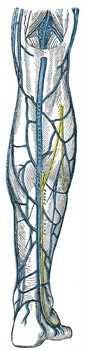 Superficial venous thrombosis (SVT) is perceived to have a benign prognosis.
 Among 844 patients with SVT, 24.9% also had deep venous thrombosis (DVT) or symptomatic pulmonary embolism.
Among 600 patients without DVT or pulmonary embolism at inclusion who were eligible for 3-month follow-up, 10.2% developed thromboembolic complications at 3 months despite 90.5% having received anticoagulants:
- pulmonary embolism 0.5%
- DVT 2.8%
- extension of SVT 3.3%
- recurrence of SVT 1.9%
A substantial number of patients with SVT exhibit venous thromboembolism at presentation, and some that do not can develop this complication in the subsequent 3 months.
References:
http://www.annals.org/content/152/4/218.short
Image source: Saphenous vein, Gray's Anatomy, 1918 (public domain).
Tuesday, January 12, 2010
Pulmonary and Critical Care Medicine
Editor: V. Dimov, M.D., Assistant Professor at the University of Chicago
Pulmonary and Critical Care Cases at ClinicalCases.org
News About Pulmonary and Critical Care at CasesBlog
Pulmonary and Critical Care Cases at ClinicalCases.org
News About Pulmonary and Critical Care at CasesBlog
Pulmonary and Critical Care Medicine: Images in Clinical Medicine
Patient Information
Follow us and connect:


Published: 01/12/2010
Updated: 12/28/2010
Patient Information
Follow us and connect:
Published: 01/12/2010
Updated: 12/28/2010
Wednesday, January 7, 2009
Critical care checklists: A case for streamlining the approval process in quality-improvement research
 Checklists have been recently promulgated as a method to enhance patient safety and improve outcomes for the critically ill patients.
Patients are advised to make a checklist before they see a doctor. Now, your ICU doctor should probably make a checklist before he sees you.
The podcasting intensivist Rich Savel, medical co-director of the surgical intensive care unit at Montefiore Medical Center in New York City, just published a paper in the journal of Critical Care Medicine on the checklists in the ICU. Here is a link to his paper:
Critical care checklists, the Keystone Project, and the Office for Human Research Protections: A case for streamlining the approval process in quality-improvement research.
Richard Savel is the author of many firsts. In 2005, he made the first podcast for a national medical society -- the official podcast of the Society of Critical Care Medicine. In 2006, Dr. Savel published the first paper about medical podcasting in the Journal of the American Medical Informatics Association.
One of the First Journal Articles About Podcasting
How a Critical Care Podcast Was Born
Advice for Patients: Make a Checklist Before You See the Doctor
Image source: picturestation.net, free license.
Saturday, May 26, 2007
$ 30 Million Lawsuit for Complications of Pressors Use in Septic Shock
 A 47 yo female was awarded $30 million to recover past and future medical costs, lost wages and pain and suffering for complications of treatment of septic shock by a Florida court.
A plastic surgeon performed a "tummy tuck" (abdominoplasty) in 2001, soon after that the patient began to to have fever. According to the newspaper story, she went to the ER and the on-call surgeon "removed some fluid from her stomach area and... she was given medicine that focused blood flow to the inner part of her body to protect her vital organs.
Yerrid said this medicine can be given only after fluids have been administered; otherwise, the flesh in the extremities will die. Haedicke never ordered fluids for Lucia.
Haedicke's attorney said Lucia's kidneys were shutting down. Had he administered fluids, she could have died.
The lack of blood flow to her extremities had caused severe damage to her hands and legs. Doctors at Tampa General were forced to amputate fingers from both hands and her legs below both knees."
Of course, it is difficult to impossible to comment on a medical case without examining the patient and reviewing the chart but we usually give IV fluids (IVF) before and during pressors administration.
The rationale of "filling the tank" before using pressors (which can cause peripheral ischemia) is well-illustrated in this clinical case: Pneumonia and Septic Shock. As you can see from the labs, this patient also had acute renal failure which actually improved with IVF.
Early rapid and appropriate treatment of septic shock is extremely important in order to decrease morbidly and mortality in this very sick patient population.
References:
Patient Wins $30 Million. The Tampa Tribune, 5/2007.
Pneumonia and Septic Shock. ClinicalCases.org.
Link via Kevin, M.D.
Image source: CDC, public domain.

Subscribe to:
Posts (Atom)