Showing posts with label Examination. Show all posts

Thursday, September 8, 2011

Burnout and Educational Debt Affect Medical Knowledge Among IM Residents (measured by exam scores)

Doctors are not impervious to stresses of daily life. Physician distress is common and has been associated with negative effects on patient care.

This JAMA study of internal medicine residents used data collected during 2008-2009 Internal Medicine In-Training Examination (IM-ITE). Participants were 16,000 IM residents, representing 74% of all eligible US internal medicine residents - approximately 7700 US medical graduates and 8500 international medical graduates (IMGs).

Quality of life was rated “as bad as it can be” or “somewhat bad” by 15% of residents.

Burnout, emotional exhaustion and depersonalization were reported by 51%, 46%, and 29% of residents, respectively.

Burnout was less common among international medical graduates than among US medical graduates (45% vs 59%),

Greater educational debt was associated with the presence of at least 1 symptom of burnout (61% vs 44%; for debt greater than $200 000 relative to no debt).

Residents reporting QOL “as bad as it can be” and emotional exhaustion daily had exam scores 2.7 points and 4.2 points lower than those with QOL “as good as it can be” and no emotional exhaustion, respectively.

Residents reporting debt greater than $200,000 had exam scores 5 points lower than those with no debt.

Suboptimal QOL and burnout were common among IM residents. Burnout was associated with higher debt and was jess frequent among international medical graduates (IMGs).

Low QOL, emotional exhaustion, and educational debt were associated with lower IM-ITE scores.

References:

Quality of Life, Burnout, Educational Debt, and Medical Knowledge Among Internal Medicine Residents. JAMA, 2011;306(9):952-960. doi: 10.1001/jama.2011.1247
Stress overdose for doctors. Star Tribune.
Image source: OpenClipArt.org, public domain.

Friday, April 23, 2010

Hockey-puck-on-a-rod test checks for concussion after head trauma

From NPR:

The hockey-puck-on-a-rod test was invented by a Michigan high school student.

It works like this: Tester suspends the device while injured athlete sits with forearm on table, fingers loosely circling the stick. Without warning, tester drops stick. Athlete grabs stick as fast as possible. Place where athlete grabs gives an instant readout of reaction time.

It all happens in milliseconds - too fast to measure with a stopwatch. Athletes with concussions had reaction times that were 15% slower.

References:

Comments:

Nicholas Genes - Neat idea. I like how it's free of stopwatches and all the variability they introduce. But it seems that athletes would need to have a baseline measurement pre-trauma to really compare (maybe they can do it when they're signing waivers at the start of the season...)

Thursday, April 22, 2010

500 repetitions of 4 cardiac murmurs improved auscultatory proficiency of medical students

According to a 2004 study in Chest, the ability of medical students to recognize heart murmurs is poor (20%), and does not improve with subsequent years of training.

Five hundred repetitions of four basic cardiac murmurs significantly improved auscultatory proficiency in recognizing basic cardiac murmurs by medical students. These results suggest that cardiac auscultation is, in part, a technical skill.

Related resources

The Heart Sounds Tutorial by Blaufuss.org is a fancy flash-based simulator with animations. The McGill University Virtual Stethoscope is another useful website. Click here for more web-based teaching resources for hearts sounds from UCLA and breath sounds from Loyola University.

References:
Mastering cardiac murmurs: the power of repetition. Barrett MJ, Lacey CS, Sekara AE, Linden EA, Gracely EJ. Chest. 2004 Aug;126(2):470-5.
http://www.ncbi.nlm.nih.gov/pubmed/15302733
Image source: Modern stethoscope. Wikipedia, public domain.

Wednesday, April 21, 2010

Standardized patient: Over the course of three days, I had 23 head-to-toe physicals from 23 medical students

From Slate:

"I was the first person these would-be doctors had ever fully examined on their own. Some were shaking so violently when they approached me with their otoscopes—the pointed device for looking in the ear—that I feared an imminent lobotomy.

A "standardized patient" is a trained person who is paid $15 an hour to be poked and prodded by inexperienced fingers, so that med students can learn communication and examination skills before they are sicced on actual sick people.

Now there are standardized patients trained for genital duty (they're called GUTAs, for genitourinary teaching associates).

Dr. N wasted the first eight minutes of the exam trying repeatedly to get a blood pressure reading. The panic in his eyes seemed to say, "She appears to be alive, yet she has no vital signs."

Comments:

Lakshman Swamy - Don't forget that some of them were capable! I have to say, in my experience as an MS2 at Wright State, our standardized patients are amazing teachers. It is much easier to learn physical exam skills and even interviewing when the patient can give you precise feedback. The author is right on with the characters that patients can portray... it is shocking when they break character to give feedback! Just recently I learned how to do the male exam with two standardized patients ("GUTA" -- never heard of that term before). I was definitely feeling a little ... awkward before the session began-- this was by far the most invasive thing I had ever done to another person. But the standardized patients were amazing about the whole process, even acting out the different hesitations that we might encounter in patients, emphasizing the importance of the exam, etc. Without being too graphic, I can't emphasize how much I learned about how to do those exams and what I was actually supposed to be finding. It was a totally different experience than I expected, and after it, I feel really confident about the whole process.

I can't even IMAGINE what it would be like to do that with my classmates-- and how much less I would have understood. Wow.

References:
Oh, no! I'm the first patient these 23 medical students have ever examined. Slate, 2010.
Image source: OpenClipArt.org, public domain.
Friday, October 24, 2008

ABIM Issues Warning Regarding Scam “Certification Boards” Plus How to Score Well on the Real Board Exam

I am a Board-certified Internist and proud of it. Although I scored at the 96-98th percentile during my in-service exams during residency, the actual 2-day paper examination (at the time) was not easy.

Beware the Scam Boards

A few days ago, the American Board of Internal Medicine (ABIM) issued a warning regarding scam “Certification Boards” after receiving reports from its diplomates regarding solicitations from groups offering “certification” in Geriatric Medicine, Cardiology and Hospital Medicine, etc.

There is no board in Hospital Medicine, at least not yet.

The phony “medical boards” listed below have been reported to ABIM as fraudulent:

* The United States Medical Specialists Federation (USMSF)
* American Board of Diabetes (ABD)
* American Academy of Cardiology (AAC)
* American Board of Geriatrics (ABG)
* American Board of Geriatric Medicine (ABGM)
* American Board of Hospital Physicians (ABOHP)
* American College of Specialists in Geriatrics (ACSG)
* American College of Christian Physicians (ACOCP)
* American College of Ethical Physicians (ACOEP)
* American College of Family Medicine (ACFM)
* American College of Geriatrics Specialists (ACGS)

Probably the most ridiculously named fake board on the list is the American College of Ethical Physicians (ACOEP). All physicians are supposed to be ethical not just the members of the (scam) board.

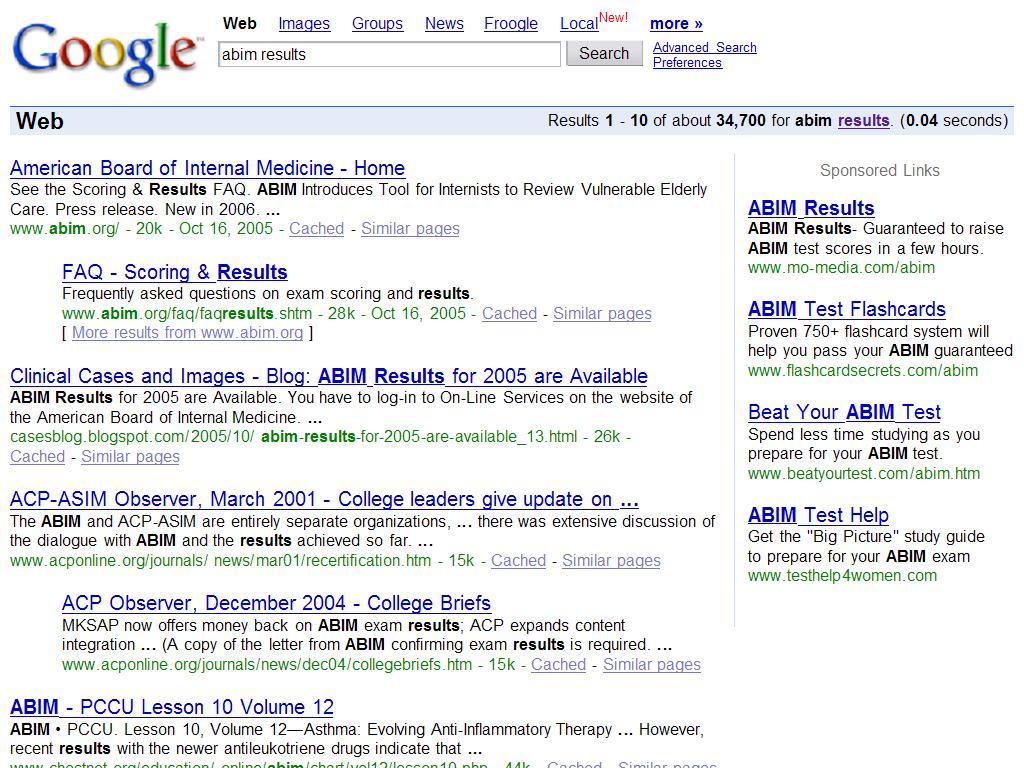
Still number 2 hit on Google for "ABIM results" after all those years

On a completely unrelated note, this blog is still the number 2 search result on Google for "ABIM results" 3 years after a small announcement made in 2005. If you search for reliable information, you know where to find it (place a "smile" emoticon here).


"ABIM Results" on Google: this blog has been the number 2 search result since 2005, directly below the official ABIM web page.

How to Score Well on the Board Exams

In 2004, I listed a few tips on How to Score Well on the Boards and some of them are still valid:

Practice makes perfect
Read a concise book
Practice with a lot of MCQ.
The formula "first line, last line, answers" works for many test takers
Pace yourself
Calculate 2 things: the percent of correct answers and the seconds you spend on each question
For those who like mnemonics, the best free resource is Medical Mnemonics.com

References:
Warning regarding scam “Certification Boards.” ABIM news.
"ABIM Results" on Google - Guess Who's Number Two in the Search Results?
How to Score Well on the Boards?
MKSAP 14 Has an Online Version
Image source: OpenClipArt.org, public domain.

Friday, August 1, 2008

Tips on Physical Exam from the Blog Musings of a Distractible Mind


Musings of a Distractible Mind offers tips on physical examination -- the post series covers a complete HEENT exam plus more:
References:
Physical exam posts from Musings of a Distractible Mind.
Physical Examination Videos. Clinical Cases and Images.
Image source: Wikipedia, a GNU Free Documentation License.

Thursday, March 13, 2008

What is Included in President's Physical Exam?

WebMD reviews items included in the 2007 annual physical examination of President George H. Bush. The inclusion of both exercise treadmill testing and stress echocardiogram is a bit unusual since he has not reported any symptoms, at least according to the publicly available information.

An annual physical examination of healthy people is not recommended by any national medical society.

References:

What’s in a President’s Physical? WebMD.
President Bush's Physical - A Good Example on How to Have a Healthy Lifestyle. CasesBlog, 2005
Executive Health Physicals. Are They Worth $ 3,000? CasesBlog, 2006.
The Presidents Club | Photos: Oval Office Secrets from Truman to Obama | TIME, 2012.
Image source: Wikipedia, public domain.

Thursday, August 23, 2007

Practical advice on prostate examination

Tundra PA summarizes a few practical points on prostate examination:

"When I told Dr. H. about the physical exam and my concern that I had felt a nodule in Evan’s prostate, he held out his arm with the wrist extended. Pressing the bony prominence just distal to the radial pulse, he said “prostate nodule.” Pressing the large muscle at the base of the thumb, he said “normal prostate.” Pressing the space on the back of his hand between thumb and forefinger, he said “boggy prostate.”

Update 09/03/2007:
Tundra PA has a follow-up of the story.

References:
A PSA Story. Tundra Medicine Dreams, 08/2007.
Cancer: Digital Rectal Examination for Prostate Problems. WebMD.
Image source: Wikipedia, public domain.

Related:
Prostate Cancer with Bone Metastases and PSA of 900
3 New Diagnoses This Year

Friday, March 31, 2006

Is Physical Examination Useless?

There has been a lot of discussion in the medical blogs recently about the usefulness (or lack) of physical examination.

I personally think that physical exam is very important but when "the HMOs force physicians to care for a maximum number of patients, in a minimum number of minutes for the lowest number of dollars" something has to give...

One of the comments on KevinMD says that clearly: "Why do I have the feeling this guy never had to see 40 patients a day at 15-minutes per encounter... I bet his physical exams would leave a lot to be desired at that rate."

Anyway, if you want to refresh your skills, you can review this large collection of free physical examination videos organized by body system.

Update 3/23/2007:

Dr. Wes comments on "Procedural Darwinism":

Take the stethoscope, for instance. It is rapidly succumbing to Procedural Darwinism. If it weren’t for the stethoscopes ability to hear breath sounds, it would have been extinct long ago. The echocardiogram is far superior to “hear” heart sounds, and adds procedural survival protection by providing additional size, structure, and functional information regarding the heart with little pain or toxicity to the patient. The echo also reimburses well.

Further reading:

Hyposkillia. Deficiency of Clinical Skills. Herbert L. Fred, MD, MACP. Tex Heart Inst J. 2005; 32(3): 255–257.
Comments about deficiency of clinical skills. Retired doc's thoughts.
Declining clinical skills. Notes from Dr. RW.
An old-timer bemoans the demise of the physical exam, or hyposkillia. KevinMD.
The Danger of Being "Too Fast"
In defense of clinical skills. Notes from Dr. RW.
What does the evidence say about clinical skills? Notes from Dr. RW.
Time, Now, to Recover the Fun in the Physical Examination Rather Than Abandon It. Arch Intern Med. 2006;166:603-604.
Imagine: Physical Exam Can Save Lives. Dr. Wes, 08/2007.
The Physical Exam Can Be Pretty Important, Part 2. Dr. Val and The Voice of Reason, 03/2008.
Mourning the loss of basic clinical skills. Notes from Dr. RW, 2009.

Updated: 09/09/2009

Saturday, March 18, 2006

Clinical Skills Videos. A Summary of Free Online Resources

Online Physical Exam Teaching Assistant by the University of Florida College of Medicine
You can watch the videos online or download them to your hard drive.

Physical Exam/Interviewing Modules & Videos by the University of Virginia
The website features streaming videos in QuickTime format.

The UCLA Physical Exam Project
Standard physical exam videos plus tutorials on how to perform a pelvic exam, Pap smear and GC/Chlamydia cultures. Videos cannot be downloaded.

Connecticut Tutorials Physical Examination by the UConn Health Center
Similar to the websites above.

Clinical Skills Online by the St. George's University of London
Videos can also be seen on Palm or Windows Mobile (Pocket PC).

Common Currency Videos by the Dalhousie University
Videos teach procedure skills, called "common currency": peripheral venous access, arterial blood gas sampling, phlebotomy/venous blood sampling, and urinary catheterization. More to be added soon.

There are more useful links for online medical education at the Clinical Skills Education Center of the Queen's University, Belfast. Our website ClinicalCases.org is also listed there.

Update 4/11/2007:
The most updated list is available here: Physical Examination Videos.

Further reading:
Imagine: Physical Exam Can Save Lives. Dr. Wes, 08/2007.
Image source: OpenClipArt.org, public domain.
Updated: 08/07/2007

Monday, January 2, 2006

Neurology Cases, Physical Exam Videos and Google Medicine

University of Nebraska School of Medicine and University of Utah School of Medicine have created a comprehensive neurology curriculum (free):

- NeuroLogic Exam: An Anatomical Approach - well-illustrated with many QuickTime video files

- Neurology cases to accompany NeuroLogic Exam

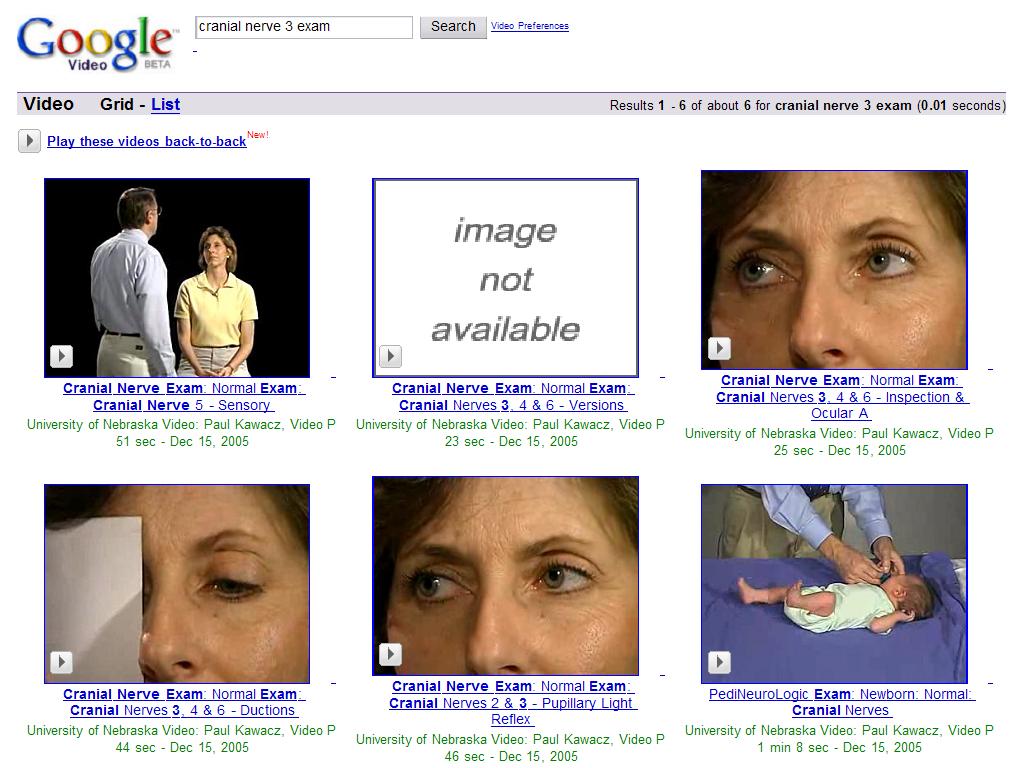
Videos are also available on Google Video which is quite convenient since you can just search for the physical exam maneuver you are interested in, for example, "cranial nerve 3 exam."


Google Videos seem to be one more step towards Google Medicine, as named by Dean Giustini.

"Google, M.D.", is what I call the way patients use search engines to look for medical information. Instead of going to the doctor, they check Google first, get the facts (or pseudo-facts), and then (hopefully) check with their doctor. Google functions as a "physician assistant". It is important to be aware that your patients will be seeing "Google, M.D." first. Be prepared for their informed questions.

References:
Physical Examination Videos
How Google is changing medicine - BMJ 12/05 (extract). Dean Giustini's blog
Top Five 2005 Search Trends in Medicine - UBC Google Scholar Blog
Google, M.D. In Action - Part II
Google in Medicine

More Google videos:
Medicare Prescription Drug Coverage
On Our Own Terms: Moyers on Dying. The Mount Sinai Medical Center, 45 min, $ 5

Image source: Google Video