Showing posts with label hypertension. Show all posts

Tuesday, April 16, 2013

Hypertension: Shifting From Prescribed Medications To Natural Remedies

You have hypertension when the blood pressure within your arteries gets higher than normal. This condition can lead to heart attacks, strokes and even leg pains while walking. Because it doesn’t manifest any symptoms until it has done much damage, having your blood pressure checked from time to time is one of the best health investments that you can make.

Hypertension

Although the use of prescription medication may be necessary to manage hypertension, there are also natural ways to control it. You can use prescribed medications to lower your blood pressure initially. When it reaches its normal level, natural remedies can be used to keep pressure at a healthy level and enable you to taper off the medicines.

Regrettably, most doctors only cure the symptoms of the disease but are not really able to identify the deep-seated cause of hypertension. In each visit, the average patient-doctor consultation takes less than seven minutes. Pharmaceutical giants who manufacture blood pressure lowering drugs invest a lot of money in educating doctors about their latest medications, and virtually nothing on teaching alternative natural cures. Sadly, doctors have been reduced to somebody who simply writes medical prescriptions.

Unlike medications that are passed as a cure for anxiety, but can cause more harm than good for most sufferers, hypertension medications really do help a lot of people. For hypertensive conditions, be sure to take first the medicines that lower blood pressure, and follow up with the natural remedies described below. In a few months, you can gradually reduce your intake of prescription medications and still stay within normal pressure levels.

Natural therapy that can bring down high blood pressure

Obesity can cause blood pressure to soar. If you are obese or overweight, exercise and the right diet can help shed off excess pounds and control your hypertension. A change in the foods you eat will also be beneficial. You should start including low sugar, low fat and high fiber foods in your diet. Quitting smoking and consuming alcohol in moderation must also be considered. Also, salt is one of the silent demons in your diet and should be avoided if possible. If you must use salt, then consume very moderate amounts.

By shifting to less fattening and more nutritious foods, you can eat your way to a trimmer and healthier you. You can also lower your blood pressure and be less prone to heart diseases if you take the following nutritional supplements.

• A healthy supply of vitamins A, C, and D with magnesium is available in powder supplement form.

• 500 to 1,000 mg of calcium can be taken partly during a meal, with the rest taken at bed time.

• Eating a banana and a cup of tomato has enough daily dose of potassium which can help lower blood pressure.

• Coenzyme Q10 is the rising star as far as lowering high blood pressure is concerned. 200 mg is the required daily dose. There were serious cases where pressure was lowered by up to 40 points. The supply of Coenzyme Q10 in the body gets depleted of cholesterol-lowering drugs are taken regularly.

• While dark chocolate only reduces blood pressure by 3 to 4 points, it makes up for its rich supply of antioxidants.

You should also consider the role of emotion in hypertension. Some people are like pressure cookers when they get angry. They keep all that pent-up anger inside until the pressure builds up. People may seem calm from their outside appearance but they are actually almost ready to keel over due to blood pressure that has gone through the roof. The best way to deal with anger is not to allow it to build up inside but to blow off some steam and let all that anger out. This way, you get to lower your blood pressure and reduce the risk of a stroke. Know more about panic attacks, depression, stress and anxiety.

Thursday, November 29, 2012

The world is getting fatter, but Kentucky's rate of obesity is two and a half times the world rate

Take no solace from The Economist, which proclaims in its yearly analysis-and-prognostication issue that this is the year world leaders will take on worldwide obesity because, writes Charlotte Howard, "they will realize something must be done."

So, no, it is not just you, Kentucky. In fact, Howard, the health-care correspondent for the magazine, writes that 30 percent of Mexico's adult population is obese. That is precisely the same percentage of Kentuckians that were considered obese by a Robert Wood Johnson Foundation and Trust for America's Health analysis released in August. (We ranked sixth fattest state nationwide.) It is also the same percentage of Chinese adults that are, as Howard put it, "too wide" -- a term that Howard uses here to include the overweight as well as the obese.

But there is no room to crow here. Kentucky is far ahead of the trend. Only 12 percent of the world counts as obese today. We beat that two and half times over. (The number of Kentuckians who were merely overweight was not calculated or included in the figures in the study.) A study released in September by the same group found that if trends continue, 60 percent of Kentuckians will be obese by 2030. The World Health Organization's estimate of the world's obesity was at 15 percent by 2020.

The Economist folks favors an approach that a democratic path to better health and fiscal sanity, given the health care cost ramifications of obesity. They like a tax on soda -- it's pure sugar, no real nutrition. They like subsidies to make fresh produce cheaper. And they like better school lunches and labeling, labeling, labeling so consumers will make better choices.

Wednesday, November 21, 2012

UK, ARH planning efforts against high rate of heart-disease deaths and limited availability of proper food in Perry County

The death rate from heart disease is nearly twice as high in Perry County (Wikipedia map) as in Kentucky as a whole, so there's no better time than now to announce that the University of Kentucky Medical Center is close to finalizing a three-year agreement with Hazard Appalachian Regional Healthcare Medical Center to provide continuing care, outreach and education to local physicians and county residents, including more and better information about heart-healthy food choices. Bailey Richards of the Hazard Herald reports that this last task is daunting, particularly since availability of good food is an issue in remote parts of the county.

Richards writes that a 2011 study of the heart-healthy food options in Perry County "showed that the area severely lacks low-fat and low-sodium options." Kevin Luley, a registered nurse at the UK Medical Center and winner of the "Heart Health in Rural Kentucky" grant, surveyed all of the restaurants and grocery stores in Perry County and found that most do not have many off-the-shelf options for a healthy diet. Of all of the items available at the restaurants in Perry County, fewer than 6 percent were considered healthy. (Residents can consult their own smartphones for that information. It should also be posted or available upon request.) Of a standard list of produce items, on average only 60 percent were found at the local grocery stores, Luley found. (Read more)

Friday, October 12, 2012

Study: Stroke victims getting younger and, yes, risk factors include obesity, diabetes and high cholesterol

A study conducted on first-ever stroke patients in the Greater Cincinnati and northern Kentucky area may have some devastating repercussions for the nation. The results of the University of Cincinnati research, published this week in the online issue of Neurology, found that the average age of stroke victims has dropped and that this has great implications for lifetime disability. Study author Brett Kissela, MD, with the UC's College of Medicine explained that the rise in risk factors like diabetes, obesity and high cholesterol are the cause. Newswise reports that the study found that strokes among people under 55 made up a greater percentage of all strokes over time, growing from about 13 percent in 1993-94 to 19 percent in 2005. The study was funded by the National Institutes of Health.

"What [the study] means is that even though young people typically feel like they're healthy and that a stroke can't happen to them, the fact is that our study is evidence that that is not true," said Kissela.“The good news is that some of the possible contributing factors to these strokes can be modified with lifestyle changes, such as diet and exercise. However, given the increase in stroke among those younger than 55, younger adults should see a doctor regularly to monitor their overall health and risk for stroke and heart disease.” (Read more)

Wednesday, September 19, 2012

Report: Two-thirds of Kentuckians obese by 2030 if trends continue; cost to nation's future unquestionably high

Nearly two-thirds of adults in Kentucky will be obese by 2030 if rates continue to climb as they are now, an analysis reported Tuesday. The level of obesity, defined as being roughly 30 or more pounds overweight, is projected to reach 60.1 percent in Kentucky in 2030, up from 30.4 percent in 2011, according to an analysis commissioned by the nonprofit Trust for America’s Health and the Robert Wood Johnson Foundation. Nancy Hellmich and Laura Ungar of The Courier-Journal in Louisville report that if states’ obesity rates continue on their current trajectories, the number of new cases of type 2 diabetes, coronary heart disease and stroke, hypertension, and arthritis could increase 10 times between 2010 and 2020, and double again by 2030. Medical costs associated with treating preventable obesity-related diseases could increase by up to $66 billion per year by 2030, and the loss in economic productivity could be as high as $580 billion annually. (Read more)

The joint report also shows that states could prevent obesity-related diseases and dramatically reduce health care costs if they reduced the average body mass index (BMI) of their residents by just 5 percent by 2030. Doing so would spare millions of Americans serious health problems, and the country could save billions of dollars in health spending. See the interactive map showing how much improvement could be made if that small change were made here.

The report also features a series of joint policy recommendations from TFAH and RWJF, including full implementation of the Healthy, Hunger-Free Kids Act, protection of the federal health reform law's Prevention and Public Health Fund, and inclusion of additional physical education and activity components in the Elementary and Secondary Education Act. To download the full report, go here

Tuesday, January 11, 2011

Number of U.S. adults treated for diabetes more than doubled in a decade; it's a big problem in Kentucky

Diabetes, a bigger problem in Kentucky than in most states, is exploding nationally. The number of U.S. adults treated for the disease more than doubled between 1996 and 2007, the federal Agency for Healthcare Research and Quality has estimated. About 19 million adults said they had been treated for the disease in 2007, up from 9 million in 1996, AHRQ reports. And the figures don't include perhaps millions of pre-diabetics who haven't been treated or even diagnosed.

Newswise, a news service about research, reports the AHRQ numbers also show:
• Costs for outpatient care doubled nationwide from about $5 billion to about $10 billion.
• Total prescription costs jumped from $4 billion to $19 billion. Patients paid an average of $1,048 for prescription meds in 2007, compared to $495 in 1996. (Read more)

Kentucky's trends are also alarming. In 2009, Kentucky was ranked fourth highest in the nation in prevalence of diabetes. A fact sheet from the state Diabetes Prevention and Control Program shows 8 percent of Kentuckians aged 35 to 44 were diagnosed with the disease. In 2000, less than 2 percent in the same age category had it. Prevalence is also increasing in seniors. In 2000, 14 percent of seniors 65 and older had diabetes. In 2009, 22 percent did.

The impacts of the disease are significant, the fact sheet indicates. In 2007, diabetes accounted for about 18 percent of hospitalizations in Kentucky, or almost 120,000 hospitalizations.

Why is diabetes increasing? Officials with the state diabetes program blame high obesity rates (30 percent of Kentucky adults), low rates of physical activity (30 percent of are considered inactive), and large shares of the population with high blood pressure (38.5 percent) and high cholesterol (30 percent).

The federal Centers for Disease Control also assess the ramifications of the disease. For a county-by-county estimate of diabetes diagnoses, go here.

Friday, October 15, 2010

10 risk factors are associated with 90% of the risk of stroke

The Lancet reported that in 3000 patients with stroke (78%, with ischaemic stroke; 22%, with intracerebral haemorrhagic stroke) and 3000 controls, significant risk factors for all types of stroke were:

- history of hypertension (OR 2·64)
- current smoking (2·09)
- waist-to-hip ratio (1·65)
- diet risk score (1·35)
- regular physical activity (0·69)
- diabetes mellitus (1·36)
- alcohol intake (1·51)
- psychosocial stress (1·30)
- depression (1·35)
- cardiac causes (2·38)
- ratio of apolipoproteins B to A1 (1·89)

Collectively, these risk factors accounted for 88·1% of the PAR for all strokes. When an alternate definition of hypertension was used (history of hypertension or blood pressure higher than 160/90 mm Hg), the combined PAR was 90·3% (85·3—93·7) for all stroke.

These risk factors were all significant for ischaemic stroke, whereas hypertension, smoking, waist-to-hip ratio, diet, and alcohol intake were significant risk factors for intracerebral haemorrhagic stroke.

Ten risk factors are associated with 90% of the risk of stroke. Targeted interventions that reduce blood pressure and smoking, and promote physical activity and a healthy diet, could substantially reduce the burden of stroke.

References:
Stroke Risk Calculator http://goo.gl/elmc
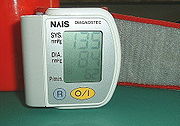
Image source: BP device used for measuring arterial pressure. Wikipedia, GNU Free Documentation License.

Thursday, June 10, 2010

18% tax on pizza and soda can decrease U.S. adults' weight by 5 pounds (2 kg) per year


Nearly a third of American children are overweight or obese. In our inner cities a prevalence of obesity of more than 50% is not uncommon. Too many calories in, too little energy out.

With two-thirds of Americans either overweight or obese, policymakers are increasingly looking at taxing as a way to address obesity on a population level.

The tobacco experience showed that education is not enough: regulation, litigation, and legislation are needed too. Increasing taxes on cigarettes has been the single most effective strategy in reducing smoking.

An important part of the obesity story is clearly the huge increase in consumption of sugar sweetened beverages (SSBs): carbonated sodas, sweet teas, energy drinks, flavoured water, and sports drinks. Their use has more than doubled in recent years.

"Sadly, we are currently subsidizing the wrong things including the product of corn, which makes the corn syrup in sweetened beverages so inexpensive."

Instead, the agricultural subsidies should be used to make healthful foods such as locally grown vegetables, fruits and whole grains less expensive.

Danish government imposed 25% tax on ice cream, chocolate, sweets, and will increase taxes on soft drinks, tobacco, alcohols to combat obesity, heart disease, and other illnesses. BMJ. http://goo.gl/ixc0

 Some pizzas are 'saltier than the sea' (NHS blog).

References:
Tax soda, pizza to cut obesity, researchers say | Reuters.
Image source: Soft drinks, Wikipedia, public domain.