Showing posts with label health reform. Show all posts

Monday, April 15, 2013

Beshear says he will decide in four to five weeks, or July 1 at the latest, whether or not to expand Medicaid

By Al Cross
Kentucky Health News
This story has been updated.

Gov. Steve Beshear said Monday that he will decide within the next four to five weeks, or maybe by July 1, whether to expand the Medicaid program under federal health-care reform.

Beshear, who has said he would expand Medicaid if the state can afford it, told reporters that he is considering other factors, which he did not name. He said his administration has not calculated the cost of expansion, which the state would not pay immediately.

The federal government pays about 71 percent of Medicaid's cost in Kentucky, and would pay the full cost of covering those newly eligible in 2014-16. The state would have to pay 3 percent in 2017, rising to 10 percent by 2020.

About 830,000 Kentuckians are covered by Medicaid, and at least 400,000 more could be added if Beshear expanded it to include households earning up to 138 percent of the federal poverty level, as required by the reform law.

Another possibility is that Beshear would seek approval from the federal government to use federal money to subsidize purchase of private health insurance by the poor, which has been approved in Arkansas but not in Tennessee.

The governor's office, asked if the administration was considering that option and what other factors Beshear is considering, has not responded had this response: "The governor is considering multiple issues as he determines whether Kentucky will expand Medicaid eligibility.  Along with affordability for the state, he is also looking at potential economic impact through jobs and investment created by possible expansion, as well anticipated changes in health outcomes for newly-eligible Kentuckians."

That is also the case with There has still been no response from Humana Inc., which does much of its business through government-financed health plans. The Louisville-based insurance company was asked if it has had discussions with the Beshear administration about the idea of a Medicaid expansion that would use federal money to buy, or subsidize the purchase of, private health insurance.

"Beshear said Monday that he is getting a lot of pressure from the medical field – particularly hospitals – to green-light the expansion," Beth Musgrave of the Lexington Herald-Leader writes. "Hospitals will lose additional money they receive through Medicaid on Jan. 1 as part of the Affordable Care Act. Hospitals in Ohio and other states have also put pressure on state governments to expand Medicaid rolls."

Beshear said, “I think they look at the expansion as a means to at least replace some of that (money) that they are going to lose.”

Many Republicans have opposed expansion, "saying that the state could not afford it," Musgrave writes. "The Republican-led state Senate passed a bill during the legislative session that would have required that the two-term Democratic governor get legislative approval before expanding the health care program. But the measure died in the Democratic-controlled House. Beshear could expand the program via executive order."

Beshear said today, “We have a very large uninsured population and we have a very unhealthy population. Anything that we can do — that we can afford — to make our population more healthy, I”m certainly in favor of doing.” He added, “We are looking long-term as well as short-term from a financial standpoint to see if it makes sense for us.”

While he said he would act within four to five weeks, Beshear gave himself some wiggle room, saying also that he would make the decision by July 1, the beginning of the state's fiscal year. (Read more)

Tuesday, April 9, 2013

Lawsuit alleges state health insurance exchange is unauthorized

Tea Party activist David Adams filed a lawsuit Monday challenging Gov. Steve Beshear's legal authority to create Kentucky's health insurance exchange without approval from the General Assembly. The governor created the exchange by executive order to offer health insurance plans for Kentuckians under federal health reform, but did not ask the legislature to approve it.

Adams claims state law requires the exchange to get legislative approval, and he seeks an injunction against it. The law allows the governor to temporarily reorganize units of state government and calls for them to be approved by the General Assembly.

Beshear's office says he exercised his constitutional authority to meet the requirements of federal law, reports Jack Brammer of the Lexington Herald-Leader.

Adams said in a telephone interview, "There is nothing in the constitution that allows him to set up a new bureaucracy that taxes, gains fees or spends money without legislative approval." He added, "This isn't about politics. It is simply about gubernatorial authority in the absence of legislative approval."

Kentucky has received about $250 million from the federal government to cover the initial costs of exchange, but Adams said that is being spent rather quickly and funds will be exhausted by 2014, he said. The state will be responsible for all funding for the exchange beginning in 2015; it plans to fund it with fees from participating insurance companies.

Kentucky is one of 17 states that the federal government approved to build its own exchange, which will be operated by the Cabinet for Health and Family Services and is expected to help insure more than 600,000 Kentuckians. (Read more)

Survey shows most rural doctors in Southern Kentucky aren’t ready for electronic health records; grant will help them switch

A recent survey found that 63 percent of rural health providers in Southern Kentucky have not installed electronic health records software, so more than 280 of the small and rural doctor practices surveyed could face financial penalties from Medicaid and Medicare if they do not install it by 2015. Federal grant money will help them make the switch.

Many rural Kentucky providers are near retirement and are deciding between making the necessary investment of capital and personnel that is required to make the switch to electronic records or to just close their practice, according to a release from Kentucky Highlands Investment Corp., which led the effort to get the grant

Decisions to close practices and to avoid using electronic health records could be problematic to rural areas in Kentucky, since the state already has doctor shortages, especially in rural areas. If the state expands the Medicaid program under federal health reform, the number of insured patients could increase much more than the number of physicians in Southern Kentucky, an area where many people are uninsured.

“Large hospitals in the region such as ARH, Baptist Regional and others have successfully installed this software, and they are using the system with quality results,” Richard Murch, an IT consultant who specializes in electronic health records and is working on the project, said in teh release. But he said the process is complicated and requires extra staff and resources that are sometimes difficult to find in the area.

The U.S. Department of Agriculture has funded a project called Stronger Economies Together to improve the biomedical and life-science practices in the region. SET plans to provide resources and training to help providers and health systems make a successful switch to electronic health records, which the release said could create about 100 jobs over the next few years.

The survey showed 73 percent of doctors’ practices have asked for help transferring to and using electronic records. “SET reviewed industry sector research to determine health care and health related businesses as the fastest growing business segment of our rural economy,” said Jerry Rickett, president and CEO of Kentucky Highlands. For more information about SET and its partner programs, click here.

Thursday, April 4, 2013

Confused or concerned about the impact of health reform on Kentucky businesses? There's a seminar for that.

To address possible confusion or concern of business people and the public about the Patient Protection and Affordable Care Act, or "Obamacare," health-care reform experts will address its impact on small and large companies across Kentucky at half-day seminars in Lexington and Louisville on May 8 and 9.

The Kentucky Health Care Reform Seminar will include specific discussions about expected cost increases and tax implications for businesses once reform is implemented, including the role of the health insurance exchange and the changing ways that coverage premiums will be determined. The seminar will be presented by The Iasis Group Inc., The Lane Report and the Kentucky Chamber of Commerce, says a chamber release.  

Guidance to employers will be provided on complying with the new rules surrounding insurance reforms and insight to whether Kentucky companies can truly afford it. The seminar is part of a statewide partnership that includes Commerce Lexington, Greater Louisville Inc., the Kentucky Society for Human Resource Management and the Northern Kentucky Chamber of Commerce (Click here for more details or to advance register)

Wednesday, April 3, 2013

UK Healthcare says it must get even bigger, and expand its market area, to provide needed services to Kentucky

By Molly Burchett and Al Cross
Kentucky Health News

The University of Kentucky's health-care system has grown by leaps and bounds in the last decade, becoming one of the state's largest businesses, but its boss says it must expand its geographical reach to maintain its newly raised national status and to ensure access to quality care for Kentuckians.

Over the last decade, UK HealthCare’s caseload has increased 85 percent, and its annual hospital budget has increased from $300 million to $922 million, Dr. Michael Karpf, executive vice president for health affairs, said in an interview.

This explosive growth, in addition to the growth of the UK medical school, has jacked up the enterprise's national ranking. It has grown from about the 85th largest academic hospital in the U.S. to approaching the 35th largest in terms of total discharges, the benchmark it uses. That means it has jumped from the bottom third to the top third in less than a decade. (For a more precise measurement over time, based on a Council of Teaching Hospitals standard, see chart.)


The push for growth and development began in 2003, after UK's caseload hit a plateau even though the 1998 General Assembly had mandated it to become a top 20 public research institution. Karpf came aboard and combined the Chandler Medical Center, clinics, faculty practice plans and the College of Medicine into a single integrated system of care -- branded as UK HealthCare -- which he commands. Good Samaritan Hospital in Lexington was added in 2007.

"Ten years ago people viewed this a safety-net hospital," Karpf said of the Chandler facility. "We've had to redo the brand." Now more people are choosing the hospital, as suggested by who's paying the bills. Medicare now covers a plurality of the patients; a decade ago, it trailed Medicaid, the program for the poor and disabled. In that time, the total caseload grew 7.2 percent; Medicare cases rose 10.9 percent.

But despite the huge growth in the last decade, the enterprise is still not big enough, Karpf said.

"We want the hospital to be the first choice when it comes to complex care,” he said. “We must advance to better serve the health-care needs of Kentucky.” To do this, he said, UK HealthCare is rejuvenating its brand as "Kentucky's Best Hospital," with a broad range of advanced specialties to keep Kentuckians from leaving the state for care, and is moving to expand its geographic reach to Western Kentucky and out-of-state markets.


Karpf said UK must expand because its traditional market, approximately the eastern half of the state, is not large enough to provide the number of cases that UK will need to receive certification as a federal “Center of Excellence” for complex services like brain surgery and heart, liver, kidney and lung transplantation. He said such a designation will be necessary to get enough referrals from doctors and smaller hospitals to maintain these services and to guarantee that Kentuckians can get the care they need inside the state. "What we make money on is the complex stuff," he said.

Unless UK secures half the available business from out-of-state competitive areas over the next 10 years, Karpf said, "It becomes an issue of access for Kentuckians."

He said the out-of-state institutions that are large and advanced enough to effectively compete with UK as a major referral center include Vanderbilt University, Washington University in St. Louis, Indiana University, Ohio State University, Cleveland Clinic, the University of Pittsburgh Medical Center and the University of Virginia. Vanderbilt is the nation's 10th largest academic medical center and gets many patients from Western and Southern Kentucky. 

UK HealthCare map shows out-of-state markets and institutions it targets for its expansion.
What about Louisville, Cincinnati, Knoxville and other cities? Karpf said the University of Louisville, the University of Tennessee, the University of Cincinnati and West Virginia University are too small and too far behind to be Centers of Excellence. U of L's hospital ranks 88th in total discharges among academic medical centers.

All hospitals are facing challenges from federal health-care reform, but Karpf said at UK it has prompted a culture change centered on quality of care, which the reform law is designed to reward. As UK tries to expand its market, he said, it is critical to stay focused on, safety, service and patient satisfaction. One issue Karpf is dealing with now is the hospital's cardiothoracic surgery program for children, which has been suspended pending an internal review.

As UK seeks more referrals, Karpf said, it is building better relationships with smaller hospitals. "in the past, academic medical centers have been seen as predatory," he said. "We concluded that we need to be seen as in another line of business. . . . We have very strong relationships with community hospitals in Western Kentucky."

For example, UK is  training a cardiologist who is dedicated to practicing in Paducah once his training is complete, and kidney specialists from the area are in its transplant network. The specialists evaluate patients, send them to Lexington for transplants, and provide follow-up care upon their return. Such coordination helps community hospitals keep patients and recruit professional staff, and helps UK capture the cases it might lose to Vanderbilt and other out-of-state hospitals.

Baptist Hospitals Inc. has a large facility in Paducah and recently bought the Trover Health System hospital in Madisonville, making Baptist the largest hospital system in Kentucky, but Karpf said UK has a strong relationships with Baptist and the Norton Healthcare hospitals in Louisville. "They do not compete with us for complex care," he said. "We don't go after the bread-and-butter cases."

Complex care, for which insurance companies pay well, accounts for 5 to 7 percent of UK's cases but almost all its profits. Karpf said UK loses money on another 5 to 7 percent and breaks about even on the rest. He said the profits are invested in buildings, technological equipment and attracting nationally recognized specialists.

The most visible evidence of that is the hospital's new bed tower, part of $1.4 billion UK Healthcare has spent revitalizing itself, mostly with its own profits. But the larger impact is probably in expansion of good-paying jobs.

Dr. Michael Karpf
"We've been the most important growth engine in this region," said Karpf. UK HealthCare went from paying $350 million in salaries and benefits in 2004 to more than $700 million last year. The College of Medicine went from 1,810 employees in 2004 to 2,337 in 2012. The hospital grew from 2,562 full time employees in 2004 to 5,544 in 2012, a 116 percent increase.

The medical school's full-time faculty has expanded from 443 a decade ago to 625 now. "We know the stronger you are clinically, the better your research profile," Karpf said. UK Healthcare hopes to achieve National Cancer Institute designation for the Markey Cancer Center, and it must continue to evolve in its clinical, education and research missions, Karpf said.

If UK HealthCare can do that, it will continue to be a major economic driver for Kentucky while ensuring that all Kentuckians have access to quality care.

Kentucky Health News is an independent news service of the Institute for Rural Journalism and Community Issues at the University of Kentucky, with support from the Foundation for a Healthy Kentucky.

Monday, March 25, 2013

Newly formed Kentucky Health Cooperative gets OK to offer plans in state's health insurance exchange

The new Kentucky Health Cooperative's health-insurance plans have received approval from the state Department of Insurance and will be available on Kentucky's insurance exchange market when it opens in October.

“This is a red-letter day for Kentuckians,” Janie Miller, CEO of the cooperative, said in a news release. “Although health-care cooperatives have offered quality care and lower overhead expenses to members since the 1930s, they’re the ‘newest kid’ on Kentucky’s health insurance block. Efforts are underway to help the public become familiar with the cooperative concept.” The cooperative was formed with a mixture of private capital and federal loans.

Miller, a former secretary of the state Cabinet for Health and Family Services, said the cooperative is like member-owned and member-operated credit unions, rural electric cooperatives and food co-ops. “Think agriculture cooperative extension offices, and consider the impact such organizations have made,” she said. “Doing so makes it easy to imagine the potential, similar value to the citizens of our Commonwealth offered by a health cooperative.”

Joe Smith, chair of the cooperative's board of directors, said “A gateway has been opened to individuals and small businesses seeking more affordable, consumer-friendly, quality-driven health insurance options.”

Details about the cooperative plans offered to individuals and businesses with 50 or fewer employees on the nw state insurance exchange will be announced in the coming months. (Read more at the KYHC website)

Monday, March 11, 2013

Survey finds employees pay greater share of health costs, and most large employers penalize them for using tobacco

As large employers respond to changes influenced by health care reform and rising costs of care, employees are paying a greater portion of their health-care costs. That trend that is likely to continue over the next few years, says a new report on employer-based health plans.

Although employers cover most costs of work-based plans, employees contribute 42 percent more for health coverage than they did five years ago, while employers paid 32 percent more, according to the study from the benefits consultant Towers Watson and the National Business Group on Health. Overall, costs went up 34.4 percent.

When employers were asked if they thought health plans would change by 2018, which is the year the excise tax on high-cost plans takes effect, 92 percent said plans would be different, and nearly half said they expect a significant or transformative change. Such change will increase both accountability and engagement for employees.
% of large employers saying they were "very confident" they would offer health benefits in 2022
Nearly two-thirds of employers surveyed offer employees financial rewards to encourage participation in health programs, according to the report, which said tying employee contributions to successful completion of specific tasks, such as health assessments and screenings, remains the most popular contribution strategy. Growth in the use of penalties to engage employees in health-program participation has slowed over the last two years, but the use of surcharges for tobacco use continues to grow. By 2014, 62 percent of surveyed companies are expected to apply tobacco-use surcharges.

"While U.S. employers remain committed to health care benefits for active employees over the next five years," the report says, "they are redifining their financial commitment in the short run and are more reluctant to commit to coverage for employees over a longer period."

The 18th annual Towers Watson/National Business Group on Health Employer Survey on Purchasing Value in Health Care tracks employers' strategies and practices. It was completed by 583 employers,between November 2012 and January 2013. The report says it identifies the actions of the best performing companies as well as current trends in health-care benefit programs of U.S. employers with at least 1,000 employees. Survey respondents collectively employ 11.3 million full-time employees and have 8.5 million employees enrolled in their health care programs. Download a report PDF by clicking here.

Thursday, March 7, 2013

Commission says drastic changes to doctor pay and cuts to wasteful services can fix Medicare problem without tax hikes

A national advisory panel says “drastic changes” in how Medicare reimburses doctors and other providers are needed to shore up Medicare's finances, improve patient outcomes and rein in health care costs, and there is no need to seek more taxpayer money.

Medicare needs $138 billion over the next decade to avoid steep cuts in physician pay, and avoiding those cuts has become an annual scramble in Congress known as "the doc fix."  A panel dominated by internal-medicine specialists, The National Commission on Physician Payment Reform, has concluded that reduction of wasteful medical services can help solve the problem and "our nation cannot control runaway medical spending without fundamentally changing how physicians are paid," it says in its report.

Source: Henry J. Kaiser Family Foundation and Congressional
Budget Office
, Budget and Economic Outlook, January 2011

The U.S. spends nearly $3 trillion a year on health care, and that level of spending is unsustainable. The report says that as a proportion of the federal budget, the cost of Medicare has risen from 3.5 percent in 1975 to 15.1 percent in 2010 in 2010). In 2020, it is projected to consume 17 percent, or 4 percent of the U.S. gross domestic product.

Recognizing the way that physicians are paid contributes substantially to the high cost of health care, The Society of General Internal Medicine convened the commission in March 2012 to make recommendations for payment reform. According to the report, some of the factors that drive up health care expenditures are:
  • Fee-for-service reimbursement
  • Consolidation in the health-care industry
  • Reliance on technology and expensive care
  • Reliance on a high proportion of specialists
  • Paying more for the same service or procedure when done in a hospital setting as opposed to an outpatient setting
  • A disproportionate percentage of health care spending directed to a small number of people who are very sick and costly to treat
  • High administrative costs
  • Fear of malpractice lawsuits
  • Fraud and abuse
The commission says increased taxes are not needed to fix the Medicare problem, and the Medicaid shortfall could be entirely found by reducing overuse of services within Medicare. See the chart to the right for a breakdown of those excess medical costs.

The commission developed 12 recommendations to reduce health costs, calling for drastic changes to the current fee-for-service payment system and a five-year transition to a physician payment system that rewards quality and value-based care and not the volume of care.

The 12 recommendations were based on the principles that payment reform should improve care quality and efficiency, encourage care for the medically disadvantaged, reduce marginal and ineffective services, increase transparency to the public and should reward patient-centered comprehensive care. (Click here to see those recommendations)

Friday, February 22, 2013

If Republican governors are agreeing to expand Medicaid after lobbying by hospitals, can Beshear be far behind?

By Al Cross
Kentucky Health News

Florida Gov. Rick Scott's surprising announcement that he would use federal health-care reform money to expand the Medicaid program to households earning up to 138 percent of the poverty level "means the dominoes are falling," says Ron Pollack, executive director of Families USA, a consumer group that lobbied for the law. And another domino seems likely to be Democratic Kentucky Gov. Steve Beshear, without involvement by the state legislature.

Beshear has said he will expand Medicaid if Kentucky can afford it, and has mentioned that the state can reserve the right to pull out of the deal in 2017, when it must start paying a small but increasing share of the cost, reaching 10 percent in 2020. Scott used the same qualification.

Pollack told The New York Times that the message sent by seven Republican governors' acceptance of the deal is  “Even though I may not have supported and even strongly opposed the Affordable Care Act, it would be harmful to the citizens of my state if I didn’t opt into taking these very substantial federal dollars to help people who truly need it.” The GOP governors (of states outlined in Times map below) have said they will expand the program partly to protect rural hospitals and the poor.

"The change of heart for some Republican governors has come after vigorous lobbying by health industry players, particularly hospitals," the Times notes. "Hospital associations around the country signed off on Medicaid cuts under the health care law on the assumption that their losses would be more than offset by new paying customers, including many insured by Medicaid. . . . Every few days, state hospital associations and advocates for poor people issue reports asserting that the economic benefits of expanding Medicaid would outweigh the costs." (Read more)

Kentucky Hospital Association President Michael Rust said the trade group is for "universal coverage" by whatever means but is not lobbying Beshear for Medicaid expansion. "We assume he is" going to expand it, Rust said in an interview today. He said the association has not taken a position on bills that would require legislative approval of expansion and the health-insurance exchange being set up under the reform law. The legislation, Senate Bill 39 and SB40, passed the Republican-controlled Senate on party-line votes today, and are expected to die in the Democratic-majority House.

Senate Majority Floor Leader Damon Thayer said the bills were aimed at reining in "big daddy government." Here's a video from cn|2:

Kentucky Health News is an independent news service of the Institute for Rural Journalism and Community Issues at the University of Kentucky, with support from the Foundation for a Healthy Kentucky.

Monday, February 18, 2013

Herald-Leader says state running out of time to fix Medicaid managed care, with decision on expansion looming

A recent editorial in the Lexington Herald-Leader called for swift legislative action to fix the problems of Medicaid managed care. Timely action is even more necessary since the state is considering expanding the program, some critics have said.

Fifteen months ago the administration of Gov. Steve Beshear made a quick transition to managed care that privatized Medicaid for 550,000 poor, elderly and disabled people and was projected to save Kentucky $375 million in three years.  If the state expands Medicaid, that number of covered individuals could grow to more than 1 million — or roughly a quarter of all Kentuckians.

Although Medicaid is encouraging preventive care, such as more well-child visits and diabetes testing, providers haven't been paid for some of their services. The state recently granted the managed care companies a seven percent rate increase, and the companies have said they're losing money here and one is pulling out in July. But at the end of the first eight months of managed care Medicaid, the state had paid $500 million more to the companies than the companies had paid to providers.

"The delay and denial of payments are creating financial crises for providers and pharmacies and forcing small hospitals to lay off employees, deplete reserves and default on bonds," the editorial said. "This is creating a massive transfer of wealth from Kentucky medical practices and hospitals to for-profit companies based in other states. . . . For patients, the companies are putting up barriers to care that would be illegal in the private sector. The new burdens that have been placed on vulnerable Kentuckians and their medical providers threaten to unravel not just the safety net but, in some places, the whole health care system."

The editorial called on the General Assembly to pass legislation to curb abuses such as "the stiffing of hospitals that provide emergency care as required by federal law. . . . House Bill 299 and Senate Bill 178 would also curb the false economy of severely limiting in-patient mental-health care for children while referring them to nonexistent out-patient care."

The legislation would also require Medicaid managed care companies to:
  • Meet the same provider network standards, including distance to hospitals and obstetrical care, as other insurers operating under Kentucky law.
  • Decide claims based on nationally recognized clinical standards and provide specific reasons for denials so providers would know what's allowable.
  • Participate in an appeals process for denied claims.
Appalachian Regional Healthcare wants to sue the U.S. Department of Health and Human Services and others, alleging that the new system is out of compliance with federal law.

"The feds shouldn't have to be dragged in," the editorial says. "The federal government covers roughly 70 percent of Kentucky’s $6 billion Medicaid program. Expanding Medicaid to include more low-income people is a linchpin of federal health care reform," and Beshear has said that he wants to expand Medicaid if the state can afford it. "Kentucky can't wait much longer to get Medicaid right." (Read more)

Wednesday, February 13, 2013

Frontier Nursing University in Hyden helps bring better family health care to rural America with distance learning

Midwives and nurse practitioners who recently graduated from Frontier Nursing University in Hyden address the unique challenges of rural areas, including shortages of health care providers, by bringing local health care to rural communities across the country. FNU was featured in a recent report from the Robert Wood Johnson Foundation.

FNU, a graduate program that offers distance education to nurses with an interest in nurse-midwifery and family nurse practitioner and women’s health specialties, aims to build a pipeline of highly educated nurses serving in rural or underserved areas, reports RWJF, one of its funders.  Many scholars and grantees sponsored by RWJF go on to spearhead projects to improve access to high quality nursing care in remote areas, the foundation says.

“We’re trying to introduce primary care providers into rural areas in such a way that they can provide high quality care and preventive services too,” says Suzan Ulrich, associate dean of midwifery and women’s health at FNU and an RWJF executive nurse fellow.

Demand for health care is rising nationwide because of an aging population that is living longer, but sicker, with multiple chronic conditions. The need for health care providers will intensify next year, when millions of new patients will become eligible for health insurance under the health-reform law.

Rural parts of the country face unique challenges and shortages of health providers, including nurses, can be particularly acute in rural areas, said Alan Morgan, CEO of the National Rural Health Association. These nurses and other providers have less access to education programs, which tend to be located in more densely populated areas. Programs that offer advanced degrees, from the baccalaureate to the doctorate, can be especially difficult to access for students living in rural areas, according to RWJF.

Identifying and educating nurses from rural areas is a key goal of FNU, which offers distance education programs that enable students to remain in their home communities and a “bridge” program that allows nurses with associate’s degrees to move more easily into master’s and doctorate programs. “These students really love where they live,” Ulrich said. “If we can educate them to stay within their communities, then those communities are going to have a provider who’s going to be there a long time." (Read more)

Wednesday, February 6, 2013

Physician assistants and some doctors urge lawmakers to pass bill that could ease provider shortage in rural Kentucky

Doctors and more than 150 physician-assistant students urged lawmakers Tuesday to pass a bill they stated involves dropping only one requirement in the law and could ease a physician shortage in Kentucky, reports Ryan Nick of cn|2's "Pure Politics."

Passage of Senate Bill 43 would repeal a law that allows physician assistants to treat patients only when a supervising physician is on site for the first 18 months after their certification. If passed, PAs would still be supervised but would be permitted to perform services in a location separate from the supervising physician, as long as that physician can be reached by phone at all times.

No other state requires PAs to have 18 months of on-site supervision. Colorado, the state with the next-longest mandate, requires supervision only for the first 1,000 hours after certification.

The bill's supporters say the burdensome supervision requirement has led to 55 out of Kentucky's 120 counties being medically underserved and has encouraged many PAs to practice in other states, reports Storm. They also say this rule needlessly complicates patient care, especially in rural areas where doctors are stretched thin, reports Melinda Beck of The Wall Street Journal.

The bill's sponsor, Sen. Tom Buford, R-Nicholasville, told Kentucky Health News that he expects the Kentucky Medical Association to seek some changes in the bill, but also expects it to pass because Senate Republican leaders, hospitals and universities support it. "We're educating these PAs at a lot of state expense just to work in other states," he said. House Speaker Greg Stumbo, D-Prestonsburg, told Storm he sees no reason why the bill shouldn't pass. Sen. Julie Denton, R-Louisville, chair of the Senate Health and Welfare Committee, told KHN that she supports the bill.

PAs are expected to be in even greater demand when the health-care reform law brings hundreds of thousands of Kentuckians into the health-insurance system. Beck notes the state is expected to face a greater shortage of physicians, particularly in primary care and rural areas. Buford said, "We're going to provide all this health care for everybody, and there's nobody to go see." For more from cn|2, including video interviews, click here.

Tuesday, February 5, 2013

Kasich of Ohio is fifth Republican governor to accept Medicaid expansion; he and others cite need to protect rural hospitals, poor

Several Republican governors have decided to expand Medicaid under federal health-care reform, saying their conservative principles were outweighed by a need to protect their state's rural hospitals and low-income people. Yesterday, the governor of one of the biggest states got on the bandwagon.

John Kasich of Ohio joined Jan Brewer of Arizona, Brian Sandoval of Nevada, Susana Martinez of New Mexico and Jack Dalrymple of North Dakota in saying they will take heavy federal subsidies to expand the program to households with incomes up to 138 percent of the federal poverty threshold.

Democratic Gov. Steve Beshear of Kentucky has said he wants to expand Medicaid if Kentucky can afford it, and he expects to get cost estimates around the end of March.

While Kasich is not an "Obamacare" supporter, he said expanding Medicaid “makes great sense for Ohio” because it would save $235 million over the next two years and free about $100 million in local funds for mental-health and addiction services, reports The Columbus Dispatch.

Kasich said the decision could extend health coverage to as many as 578,000 uninsured Ohio residents, and could keep everyone else’s health insurance premiums down because there won’t be so many uninsured people going to emergency rooms for their medical care, reports David Nather of Politico.

Kasich emphasized that he would like to see the 2010 law repealed, but the federal money it would pump into the state — about $13 billion over the next seven years — was too much to pass up, reports Stateline. The federal government will pay the full cost of expansion through 2016; then  states will have to pitch in, rising to a limit of 10 percent by 2020.

Brewer likewise said it doesn't make sense for Arizona to pass up federal dollars, reports Howard Fischer of the Arizona Daily Sun. "We will protect rural and safety-net hospitals from being pushed to the brink by growing their cost in caring for the uninsured," Brewer said. She also said the expansion will create enormous economic benefit, inject $2 billion into the Arizona economy, save and create thousands of jobs and provide health care to hundreds of thousands of low-income individuals, reports Fischer.

Brewer said going along with expansion will save Arizona money because the costs of providing care to the uninsured are not simply absorbed by hospitals but passed along through increased insurance premiums. Supporters of the expansion hope the five Republicans' decisions will prompt more GOP governors to follow suit. Twenty governors from both political parties are still undecided. (Read more)


Friday, January 25, 2013

Health reform will let insurers charge smokers up to 50 percent higher premiums, which is likely to have a big impact in Kentucky

"Millions of smokers could be priced out of health insurance" because the health-care reform law will let health-insurance companies charge smokers as much as 50 percent more starting next year on individual policies, according to experts who are just now teasing out the potential impact of a little-noted provision in the massive legislation," The Associated Press reports.

The provision is likely to have a major impact in Kentucky, where 29 percent of adults are smokers, a figure exceeded by no other state, and where 25 to 30 percent of people under 65 are estimated to have no health insurance.

"For a 55-year-old smoker, the penalty could reach nearly $4,250 a year" AP reports. "A 60-year-old could wind up paying nearly $5,100 on top of premiums. Younger smokers could be charged lower penalties under rules proposed last fall by the Obama administration."

A state health insurance exchange, now being created under the law, will be a place to buy insurance with tax credits depending on income. Gov. Steve Beshear has said he wants to expand the state Medicaid program to cover people in households with incomes up to 138 percent of the federal poverty level, but many Republicans in the legislature are opposed to that because the state would ultimately have to pay 10 percent of the expansion's cost.

The provisions to discourage smoking would allow employees covered by employer plans to avoid penalties by joining smoking-cessation programs,"but experts say that option is not guaranteed to smokers trying to purchase coverage individually," AP reports.

There is concern about the provision's effect on older smokers who "could face a heavy hit on their household budgets at a time in life when smoking-related illnesses tend to emerge. . . . Several provisions in the federal health care law work together to leave older smokers with a bleak set of financial options," AP reports, citing Karen Pollitz, a health-insurance expert with the Kaiser Family Foundation and former deputy director of the Office of Consumer Support in the U.S. Department of Health and Human Services.

Pollitz notes that the reform law lets insurers charge older customers up to three times as much as their youngest customers; charge the full 50 percent penalty on older smokers while charging less to younger ones; and does not allow smokers to use tax credits to offset the cost of the penalty.

And there's a good argument to charge the full penalty, insurance consultant Robert Laszewski told AP: "If you don’t charge the 50 percent, your competitor is going to do it, and you are going to get a disproportionate share of the less-healthy older smokers,” said Laszewski. “They are going to have to play defense." (Read more)

Wednesday, January 2, 2013

Health reform drives hospital mergers and affiliations, and makes clinical collaborations more important

Is your community's hospital one of the many rural hospitals considering sale, merger or affiliation with a larger hospital or group of hospitals, all options that are becoming more common, partly due to federal health-care reform? A recent article in HealthLeaders magazine, which examines some of the considerations, may inform your coverage.

Basing decisions on past experiences "is difficult because the creativity surrounding partnerships among hospitals and health systems is expanding rapidly," writes Philip Betbeze, the magazine's senior leadership editor. For example, clinical collaborations have become more important in affiliations. "Whether they own or don't own each other doesn't matter as much as coming up with a structure for sharing those value-based purchasing points together," Joseph R. Lupica, chairman of Newpoint Healthcare Advisors, told Betbeze, who writes: "That's a sea change compared to prior affiliations or mergers. In the past, such deals were driven by traditional aims around increasing market share and increasing bargaining power."

Health reform will create incentives for better patient outcomes, which upsets the old "iron trangle" of hospitals: "volume, rates, and the ability to decrease unit costs," said Dr. Gregg Meyer, chief medical officer of Dartmouth-Hitchcock, a New Hampshire hospital group that recently affiliated with the Mayo Clinic, more than 1,000 miles away, "because we know that patients who come to us for care will often seek a second opinion. In the past, that meant going to Boston or New York, and we lost out on that because we lost the ability to keep that care local. Now we can have a virtual second opinion with arguably the most famous health system in the world."

The article has several more examples. to read it, click here.

Chart shows how to get coverage under federal health reform

The core of the Patient Protection and Affordable Care Act is helping people get health insurance, beginning next year. That will be relatively simple for some people, but complicated for others, as this infographic produced by the Kaiser Family Foundation for the Journal of the American Medical Association shows. For a larger, clearer, PDF of the chart, click here. In most states, including Kentucky, a key question remains unanswered: Will the state opt to expand Medicaid eligibility to households with incomes up to 133 percent of the federal poverty level (138 percent with a fudge factor)?


Wednesday, December 19, 2012

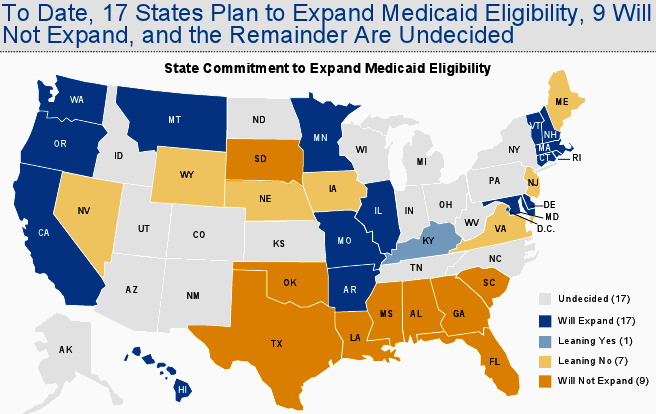
Feds tell states it's all or nothing on Medicaid expansion; Washington Post map shows Ky. is only state 'leaning' toward it

By Al Cross
Kentucky Health News

When the Supreme Court upheld federal health reform but said states could opt out of the expansion of Medicaid to people with incomes above the poverty line, to be funded with generous federal subsidies, one of the first questions was whether a state had to go all the way: to 133 percent of poverty (138 percent with an official fudge factor). Now the Obama administration has answered "no." And that could make the decision tougher for Kentucky, which is the only state The Washington Post listed this month as leaning toward expansion.


The Post's Sarah Kliff wrote, "The administration’s reasoning goes like this: The federal government was giving states a really, really good deal on the Medicaid expansion. It was footing the entire bill for the newly eligible enrollees for three years," 2014 through 2016, rather than the 72 percent it pays Kentucky for current enrollees. The subsidy for the new eligibles would drop to 95 percent in 2017, 94 percent in 2018, 93 percent in 2019; and 90 percent in 2020.

White House aides told Kliff that in passing the bill, Congress (which is to say the Democrats in Congress) "gave states that really high funding in the service of a very specific goal: Ensuring all Americans have access to insurance options." But "If a state decided to cover, say, everyone up to the federal poverty line, they would be working with a smaller, more manageable population," Kliff explains. "Those living above the poverty line, meanwhile, wouldn’t be left in the lurch. The Affordable Care Act allows them to receive very generous subsidies in the private insurance market."

However, Medicaid Administrator Cindy Mann told Kliff that if states could fall short of the 133 percent level, they wouldn’t be within the spirit of the law. Kliff paraphrases Mann: "They wouldn’t offer all their residents a way to purchase affordable coverage, and if they’re not going to do that, the White House says they don’t deserve the extra funding."

Gov. Steve Beshear said again today that Kentucky should expand Medicaid "if we can afford it" because so many people in the state have no health insurance and are in poor health, and improving their health would be good for the state's economy.

Kentucky now makes Medicaid available to people with household incomes below 70 percent of the poverty line, which varies by household size. The Urban Institute has estimated that expanding the program to 133 percent of poverty would cost the state about 5 percent more than it would otherwise spend through 2022. That would be $1.3 billion extra in 2017-22, and some Republicans in the legislature have said the state can't afford it. The state expects to spend $1.5 billion on Medicaid in the 2013-14 fiscal year.

While the Post lists Kentucky as the only state "leaning yes" to expansion, it seems likely to be joined by several others. "States have stayed mum on whether they will participate in the expansion, seeing first if they could get a better deal — the partial expansion," Kliff writes. "The federal government took a while to show its cards; it wanted to see if states would sign up for the full expansion, without giving them a scaled-back option." Only 17 states have said yes, and as many are undecided, the Post reports.

In setting a firm rule, the White House may think states "will decide the 100 percent match is too good to pass up and that the federal money will pull everyone in," Kliff writes. "Or, it could indicate the Obama administration is okay with not all states participating with the Medicaid expansion on day one. Again, this wouldn’t be unprecedented: Only six states initially signed up for Medicaid when it launched in 1965."

States should realize that expanding Medicaid is a long-term investment in the health of their people that will pay off in the long run, Dr. Wayne Myers, who once ran Kentucky's rural-health office and was the first director of the federal Office of Rural Health Policy, writes in the Daily Yonder. He says that if a state doesn't expand Medicaid, many of its people will remain or become uninsured.

"Medicaid is a rural issue because a higher percentage of low-income people live in rural communities, and rural families are less likely to have private health insurance," Myers writes, adding that the program is also "a major economic driver." According to the National Center for Rural Health Works at Oklahoma State University, Medicaid was responsible for 113,000 jobs and a total of $10.5 billion in economic activity in Oklahoma in 2010.

Myers cites studies showing that patients with insurance who are hospitalized after accidents are 40 percent less likely to die than those without insurance, because uninsured patients got less attention from medical staff. Opting out of the expansion "may get a governor a self-inflicted gunshot wound to the foot, some dead hospitals and a bunch of dead citizens who needn't have died," Myers writes.

Kentucky Health News is a service of the Institute for Rural Journalism and Community Issues at the University of Kentucky, with support from the Foundation for a Healthy Kentucky.

Tuesday, December 4, 2012

American Lung Association calls state's tobacco-cessation benefit inadequate now that Medicaid is under managed care

Kentucky added a robust tobacco cessation benefit to its Medicaid program, only to lose much of it in 2011 by putting the program under managed care by insurance companies, the American Lung Association notes in its annual report. Not only do their plans offer fewer treatments, explained the report, but information was confusing to patients and healthcare providers alike. The report also notes that the state -- which is not alone in this -- offers its smokers who desire to quit inadequate access to medications and counseling.

Robert Preidt of HealthDay reports that the U.S. Department of Health and Human Services late last month published a proposed rule that requires tobacco cessation as an essential health benefit under the Patient Protection and Affordable Care Act. The lung association report how states could put that rule to maximum use. "Giving all smokers access to a comprehensive cessation benefits is not only the right thing to do, it's the smart thing to do," Billings said. "The bottom line is that quitting smoking saves lives and saves money." One recent study, reports Preidt, showed that providing smokers with help to quit has a three-to-one return on investment, meaning $3 is saved for every for $1 spent. (Read more)

To see more about how Kentucky's tobacco cessation coverage rates, according to the American Lung Association, go here.

Friday, October 26, 2012

Health care is strong second to economy among concerns of Ky. registered voters; candidates compared on handling of issues

Health care ranks high among the concerns of Kentucky voters, according to the latest Kentucky Health Issues Poll taken for the Foundation for a Healthy Kentucky.

The poll, taken Sept. 20 through Oct. 14, asked registered voters to name the two most important issues in the Nov. 6 presidential election. The economy was mentioned by 65 percent; health care was second, with 42 percent. Foreign policy was a distant third, at 21 percent. The error margin on the sample of 1,160 voters is plus or minus 2.88 percentage points.

The poll did not ask voters whom they favored for president, but did ask which candidate they trusted to do a better job on certain issues. Romney, who is considered certain to win Kentucky, had a clear advantage on two issue areas, listed first:
• Dealing with the federal budget deficit: Romney 49%; Obama 36%
• Dealing with the economy and jobs: Romney 48%; Obama 36%
• Dealing with the future of the health reform law: Romney 45%; Obama 40%
• Addressing terrorism: Romney 43%; Obama 42%
• Dealing with the situation in Afghanistan: Romney 42%; Obama 40%
• Improving education: Obama 45%; Romney 40%
• Looking out for the best interests of women: Obama 42%; Romney 40%
• Making decisions about women's reproductive health choices and services: Obama 41%; Romney 38%

"This poll gives us a reliable snapshot of the issues most important to Kentucky voters as they decide who they will vote for on Nov. 6," said Dr. Susan Zepeda, president/CEO of the foundation. "Regardless of the outcomes of the election, our foundation believes it is essential for our elected officials to know what Kentuckians think about these issues." To download the full report by the Institute for Policy Research at the University of Cincinnati, click here.

Thursday, October 25, 2012

Association of Health Care Journalists' reporting fellowship application deadline is Nov. 9

The Association of Health Care Journalists is offering fellowships for reporting on health care performance to journalists who wish to pursue a significant year-long reporting project related to the U.S. health care system. It can be local or national in scope -- or a little of both, according to materials included with the announcement, which suggests a topic could be "an aspect of the Patient Protection and Affordable Care Act playing out in your community or subject specialty, or the impact of particular evidence-based treatments on health outcomes, or an analysis of a health care organization’s performance, using public data sets."

Newsrooms for which the fellows work need to commit to publish or air their work. Freelancers will also need to have that commitment from a news source. Guidance is provided by AHCJ fellowship leaders through seminars on health care systems, conference calls and email consultations. The fellowship covers the cost of attending the seminars and conferences, and a project allowance is available. Application deadline: Nov. 9, 2012. (Read more)

Here are some examples of the work done by those awarded fellowships in 2012: