Showing posts with label poverty. Show all posts

Monday, April 15, 2013

Beshear says he will decide in four to five weeks, or July 1 at the latest, whether or not to expand Medicaid

By Al Cross
Kentucky Health News
This story has been updated.

Gov. Steve Beshear said Monday that he will decide within the next four to five weeks, or maybe by July 1, whether to expand the Medicaid program under federal health-care reform.

Beshear, who has said he would expand Medicaid if the state can afford it, told reporters that he is considering other factors, which he did not name. He said his administration has not calculated the cost of expansion, which the state would not pay immediately.

The federal government pays about 71 percent of Medicaid's cost in Kentucky, and would pay the full cost of covering those newly eligible in 2014-16. The state would have to pay 3 percent in 2017, rising to 10 percent by 2020.

About 830,000 Kentuckians are covered by Medicaid, and at least 400,000 more could be added if Beshear expanded it to include households earning up to 138 percent of the federal poverty level, as required by the reform law.

Another possibility is that Beshear would seek approval from the federal government to use federal money to subsidize purchase of private health insurance by the poor, which has been approved in Arkansas but not in Tennessee.

The governor's office, asked if the administration was considering that option and what other factors Beshear is considering, has not responded had this response: "The governor is considering multiple issues as he determines whether Kentucky will expand Medicaid eligibility.  Along with affordability for the state, he is also looking at potential economic impact through jobs and investment created by possible expansion, as well anticipated changes in health outcomes for newly-eligible Kentuckians."

That is also the case with There has still been no response from Humana Inc., which does much of its business through government-financed health plans. The Louisville-based insurance company was asked if it has had discussions with the Beshear administration about the idea of a Medicaid expansion that would use federal money to buy, or subsidize the purchase of, private health insurance.

"Beshear said Monday that he is getting a lot of pressure from the medical field – particularly hospitals – to green-light the expansion," Beth Musgrave of the Lexington Herald-Leader writes. "Hospitals will lose additional money they receive through Medicaid on Jan. 1 as part of the Affordable Care Act. Hospitals in Ohio and other states have also put pressure on state governments to expand Medicaid rolls."

Beshear said, “I think they look at the expansion as a means to at least replace some of that (money) that they are going to lose.”

Many Republicans have opposed expansion, "saying that the state could not afford it," Musgrave writes. "The Republican-led state Senate passed a bill during the legislative session that would have required that the two-term Democratic governor get legislative approval before expanding the health care program. But the measure died in the Democratic-controlled House. Beshear could expand the program via executive order."

Beshear said today, “We have a very large uninsured population and we have a very unhealthy population. Anything that we can do — that we can afford — to make our population more healthy, I”m certainly in favor of doing.” He added, “We are looking long-term as well as short-term from a financial standpoint to see if it makes sense for us.”

While he said he would act within four to five weeks, Beshear gave himself some wiggle room, saying also that he would make the decision by July 1, the beginning of the state's fiscal year. (Read more)

Thursday, March 28, 2013

Will Kentucky expand Medicaid, and if so, how?

By Molly Burchett
Kentucky Health News

Kentucky is one of the last states to decide whether to expand Medicaid under federal health reform, and now that the General Assembly has gone home, Democratic Gov. Steve Beshear can turn his attention to the many questions that linger. Some Republican legislators think he will expand the program, but they worry about the cost when the state would have to start helping cover the new expenses, beginning in 2017.

Republican Gov. Bill Haslam of Tennessee decided Wednesday that he will not pursue Medicaid expansion, saying that it could put hospitals in financial jeopardy by giving them more patients on which they lose money, reports Michelle Kaske of Bloomberg. If he is right and the same logic applies to Kentucky, Medicaid expansion in the state could harm the rural hospitals and providers -- some of whom are already squeezed by the issues with the new managed-care system.

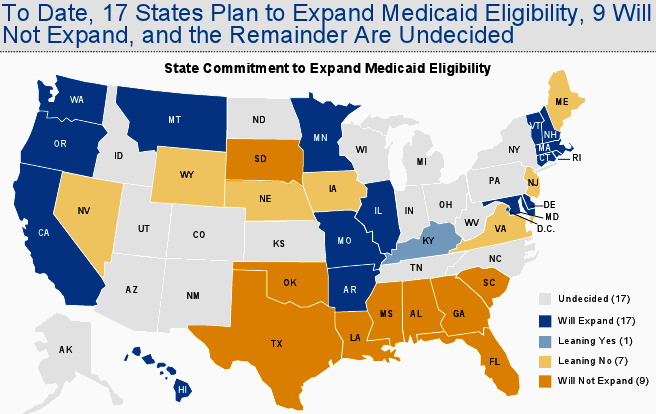
Along with Kentucky, 10 other states are undecided about Medicaid expansion: Alaska, Indiana, Kansas, Nebraska, New York, Oregon, Utah, Virginia, West Virginia and Wyoming. The map by The Advisory Board Company shows the lay of the land; for an interactive picture that outlines the research behind the map, click here.
Red=Not participating; Pink=Leaning toward not participating;
Gray=Undecided; Blue=Participating; Light Blue=Leaning toward participating
Only three states with Democratic governors are undecided; 18 Republican governors have rejected expansion. Kentucky is shown as leaning for it because Beshear has repeatedly said that he will expand Medicaid if the state can afford it. He has also mentioned that the state can reserve the right to pull out of the deal in 2017, when it must paying 3 percent of the cost of covering the newly insured, reaching 10 percent in 2020. Still, the questions about cost and affordability remain, and Beshear could be considering another option.

Tennessee has joined Ohio and Arkansas in negotiating with the Obama administration over plans to use federal Medicaid money to purchase private insurance for those who can't afford it but don't qualify for Medicaid now. However, Haslam's plan has been held up because the administration placed too many conditions on the money, writes Kaske. Republicans in other states, including Florida, Louisiana, Pennsylvania and Texas, have expressed interest in this option since Gov. Mike Beebe of Arkansas, a Democrat, ignited the wildfire of creating a hybrid of the two alternatives, reports Robert Pear of The New York Times.

The idea of privatizing Medicaid expansion appeals to many doctors and hospitals because they typically receive higher payments from commercial insurance than from Medicaid. However, many Kentucky hospitals and providers are concerned about the managed-care program that is run by three private organizations, and are calling for immediate action. Beshear has not said whether he will sign or veto a bill that would subject the managed-care firms to the prompt-payments and dispute-resolution rules of the state Department of Insurance.

"Action is needed to address the problems that patients and hospitals are experiencing with Medicaid managed care and to make the system work properly," wrote Harold "Bud" Warman, chair of the Kentucky Hospital Association, and Charles Lovell, chair-elect of the association, in a recent Herald-Leader article that laid out the various problems with the system. "And with the possibility that Medicaid will be expanded in Kentucky to include an additional 350,000 people, it is critical that these issues be addressed right away to avoid even greater problems in the future."

Either using federal dollars to buy private insurance in order to cover newly qualified individuals (the hybrid plan) under the health law's expansion  or expanding in the "traditional" way will not change the current managed care structure of Medicaid in Kentucky. Yet, it would mean that 350,000 more Kentuckians would be covered under managed care; Medicaid would cover those earning up to 138 percent of the federal poverty level, currently up to $15,856 a year for an individual.

The money that the federal government offers for expansion is very tempting. The question then may be, how will it be used?

Kentucky Health News is an independent news service of the Institute for Rural Journalism and Community Issues at the University of Kentucky, with support from the Foundation for a Healthy Kentucky.

Tuesday, March 5, 2013

Study finds only counties in Appalachia, mostly in Kentucky, had increasing rates of death among both sexes as century turned

By Molly Burchett
Kentucky Health News

More than 40 percent of counties saw increases in female death rates as the 21st Century began, while the death rate for men rose in just 3 percent of counties, a study shows. Only Appalachian counties, mostly in Kentucky, had worsening rates for both sexes. (Click on a map for a larger version.)

Change In Male Mortality Rates From 1992–96 To 2002–06

Change In Female Mortality Rates From 1992–96 To 2002–06

On the Health Affairs maps above, blue counties showed substantial improvement, while those in aqua showed minimal improvement and worsening counties are in red.

The study identifies some shared characteristics among the 1,334 counties where more women are dying prematurely, but the main factors weren't medical or behavioral, according to David Kindig and Erika Cheng, authors of the study report.

Although counties with high rates of smoking and obesity had increased mortality rates, the report found socioeconomic factors in the Appalachian states of Kentucky and West Virginia, such as the percentage of a county’s population with a college education and the rate of children living in poverty, had more to do with increased mortality rates.

In Kentucky, Owsley County has been ranked last on health-related measures by the Population Health Institute. Areas like this in Appalachia suffered rising death rates in both sexes because college education is a rarity, child poverty is normal, recreational facilities are scarce, restaurants are mostly fast-food outlets, and adults lack social support, reports Geoffrey Cowley of msnbc.

The chart below shows how Kentucky compares to the national average in premature death and that Owsley County suffers from tremendously high rates.
County Health Rankings by University of Wisconsin's Population Health
Institute and the Robert Wood Johnson Foundation (countyhealthrankings.org)
These findings provide supporting evidence for the ever-increasing need for significant health improvement efforts in Appalachia. According to the report, efforts must extend beyond a focus on health care delivery and include stronger policies affecting health behaviors and the social and environmental determinants of health,with corresponding investments in those areas. (Read more)

Kentucky Health News is an independent news service of the Institute for Rural Journalism and Community Issues at the University of Kentucky, with support from the Foundation for a Healthy Kentucky.

Tuesday, February 26, 2013

Survey suggests Great Recession has harmed the health of Kentuckians

A recent poll shows continuation of a trend threatening Kentucky's overall health: as the number of Kentuckians living in poverty goes up, the percentage of adults who report their health as excellent or very good goes down.

Just over four in 10 Kentucky adults in the latest Kentucky Health Issues Poll described their health as excellent or good. In 2008, almost half used those descriptions.

People with higher incomes have consistently reported better health since the poll began tracking the health status of Kentucky adults 2008. Since research has shown a strong link between higher income and better health, the Great Recession and the resulting increases in unemployment, underemployment and poverty appear to be harming the overall health of Kentucky’s population.

In the accompanying graph, showing responses by income categories, FPL stands for federal poverty level, which in 2011 was a yearly household income of $22,350. Among the categories, 58 percent in the highest category said their health is excellent or good, but only 25 percent of those living in poverty used those descriptions.


Although the health status for each income category has remained fairly constant, the poll reflects federal data that show more people living in poverty. More than 33 percent in the latest poll were earning less than the federal poverty level; in 2008, that was only 19 percent. The polls, which used self-reporting of income and survey methods that differ from federal methods, showed much higher poverty rates than federal data.

“We know there is a direct relationship between income and good health, and these data reflect that,” said Dr. Susan Zepeda, president and CEO of the Foundation for a Healthy Kentucky, a sponsor of the poll. “While changes in our health-care delivery system may provide more health-care opportunities for low-income Kentuckians, these results show how vital a strong economy, and jobs that pay well, are to our population’s health.”

The poll, co-sponsored by the Health Foundation of Greater Cincinnati, was taken Sept. 20 through Oct. 14 by the Institute for Policy Research at the University of Cincinnati. A random sample of 1,680 adults throughout Kentucky was interviewed by landline and cell telephones. The poll's margin of error is plus or minus 2.5 percentage points.

Tuesday, February 5, 2013

Kasich of Ohio is fifth Republican governor to accept Medicaid expansion; he and others cite need to protect rural hospitals, poor

Several Republican governors have decided to expand Medicaid under federal health-care reform, saying their conservative principles were outweighed by a need to protect their state's rural hospitals and low-income people. Yesterday, the governor of one of the biggest states got on the bandwagon.

John Kasich of Ohio joined Jan Brewer of Arizona, Brian Sandoval of Nevada, Susana Martinez of New Mexico and Jack Dalrymple of North Dakota in saying they will take heavy federal subsidies to expand the program to households with incomes up to 138 percent of the federal poverty threshold.

Democratic Gov. Steve Beshear of Kentucky has said he wants to expand Medicaid if Kentucky can afford it, and he expects to get cost estimates around the end of March.

While Kasich is not an "Obamacare" supporter, he said expanding Medicaid “makes great sense for Ohio” because it would save $235 million over the next two years and free about $100 million in local funds for mental-health and addiction services, reports The Columbus Dispatch.

Kasich said the decision could extend health coverage to as many as 578,000 uninsured Ohio residents, and could keep everyone else’s health insurance premiums down because there won’t be so many uninsured people going to emergency rooms for their medical care, reports David Nather of Politico.

Kasich emphasized that he would like to see the 2010 law repealed, but the federal money it would pump into the state — about $13 billion over the next seven years — was too much to pass up, reports Stateline. The federal government will pay the full cost of expansion through 2016; then  states will have to pitch in, rising to a limit of 10 percent by 2020.

Brewer likewise said it doesn't make sense for Arizona to pass up federal dollars, reports Howard Fischer of the Arizona Daily Sun. "We will protect rural and safety-net hospitals from being pushed to the brink by growing their cost in caring for the uninsured," Brewer said. She also said the expansion will create enormous economic benefit, inject $2 billion into the Arizona economy, save and create thousands of jobs and provide health care to hundreds of thousands of low-income individuals, reports Fischer.

Brewer said going along with expansion will save Arizona money because the costs of providing care to the uninsured are not simply absorbed by hospitals but passed along through increased insurance premiums. Supporters of the expansion hope the five Republicans' decisions will prompt more GOP governors to follow suit. Twenty governors from both political parties are still undecided. (Read more)


Tuesday, January 29, 2013

Feds plan to let states impose co-payments on Medicaid patients above poverty level to encourage them to expand the program

By Molly Burchett and Al Cross
Kentucky Health News

If Kentucky expands its Medicaid program, it will probably be able to reduce the cost by requiring patients whose incomes are above the federal poverty level to help pay for their care. That could make it more feasible for the state to expand the program to people with incomes up to 138 percent of the poverty line.

A proposed federal policy will let states charge co-payments and increased premiums for doctor visits and some prescription drugs and hospital care. Robert Pear of The New York Times reports that the policy is designed to encourage states to expand Medicaid under the federal health-care reform law, with generous federal help. By shifting costs to patients, the state and federal governments would pay less.

That adds a new perspective to the cost consideration in Kentucky's debate over expansion of Medicaid. It could influence the state's decision, Republican state Sen. Julie Denton of Louisville said Friday during a legislative panel at the Kentucky Press Association convention.

Denton cautioned that the state needs to fix its problems with Medicaid managed care before it expands the program. Democratic Gov. Steve Beshear has said he wants to expand Medicaid if the state can afford it, and since there is no deadline for deciding whether to participate in the expansion, the debate may carry over into 2014.

Some Republicans have said Kentucky can't afford the expansion. If the state expands Medicaid eligibility to 138 percent of poverty from its current threshold of 70 percent, the federal government would pay all the cost of the expansion until 2017, when the state would begin helping out, with its share reaching 10 percent in 2020. The federal share of the state's current program is 72 percent.

This proposed rule could have important implications not just for state finances, but for Medicaid patients. It means that a family of three with an annual income of $30,000 could be required to pay $1,500 in premiums and co-payments, Pear reports in the Times.

As published in the Federal Register last week, the rule proposes to "update and simplify Medicaid premium and cost sharing requirements, to promote the most effective use of services and to assist states in identifying cost-sharing flexibilities." It proposes "new options for states to establish higher cost sharing for nonpreferred drugs and to propose higher cost sharing for non-emergency use" of emergency rooms.

Barbara K. Tomar, director of federal affairs at the American College of Emergency Physicians, told Pear that the administration had not adequately defined the “nonemergency services” for which the poor might have to pay. "In many cases, she said, patients legitimately believe they need emergency care, but the final diagnosis does not bear that out," Pear writes.

The proposed rule has no limit on emergency department charges for "non-emergency use." It says the hospital will have responsibility to assess the individual clinically and ensure access to other sources of care before requiring payment, which could pose problems for hospitals.

The public has until Feb. 13 to comment on the proposed rule, which can be submitted at www.regulations.gov.

Wednesday, December 19, 2012

Feds tell states it's all or nothing on Medicaid expansion; Washington Post map shows Ky. is only state 'leaning' toward it

By Al Cross
Kentucky Health News

When the Supreme Court upheld federal health reform but said states could opt out of the expansion of Medicaid to people with incomes above the poverty line, to be funded with generous federal subsidies, one of the first questions was whether a state had to go all the way: to 133 percent of poverty (138 percent with an official fudge factor). Now the Obama administration has answered "no." And that could make the decision tougher for Kentucky, which is the only state The Washington Post listed this month as leaning toward expansion.


The Post's Sarah Kliff wrote, "The administration’s reasoning goes like this: The federal government was giving states a really, really good deal on the Medicaid expansion. It was footing the entire bill for the newly eligible enrollees for three years," 2014 through 2016, rather than the 72 percent it pays Kentucky for current enrollees. The subsidy for the new eligibles would drop to 95 percent in 2017, 94 percent in 2018, 93 percent in 2019; and 90 percent in 2020.

White House aides told Kliff that in passing the bill, Congress (which is to say the Democrats in Congress) "gave states that really high funding in the service of a very specific goal: Ensuring all Americans have access to insurance options." But "If a state decided to cover, say, everyone up to the federal poverty line, they would be working with a smaller, more manageable population," Kliff explains. "Those living above the poverty line, meanwhile, wouldn’t be left in the lurch. The Affordable Care Act allows them to receive very generous subsidies in the private insurance market."

However, Medicaid Administrator Cindy Mann told Kliff that if states could fall short of the 133 percent level, they wouldn’t be within the spirit of the law. Kliff paraphrases Mann: "They wouldn’t offer all their residents a way to purchase affordable coverage, and if they’re not going to do that, the White House says they don’t deserve the extra funding."

Gov. Steve Beshear said again today that Kentucky should expand Medicaid "if we can afford it" because so many people in the state have no health insurance and are in poor health, and improving their health would be good for the state's economy.

Kentucky now makes Medicaid available to people with household incomes below 70 percent of the poverty line, which varies by household size. The Urban Institute has estimated that expanding the program to 133 percent of poverty would cost the state about 5 percent more than it would otherwise spend through 2022. That would be $1.3 billion extra in 2017-22, and some Republicans in the legislature have said the state can't afford it. The state expects to spend $1.5 billion on Medicaid in the 2013-14 fiscal year.

While the Post lists Kentucky as the only state "leaning yes" to expansion, it seems likely to be joined by several others. "States have stayed mum on whether they will participate in the expansion, seeing first if they could get a better deal — the partial expansion," Kliff writes. "The federal government took a while to show its cards; it wanted to see if states would sign up for the full expansion, without giving them a scaled-back option." Only 17 states have said yes, and as many are undecided, the Post reports.

In setting a firm rule, the White House may think states "will decide the 100 percent match is too good to pass up and that the federal money will pull everyone in," Kliff writes. "Or, it could indicate the Obama administration is okay with not all states participating with the Medicaid expansion on day one. Again, this wouldn’t be unprecedented: Only six states initially signed up for Medicaid when it launched in 1965."

States should realize that expanding Medicaid is a long-term investment in the health of their people that will pay off in the long run, Dr. Wayne Myers, who once ran Kentucky's rural-health office and was the first director of the federal Office of Rural Health Policy, writes in the Daily Yonder. He says that if a state doesn't expand Medicaid, many of its people will remain or become uninsured.

"Medicaid is a rural issue because a higher percentage of low-income people live in rural communities, and rural families are less likely to have private health insurance," Myers writes, adding that the program is also "a major economic driver." According to the National Center for Rural Health Works at Oklahoma State University, Medicaid was responsible for 113,000 jobs and a total of $10.5 billion in economic activity in Oklahoma in 2010.

Myers cites studies showing that patients with insurance who are hospitalized after accidents are 40 percent less likely to die than those without insurance, because uninsured patients got less attention from medical staff. Opting out of the expansion "may get a governor a self-inflicted gunshot wound to the foot, some dead hospitals and a bunch of dead citizens who needn't have died," Myers writes.

Kentucky Health News is a service of the Institute for Rural Journalism and Community Issues at the University of Kentucky, with support from the Foundation for a Healthy Kentucky.

Friday, October 5, 2012

Four companies will oversee Medicaid coverage in 16-county Louisville region that includes 175,000 Kentuckians

Beginning Jan. 1, four companies will share management of the health care of roughly 175,000 Medicaid patients in the Jefferson County region. This reflects a major, federally mandated change that some say raises concerns about disrupting care. The nonprofit Passport Health Plan has served all Medicaid recipients in the 16-county region for 15 years. On Thursday, the state Cabinet for Health and Family Services said it had signed 18-month contracts with Passport and three other companies -- Humana, Wellcare of Kentucky and Coventry Cares -- to manage Medicaid recipients’ care starting next year. Other details of the contracts were not released.

The federal government has made it clear that the state it could no longer operate with a single managed-care company in the region and that it must give patients a choice among several providers. In addition to Jefferson, the region’s other counties are Breckinridge, Bullitt, Carroll, Grayson, Hardin, Henry, LaRue, Marion, Meade, Nelson, Oldham, Shelby, Spencer, Trimble and Washington.

According to The Courier-Journal's Tom Loftus, "Passport had hoped that, if the state went with multiple companies, it initially would assign all recipients to it and then give them an option of moving to another company. Instead, the cabinet initially will assign recipients to one of the four companies. The cabinet said the state will use 'a high-tech matching system' that assigns a person based on 'available provider networks and any special health care needs.' (Read more)

Andrea Bennett, deputy director of Kentucky Youth Advocates, said the new system raises concerns for child advocates. "While we still have threads of hope, we cannot ignore the ongoing Medicaid managed care issues that have occurred throughout the rest of the state over the past year.  . . . We’ve heard providers threaten to give up on Medicaid altogether because they are frustrated and still not receiving proper payment. We’ve seen lawsuits and fights between the state, the managed care companies, and the providers. And we still haven’t seen hard data showing how managed care is improving quality and access to care for children in the Commonwealth."

Thursday, July 19, 2012

Infant mortality, pre-term birth, teenage pregnancy, children living in smokers' homes all drop even as as child poverty goes up

Nationwide, the rates of infants who die, babies who are born prematurely, teens who are having babies, and the percentage of young children who live in a home where someone smokes have all decreased in the last five years. But the percentage of kids who live in poverty has gone up.

These findings are some highlights of the report "America's Children in Brief: Key National Indicators of Well-Being, 2012," compiled by the Federal Interagency Forum on Child and Family Statistics. The report, which does not break down data by state, looks at children's demographic backgrounds, family and social environments, economic circumstances, health care, physical environment and safety, behavior, education and health.

"This year's report contains good news about newborns," said Dr. Alan E. Guttmacher, director of the Eunice Kennedy Shriver National Institute of Child Health and Human Development. "Fewer infants were born pre-term and fewer died in the first year of life."

Among other findings: In the last five years there has been a five-fold increase in the percentage of teens who have received the vaccine that prevents the most dangerous form of meningitis. Other key findings show:
• A drop in the percentage of children who live in homes that are classified as food insecure.
• A drop in the percentage of teens ages 16 to 19 who don't work and are not enrolled in high school or college.
• A rise in the percentage of children from birth to age 17 who live in counties in which one or more air pollutants were above allowable levels.
• An increase of one statistical point in the average math scores for 4th and 8th graders from 2009 to 2011. For a quick glance at the findings, click here(Read more)

Tuesday, July 10, 2012

Who is on Medicaid already? Not all poor Kentuckians, foundation president says on op-ed distributed to Kentucky newspapers

By Susan Zepeda
President and CEO, Foundation for a Healthy Kentucky

In the wake of the recent Supreme Court decision upholding much of the Affordable Care Act, states have many factors to weigh. Importantly, SCOTUS affirmed the right of states to opt out of the expansion in Medicaid coverage envisioned under Affordable Care, without penalty. Some state and national leaders have been heard to say that the poor are “already covered under Medicaid.”

Currently, nearly 15 percent of Kentuckians lack health insurance, including approximately 290,000 low-income adults who are uninsured and would be eligible for the Medicaid expansion. It may surprise many to know that about eight out of 10 uninsured Kentuckians are working adults. According to the Kaiser Family Foundation, Kentucky could benefit the most, compared to other states, as a result of the Medicaid expansion — with about 57 percent of our uninsured adults newly eligible for coverage.

While many believe that Medicaid provides coverage for all low-income individuals, Medicaid coverage is actually quite complex, with significant state-to-state variation. In Kentucky:
• Working parents are eligible for Medicaid only if they earn 62 percent or less of the federal poverty level - less than $8,926 per year for a family of two.
• Jobless parents are eligible if their total income is 36 percent or less of the federal poverty level – less than $5,144 per year for a family of two.
• Pregnant women are eligible if their income is up to 185 percent of the poverty level (about $20,665) but lose this eligibility, dropping to the lower income limits above, after the child is born.
• Legal immigrants, child or adult, in the U.S. for less than five years, are not eligible for Medicaid. Undocumented immigrants are not eligible for Medicaid coverage regardless of how long they’ve been in the U.S.

Susan Zepeda
In short, not all Kentuckians living in poverty are covered by Medicaid. If Kentucky does not take the option of expanding Medicaid, many individuals and families living in low-income and poor households will be left without health-insurance access.

The new law also creates health insurance exchanges, and places limits on out-of-pocket expenses on health insurance depending on income level. While these subsidies will allow many low-income parents and individuals to purchase health insurance, they appear only to be available for families above the poverty level.

And other pieces of the law were developed with the assumption that all states would expand Medicaid coverage. Because of this assumption, cuts to other federal health funding are built into the continuing roll-out of the Affordable Care law: For example, nationally Disproportionate Share Hospital (DSH) funding has provided an average of 95 percent of uncompensated care costs for state-owned hospitals; 69 percent of uncompensated care for local public hospitals; and 38 percent of uncompensated care for private hospitals. The law will reduce DSH funding by $14 billion over 10 years, starting in 2014.

This funding decrease to key providers was supposed to be offset by the increase in Medicaid coverage, since the number of uninsured individuals seen at hospitals would drop significantly under the Medicaid expansion. If Kentucky opts out of the Medicaid expansion, however, state, local, and private hospitals could be faced with sharp increases in uncompensated care (care provided but not paid).

The coming months will present opportunities for our state leaders to look at the sometimes difficult health realities of our Commonwealth and make decisions that will best serve the health of all Kentuckians. To quote the late Daniel Patrick Moynihan, “Everyone is entitled to his own opinion, but not to his own facts.”

Susan G. Zepeda is president and CEO of the Foundation for a Healthy Kentucky, a non-profit, non-partisan philanthropic organization that invests in communities and informs health policy through research, education and grant making.

Saturday, May 19, 2012

Using The Poor As Piggy Banks

By Barbara Ehrenreich, cross-posted from TomDispatch

Individually the poor are not too tempting to thieves, for obvious reasons. Mug a banker and you might score a wallet containing a month’s rent. Mug a janitor and you will be lucky to get away with bus fare to flee the crime scene. But as Business Week helpfully pointed out in 2007, the poor in aggregate provide a juicy target for anyone depraved enough to make a business of stealing from them.

The trick is to rob them in ways that are systematic, impersonal, and almost impossible to trace to individual perpetrators. Employers, for example, can simply program their computers to shave a few dollars off each paycheck, or they can require workers to show up 30 minutes or more before the time clock starts ticking.

Lenders, including major credit companies as well as payday lenders, have taken over the traditional role of the street-corner loan shark, charging the poor insanely high rates of interest. When supplemented with late fees (themselves subject to interest), the resulting effective interest rate can be as high as 600% a year, which is perfectly legal in many states.

It’s not just the private sector that’s preying on the poor. Local governments are discovering that they can partially make up for declining tax revenues through fines, fees, and other costs imposed on indigent defendants, often for crimes no more dastardly than driving with a suspended license. And if that seems like an inefficient way to make money, given the high cost of locking people up, a growing number of jurisdictions have taken to charging defendants for their court costs and even the price of occupying a jail cell.

The poster case for government persecution of the down-and-out would have to be Edwina Nowlin, a homeless Michigan woman who was jailed in 2009 for failing to pay $104 a month to cover the room-and-board charges for her 16-year-old son’s incarceration. When she received a back paycheck, she thought it would allow her to pay for her son’s jail stay. Instead, it was confiscated and applied to the cost of her own incarceration.


Government Joins the Looters of the Poor

You might think that policymakers would take a keen interest in the amounts that are stolen, coerced, or extorted from the poor, but there are no official efforts to track such figures. Instead, we have to turn to independent investigators, like Kim Bobo, author of Wage Theft in America, who estimates that wage theft nets employers at least $100 billion a year and possibly twice that. As for the profits extracted by the lending industry, Gary Rivlin, who wrote Broke USA: From Pawnshops to Poverty, Inc. -- How the Working Poor Became Big Business, says the poor pay an effective surcharge of about $30 billion a year for the financial products they consume and more than twice that if you include subprime credit cards, subprime auto loans, and subprime mortgages.

These are not, of course, trivial amounts. They are on the same order of magnitude as major public programs for the poor. The government distributes about $55 billion a year, for example, through the largest single cash-transfer program for the poor, the Earned Income Tax Credit; at the same time, employers are siphoning off twice that amount, if not more, through wage theft.

And while government generally turns a blind eye to the tens of billions of dollars in exorbitant interest that businesses charge the poor, it is notably chary with public benefits for the poor. Temporary Assistance to Needy Families, for example, our sole remaining nationwide welfare program, gets only $26 billion a year in state and federal funds. The impression is left of a public sector that’s gone totally schizoid: on the one hand, offering safety-net programs for the poor; on the other, enabling large-scale private sector theft from the very people it is supposedly trying to help.

At the local level though, government is increasingly opting to join in the looting. In 2009, a year into the Great Recession, I first started hearing complaints from community organizers about ever more aggressive levels of law enforcement in low-income areas. Flick a cigarette butt and get arrested for littering; empty your pockets for an officer conducting a stop-and-frisk operation and get cuffed for a few flakes of marijuana. Each of these offenses can result, at a minimum, in a three-figure fine.

And the number of possible criminal offenses leading to jail and/or fines has been multiplying recklessly. All across the country -- from California and Texas to Pennsylvania -- counties and municipalities have been toughening laws against truancy and ratcheting up enforcement, sometimes going so far as to handcuff children found on the streets during school hours. In New York City, it’s now a crime to put your feet up on a subway seat, even if the rest of the car is empty, and a South Carolina woman spent six days in jail when she was unable to pay a $480 fine for the crime of having a “messy yard.” Some cities -- most recently, Houston and Philadelphia -- have made it a crime to share food with indigent people in public places.

Being poor itself is not yet a crime, but in at least a third of the states, being in debt can now land you in jail. If a creditor like a landlord or credit card company has a court summons issued for you and you fail to show up on your appointed court date, a warrant will be issued for your arrest. And it is easy enough to miss a court summons, which may have been delivered to the wrong address or, in the case of some bottom-feeding bill collectors, simply tossed in the garbage -- a practice so common that the industry even has a term for it: “sewer service.” In a sequence that National Public Radio reports is “increasingly common,” a person is stopped for some minor traffic offense -- having a noisy muffler, say, or broken brake light -- at which point the officer discovers the warrant and the unwitting offender is whisked off to jail.

Local Governments as Predators

Each of these crimes, neo-crimes, and pseudo-crimes carries financial penalties as well as the threat of jail time, but the amount of money thus extracted from the poor is fiendishly hard to pin down. No central agency tracks law enforcement at the local level, and local records can be almost willfully sketchy.

According to one of the few recent nationwide estimates, from the National Association of Criminal Defense Lawyers, 10.5 million misdemeanors were committed in 2006. No one would risk estimating the average financial penalty for a misdemeanor, although the experts I interviewed all affirmed that the amount is typically in the “hundreds of dollars.” If we take an extremely lowball $200 per misdemeanor, and bear in mind that 80%-90% of criminal offenses are committed by people who are officially indigent, then local governments are using law enforcement to extract, or attempt to extract, at least $2 billion a year from the poor.

And that is only a small fraction of what governments would like to collect from the poor. Katherine Beckett, a sociologist at the University of Washington, estimates that “deadbeat dads” (and moms) owe $105 billion in back child-support payments, about half of which is owed to state governments as reimbursement for prior welfare payments made to the children. Yes, parents have a moral obligation to their children, but the great majority of child-support debtors are indigent.

Attempts to collect from the already-poor can be vicious and often, one would think, self-defeating. Most states confiscate the drivers’ licenses of people owing child support, virtually guaranteeing that they will not be able to work.  Michigan just started suspending the drivers’ licenses of people who owe money for parking tickets.  Las Cruces, New Mexico, just passed a law that punishes people who owe overdue traffic fines by cutting off their water, gas, and sewage.


Once a person falls into the clutches of the criminal justice system, we encounter the kind of slapstick sadism familiar to viewers of Wipeout. Many courts impose fees without any determination of whether the offender is able to pay, and the privilege of having a payment plan will itself cost money.

In a study of 15 states, the Brennan Center for Justice at New York University found 14 of them contained jurisdictions that charge a lump-sum “poverty penalty” of up to $300 for those who cannot pay their fees and fines, plus late fees and “collection fees” for those who need to pay over time. If any jail time is imposed, that too may cost money, as the hapless Edwina Nowlin discovered, and the costs of parole and probation are increasingly being passed along to the offender.

The predatory activities of local governments give new meaning to that tired phrase “the cycle of poverty.” Poor people are more far more likely than the affluent to get into trouble with the law, either by failing to pay parking fines or by incurring the wrath of a private-sector creditor like a landlord or a hospital.

Once you have been deemed a criminal, you can pretty much kiss your remaining assets goodbye. Not only will you face the aforementioned court costs, but you’ll have a hard time ever finding a job again once you’ve acquired a criminal record. And then of course, the poorer you become, the more likely you are to get in fresh trouble with the law, making this less like a “cycle” and more like the waterslide to hell.  The further you descend, the faster you fall -- until you eventually end up on the streets and get busted for an offense like urinating in public or sleeping on a sidewalk.

I could propose all kinds of policies to curb the ongoing predation on the poor. Limits on usury should be reinstated. Theft should be taken seriously even when it’s committed by millionaire employers. No one should be incarcerated for debt or squeezed for money they have no chance of getting their hands on. These are no-brainers, and should take precedence over any long term talk about generating jobs or strengthening the safety net. Before we can “do something” for the poor, there are some things we need to stop doing to them.

Barbara Ehrenreich, a TomDispatch regular, is the author of Nickel and Dimed: On (Not) Getting By in America (now in a 10th anniversary edition with a new afterword). She is most recently the founder of the just-launched Economic Hardship Reporting Project, which supports innovative journalism on poverty and economic hardship.

Wednesday, May 2, 2012

Appalachian Regional Healthcare asks federal judge to make managed-care firm keep it under contract

Appalachian Regional Healthcare, a hospital chain in Eastern Kentucky and southern West Virginia, is seeking an emergency injunction by a federal judge ordering Coventry Cares to let its Kentucky members continue receiving services from the hospitals, and to avoid widespread layoffs the chain says will happen if the judge doesn't intervene, reports Bill Estep of the Lexington Herald-Leader. Coventry Cares is one of three state-approved companies to provide managed care services through Medicaid. It said it would cancel its ARH contract after Friday, which would affect about 25,000 Medicaid recipients.

With a few exceptions, Coventry members would lose access to treatment or have to travel long distances to get to other facilities approved by the company, which ARH and officials in affected counties say would be difficult for most because they don't have money or reliable transportation to make the trip. Coventry spokesman Matthew Eyles said the company would continue paying for some services at ARH hospitals, including ob-gyn services to women who are more than 12 weeks pregnant and have a relationship with an ARH doctor.

The state switched to managed-care last year as a way to save money, but as Estep reports, the move has been "rocky." Providers have complained about delayed payments from the companies and their cumbersome pre-approval processes for treatments. ARH sued Coventry and Kentucky Spirit, another provider, claiming the companies owed more than $18 million for services ARH had provided.  Estep notes, "The state allowed another managed care provider not to include ARH in its network, which meant a lot of higher-risk, higher-cost patients ended up covered by Coventry, the company said." The company also said the state failed to implement a method to assess risks that would adequately compensate managed-care providers who have more high-risk patients."

ARH and its Coventry patients think the company is trying to get more money out of the state. Many of ARH's patients are covered by Coventry, and ARH spokeswoman said about 300 to 400 jobs would be cut if Coventry cancels its contract. State officials are encouraging continues negotiation between ARH and Coventry. (Read more)

Meanwhile, Bardstown pediatrician and Passport Health Plan board member James Hendrick wrote a letter to the editor of The Courier-Journal offering Passport's services to "help the state get Medicaid back on track." He said he's been very impressed with the nonprofit's "strong and engaged provider network, and an intense focus on delivering services at a cost that doesn’t diminish quality," adding that because Passport is a nonprofit, it's not concerned with appeasing shareholders. Passport has been managing Medicaid in the Louisville region for several years.

Tuesday, May 1, 2012

Welcome To The 2012 Hunger Games

Sending Debt Peonage, Poverty, and Freaky Weather Into The Arena

By Rebecca Solnit, cross-posted from TomDispatch

When I was growing up, I ate books for breakfast, lunch, and dinner, and since I was constantly running out of reading material, I read everyone else’s -- which for a girl with older brothers meant science fiction. The books were supposed to be about the future, but they always turned out to be very much about this very moment.

Some of them -- Robert Heinlein’s Stranger in a Strange Land -- were comically of their time: that novel’s vision of the good life seemed to owe an awful lot to the Playboy Mansion in its prime, only with telepathy and being nice added in. Frank Herbert’s Dune had similarly sixties social mores, but its vision of an intergalactic world of disciplined desert jihadis and a great game for the substance that made all long-distance transit possible is even more relevant now.  Think: drug cartels meet the oil industry in the deep desert.

We now live in a world that is wilder than a lot of science fiction from my youth. My phone is 58 times faster than IBM’s fastest mainframe computer in 1964 (calculates my older brother Steve) and more powerful than the computers on the Apollo spaceship we landed on the moon in 1969 (adds my nephew Jason). Though we never got the promised jetpacks and the Martians were a bust, we do live in a time when genetic engineers use jellyfish genes to make mammals glow in the dark and nerds in southern Nevada kill people in Pakistan and Afghanistan with unmanned drones.  Anyone who time-traveled from the sixties would be astonished by our age, for its wonders and its horrors and its profound social changes. But science fiction is about the present more than the future, and we do have a new science fiction trilogy that’s perfect for this very moment.

Sacrificing the Young in the Arenas of Capital 

The Hunger Games, Suzanne Collins’s bestselling young-adult novel and top-grossing blockbuster movie, is all about this very moment in so many ways. For those of you hiding out deep in the woods, it’s set in a dystopian future North America, a continent divided into downtrodden, fearful districts ruled by a decadent, luxurious oligarchy in the Capitol. Supposedly to punish the districts for an uprising 74 years ago, but really to provide Roman-style blood and circuses to intimidate and distract, the Capitol requires each district to provide two adolescent Tributes, drawn by lottery each year, to compete in the gladiatorial Hunger Games broadcast across the nation.

That these 24 youths battle each other to the death with one lone victor allowed to survive makes it like -- and yet not exactly like -- high school, that concentration camp for angst and competition into which we force our young. After all, even such real-life situations can be fatal: witness the gay Iowa teen who took his life only a few weeks ago after being outed and taunted by his peers, not to speak of the epidemic of other suicides by queer teens that Dan Savage’s “It Gets Better” website, film, and books aspire to reduce.

But really, in this moment, the cruelty of teens to teens is far from the most atrocious thing in the land. The Hunger Games reminds us of that.  Its Capitol is, of course, the land of the 1%, a sort of amalgamation of Fashion Week, Versailles, and the KGB/CIA. Collins’s timely trilogy makes it clear that the 1%, having created a system of deeply embedded cruelty, should go, something highlighted by the surly defiance of heroine Katniss Everdeen -- Annie Oakley, Tank Girl, and Robin Hood all rolled into one -- who refuses to be disposed of.

Now, in our world, gladiatorial entertainment and the disposability of the young are mostly separate things (except in football, boxing, hockey, and other contact sports that regularly result in brain damage, and sometimes even in death). But while the Capitol is portrayed as brutal for annually sacrificing 23 teenagers from the Districts, what about our own Capitol in the District of Columbia? It has a war or two on, if you hadn’t noticed.

In Iraq, 4,486 mostly young Americans died.  If you want to count Iraqis (which you should indeed want to do), the deaths of babies, children, grandmothers, young men, and others total more than 106,000 by the most conservative count, hundreds of thousands by others. Even the lowest numbers represent enough kill to fill nearly 5,000 years of Hunger Games.

Then, of course, there are thousands more Americans who were so grievously wounded they might have died in previous conflicts, but are now surviving with severe brain damage, multiple missing limbs, or other profound mutilations. And don’t forget the trauma and mental illness that mostly goes unacknowledged and untreated or the far more devastating Iraqi version of the same. And never mind Afghanistan, with its own grim numbers and horrific consequences.

Our wartime carnage has been on a grand scale, but it hasn’t been on television in any meaningful way; it’s generally been semi-hidden by most of the American media and the government, which censored images of returning coffins, corpses, civilian casualties, and anything else uncomfortable (though in our science-fiction era when every phone is potentially a video camera, the leakage has still been colossal). Most of us did a good job of being distracted by other things -- including reality TV, of course.  The US Ambassador and military commander in Afghanistan were furious not that our soldiers struck jokey poses with severed limbs, but that the Los Angeles Times dared to publish them last month. And those whistleblowers who took the effort to reveal the little men behind the throne are facing severe punishment.  Witness one Hunger-Games-style hero, Bradley Manning, the slight young soldier turned alleged leaker, long held in inhumane conditions and now facing a potential life sentence.


The Return of Debt Peonage

In The Hunger Games, kids in poor families take out extra chances in their District lottery -- that is, extra chances to die -- in return for extra food rations; in ours, poor kids enlist in the military to feed their families and maybe escape economic doom. Many are seduced by military recruiters who stalk them in high school with promises as slippery as those the slave trade uses to recruit poor young women for sex work abroad.

And then there’s another form of debt peonage that is far more widespread in our strange and ever-changing land: student loans. The young are constantly told that only a college education can give them a decent future. Then they’re told that, to pay for it, they need to go into debt -- usually into five figures, sometimes well into six. And these debts are, in turn, governed by special laws that don’t allow you to declare bankruptcy -- no matter what.  In other words, they are guaranteed to follow you all your life.

One of my close friends wept when her husband began to earn enough money to pay off her $45,000 loan, structured so that it looked like she would continue to pay interest on it for the rest of her life; not so dissimilar, that is, from the debts sharecroppers and workers in company towns used to incur.

In other words, we’re creating a new generation of debt peonage. And she’s not the worst case by far. Early in the Occupy Wall Street moment, she told me, someone arrived at Zuccotti Park in downtown Manhattan with markers and cardboard on which participants were to write their debt.  What shocked her was how many of the occupiers in their early twenties were already carrying huge debt burdens.

According to the website for Occupy Student Debt, 36,000,000 Americans have student debts.  These have increased more than fivefold since 1999, creating a debt load that’s approaching a trillion dollars, with students borrowing $96 billion more every year to pay for their educations. Two-thirds of college students find themselves in this trap nowadays. As commentator Malcolm Harris put it in N + 1 magazine:

“Since 1978, the price of tuition at U.S. colleges has increased over 900%, 650 points above inflation. To put that number in perspective, housing prices, the bubble that nearly burst the U.S. economy, then the global one, increased only fifty points above the Consumer Price Index during those years. But… wages for college-educated workers outside of the inflated finance industry have stagnated or diminished. Unemployment has hit recent graduates especially hard, nearly doubling in the post-2007 recession. The result is that the most indebted generation in history is without the dependable jobs it needs to escape debt.”

About a third are already in default. You can only hope that this bubble will burst in a wildcat strike against student debt, and if we’re lucky, a move to force tuition lower and have a debt jubilee.

The rest of us, the 99%, need to remember that, when it comes to public education, the crisis has everything to do with slashed tax rates -- to the wealthy and corporations in particular -- over the last 30 years. We went into bondage so that they might be free. Getting an education to make your way out of poverty and maybe expand your mind is becoming another way of being trapped forever in poverty. For too many, there’s no way out of the hunger labyrinth.

The Labyrinths of Poverty 

Which brings us to the hungriest in our 2012 real-life version of the Hunger Games: the poor. The wealthiest and most powerful nation the world has ever seen is full of hungry people. You know it, and you know why. In this vast, bountiful, food-producing, food-wasting nation, it’s a crisis of distribution, also known as economic inequality, described at last with clarity and force by the Occupy movement.

One of the sad and moving spectacles of camps like Occupy Oakland last year was the way they became de facto soup kitchens as the homeless and hungry came out of the shadows for the chance at a decent meal. Some of the camps had really dedicated chefs who cooked superbly.  They also had rudimentary medical clinics where the poor received the healthcare they couldn’t get anywhere else.

We are in a new era of desperation, when lots of people who were getting by these last several decades aren’t anymore. There are no jobs, or the jobs available pay so abysmally that workers can barely survive on them.

Of course, we do have one arena in which meals are guaranteed, and the population there keeps growing. Six million Americans live there, and it often does get gladiatorial inside. It’s called prison, and we have the highest percentage of prisoners per population in the world, higher than in the USSR gulags under Stalin. Half of them are there for drug offenses, 80% of those for simple possession.

Which, as I’m sure you’ve noticed, hasn’t stopped the flow of drugs meant to numb the pain we’re so good at creating here.  We should create a measure for Gross National Suffering (GNS) before we even think about the Gross National Happiness they measure in Bhutan.

And once our prisoners get out, they’re a stigmatized caste, uniquely ill-suited to survival in this economy -- speaking of hunger, debt, poverty, being branded for life, and hopelessness. Like universities, prisons are profitable industries, though not for the human beings who are the raw material they process.  In this age, both systems seem increasingly like so many factories.

In the Shadow of 900 Tornados

But if you want to think about all the ways we’re dooming the young, there’s one that puts the others in the shade, a form of destruction that includes not just American youth, or human youth, but all species everywhere, from coral reefs to caribou. That’s climate change, of course.

Our failure to do anything adequate about it has rocketed us into the science-fiction world Bill McKibben so eloquently warned us about in his 2010 book Eaarth. His argument is that we’ve so altered the planet we live on that we might as well have landed on a new one (with an extra “a” in its name), more turbulent and far less hospitable than the beautiful Holocene one we trashed.
There were 160 tornados reported on March 2nd of this year. Remember that, in April of 2011, 900 tornadoes were ripping up interior United States, and this April was similarly volatile.  Remember the unprecedented wildfires, the catastrophic floods, the heat waves, the bizarrely hot North American January and other oddities? That’s science fiction of the scariest sort, and we’re in it. Or on it, on the crazy new planet we’ve made ourselves. Here in the USA sector of Eaarth in the year 2012, 15,000 high-temperature records were broken in March alone, and summer is yet to come. A town in north-central Texas hit 111 degrees -- in April! What turbulent planet is this?

One grain of good news: a lot of us, even in this country, finally seem to be of aware of the strangeness of the planet we’re now on. As the New York Times reported, a new survey “shows that a large majority of Americans believe that this year’s unusually warm winter, last year’s blistering summer, and some other weather disasters were probably made worse by global warming. And by a 2-to-1 margin, the public says the weather has been getting worse, rather than better, in recent years.”
If you want to talk about hunger, talk about the unprecedented flooding that’s turned Pakistan from one of the world’s breadbaskets into a net food-importing nation, with dire consequences for the agricultural poor. Talk about China’s many impending ecological disasters, its degraded soil, contaminated air and water, its many systems ready to collapse. There’s more disruption of food production to come, a lot more, and lots more hunger, too.

Around this point in science fiction books and even history books, a revolution seems necessary. The good news I have for you this May Day is that it’s underway.

Revolution 2012

2011 was the year of strange weather, but it was also the year of global uprisings, and they’re far from over. They erupted in Russia, Israel, Spain, Greece, Britain, much of the Arab-speaking world, parts of Africa, and Chile, among other spots in Latin America (some of which got their revolutions underway earlier in the millennium). Uprisings have blossomed even in what the rest of the hungry world sees as the elite Capitol, the United States, and much of the English-speaking world, from London to New Zealand.

Remember that revolution doesn’t look much like revolution used to. That might be the most retrograde aspect of the very violent Hunger Games trilogy, the way in which the author’s imagination travels along conventional or old-fashioned lines. There, violence is truly the arbitrator of power, along with cunning, whether in the ways the teenagers survive in the gladiatorial arena or the Capitol, or how both sides operate in conflicts between the Districts and the Capitol. In our own world, the state is very good at violence, whether in its wars overseas or in pepper-spraying and clubbing young demonstrators. You’ll notice, however, that neither the Iraqis, nor the Afghanis, nor the Occupiers were subjugated by these means.

Violence is not power, as Jonathan Schell makes strikingly clear in The Unconquerable World, it’s what the state uses when we are not otherwise under control. In addition, when we speak of “nonviolence” as an alternative to violence, we can’t help but underestimate our own power.  That word, unfortunately, sounds like it’s describing an absence, a polite refraining from action, when what’s at stake -- as demonstrators around the world proved last year -- is a force to be reckoned with; so call it “people power” instead.

When we come together as civil society to exercise this power, regimes tremble and history is made. Not instantly and not exactly according to plan, but who ever expected that?

Still, many regimes have been toppled by this power, and the capacity to do so is ours in the present.  As Erica Chenoweth and Maria Stephan point out in their recent Why Civil Resistance Works: The Strategic Logic of Nonviolent Conflict, since 1900 people-power campaigns have been successful in achieving regime change more than twice as often as violent campaigns.

It’s May Day, a worldwide General Strike has been called, and last week tiny Occupy Norman (Oklahoma) announced that it “had won a major battle”: their city is moving all its money out of Bank of America into a local bank. Last fall’s Move Your Money campaign included city money from the outset and quiet victories like this could begin to reshape our economic landscape. Activism in the streets is so intimidating that next month's G8 Summit scheduled for Chicago will hole up at Camp David instead.

Meanwhile last week, both the Wells Fargo and General Electric shareholders’ meetings were under siege from Occupy activists.  The Wells Fargo meeting and protests took place in San Francisco, and afterward an arrested friend of mine posted this on Facebook: “I forgot to mention that Max gave me the Hunger Games salute in jail today. It was awesome.”

In this way do fiction and reality meld in misery and triumph as, this very day, janitors in California go out on strike, and even Golden Gate Bridge workers will be protesting. May Day actions are planned across the globe.

Still alive and kicking, Occupy is chipping away in a thousand places at the status quo. 350.org, the little organization that defeated the Keystone XL Pipeline (so far), is holding a global Climate Impacts Day on May 5th and plans to take on the petroleum industry in its next round of actions.
Of course, this is only a beginning, and the banking and oil companies, the 1%, and the prison and education rackets are more than capable of pushing back.  So we need one more tool in our arsenal, and that’s a picture of what we want, of what a better world looks like. McKibben’s Eaarth and Deep Economy offer such a picture, as does William Morris’s News from Nowhere, even 120-odd years later, but we won’t get that from The Hunger Games, which, for all its thrilling, subversive, and surly delights, is all dystopia all the way home. We may still get it, however, on our stranger-than-fiction planet.

May Day is a day of liberation -- a day to be seized and celebrated, a day to remember who was shot down on it and who fought for it.  It’s a day to join those who fought and fight for liberation, to imagine what its most delicious and profound possibilities might look like.

So skip work, flip a bird at the Capitol, commit your deepest love and solidarity to the young whose lives are being gambled away, feed the hungry, take a long look at how beautiful our planet still is, find your way into solidarity and people power, and dream big about other futures. Resistance is one of your obligations, but it’s also a pleasure and a way of stealing back hope. 

Rebecca Solnit grew up in California public libraries and is thrilled to be revisiting them all over the state as part of the Cal Humanities California Reads project, which is now featuring five books, including her A Paradise Built in Hell: The Extraordinary Communities That Arise in Disaster

Managed-care firm blames state for problems leading to impending end of contract with ARH hospitals

In the face of a lawsuit that alleges it did not pay claims promptly, Coventry Health and Life Insurance Co. blamed the state for problems that have surfaced since managed care was implemented. Coventry has canceled its contract with Appalachian Regional Healthcare, which has sued the company as well as Kentucky Spirit Health Plan Inc., reports Nola Sizemore for the Harlan Daily Enterprise.

"The current crisis would have never occurred except for the commonwealth's failure to make timely and reasonable decisions on three major issues," Coventry Executive Vice President Timothy Nolan said in a letter to ARH President Jerry W. Haynes. The issues are "a failure to implement a risk adjustment methodology, failure to find a solution to the supplemental hospital payment issue and errors in the original data book and failure to ensure all MCOs meet the same robust standards for network adequacy," Sizemore reports. MCOs are managed-care organizations.

Conventry Health and Kentucky Spirit are two of three MCOs chosen to manage the state's Medicaid program. Since they took over Nov. 1, there have been repeated complaints about delayed payments, as well as burdensome rules requiring doctors to get pre-authorization from the companies before they can provide care.

ARH treats about 25,000 Medicaid patients at its eight hospitals. In the past six months, nearly 11,000 Medicaid visits have been made at the Harlan facility alone, with 7,800 of them covered by Coventry, said Mark Bell, community and patient advocate. This will "present a complex and serious crisis for everyone," he said. (Read more)


Friday, March 16, 2012

Rediscovering Poverty

How We Cured "The Culture of Poverty," Not Poverty Itself

NYC in 1952 (New York Times)
By Barbara Ehrenreich, cross-posted from Tom Dispatch

It’s been exactly 50 years since Americans, or at least the non-poor among them, “discovered” poverty, thanks to Michael Harrington’s engaging book The Other America. If this discovery now seems a little overstated, like Columbus’s “discovery” of America, it was because the poor, according to Harrington, were so “hidden” and “invisible” that it took a crusading left-wing journalist to ferret them out.

Harrington’s book jolted a nation that then prided itself on its classlessness and even fretted about the spirit-sapping effects of “too much affluence.” He estimated that one quarter of the population lived in poverty -- inner-city blacks, Appalachian whites, farm workers, and elderly Americans among them. We could no longer boast, as President Nixon had done in his “kitchen debate” with Soviet Premier Nikita Khrushchev in Moscow just three years earlier, about the splendors of American capitalism.

At the same time that it delivered its gut punch, The Other America also offered a view of poverty that seemed designed to comfort the already comfortable. The poor were different from the rest of us, it argued, radically different, and not just in the sense that they were deprived, disadvantaged, poorly housed, or poorly fed. They felt different, too, thought differently, and pursued lifestyles characterized by shortsightedness and intemperance. As Harrington wrote, “There is… a language of the poor, a psychology of the poor, a worldview of the poor. To be impoverished is to be an internal alien, to grow up in a culture that is radically different from the one that dominates the society.”

Harrington did such a good job of making the poor seem “other” that when I read his book in 1963, I did not recognize my own forbears and extended family in it. All right, some of them did lead disorderly lives by middle class standards, involving drinking, brawling, and out-of-wedlock babies. But they were also hardworking and in some cases fiercely ambitious -- qualities that Harrington seemed to reserve for the economically privileged.

According to him, what distinguished the poor was their unique “culture of poverty,” a concept he borrowed from anthropologist Oscar Lewis, who had derived it from his study of Mexican slum-dwellers. The culture of poverty gave The Other America a trendy academic twist, but it also gave the book a conflicted double message: “We” -- the always presumptively affluent readers -- needed to find some way to help the poor, but we also needed to understand that there was something wrong with them, something that could not be cured by a straightforward redistribution of wealth. Think of the earnest liberal who encounters a panhandler, is moved to pity by the man’s obvious destitution, but refrains from offering a quarter -- since the hobo might, after all, spend the money on booze.

In his defense, Harrington did not mean that poverty was caused by what he called the “twisted” proclivities of the poor. But he certainly opened the floodgates to that interpretation. In 1965, Daniel Patrick Moynihan -- a sometime-liberal and one of Harrington’s drinking companions at the famed White Horse Tavern in Greenwich Village -- blamed inner-city poverty on what he saw as the shaky structure of the “Negro family,” clearing the way for decades of victim-blaming. A few years after The Moynihan Report, Harvard urbanologist Edward C. Banfield, who was to go on to serve as an advisor to Ronald Reagan, felt free to claim that:

“The lower-class individual lives from moment to moment... Impulse governs his behavior... He is therefore radically improvident: whatever he cannot consume immediately he considers valueless… [He] has a feeble, attenuated sense of self.”

In the "hardest cases," Banfield opined, the poor might need to be cared for in “semi-institutions... and to accept a certain amount of surveillance and supervision from a semi-social-worker-semi-policeman.”

By the Reagan era, the “culture of poverty” had become a cornerstone of conservative ideology: poverty was caused, not by low wages or a lack of jobs, but by bad attitudes and faulty lifestyles. The poor were dissolute, promiscuous, prone to addiction and crime, unable to “defer gratification,” or possibly even set an alarm clock. The last thing they could be trusted with was money. In fact, Charles Murray argued in his 1984 book Losing Ground, any attempt to help the poor with their material circumstances would only have the unexpected consequence of deepening their depravity.

So it was in a spirit of righteousness and even compassion that Democrats and Republicans joined together to reconfigure social programs to cure, not poverty, but the “culture of poverty.” In 1996, the Clinton administration enacted the “One Strike” rule banning anyone who committed a felony from public housing. A few months later, welfare was replaced by Temporary Assistance to Needy Families (TANF), which in its current form makes cash assistance available only to those who have jobs or are able to participate in government-imposed “workfare.”

In a further nod to “culture of poverty” theory, the original welfare reform bill appropriated $250 million over five years for “chastity training” for poor single mothers. (This bill, it should be pointed out, was signed by Bill Clinton.)

Even today, more than a decade later and four years into a severe economic downturn, as people continue to slide into poverty from the middle classes, the theory maintains its grip. If you’re needy, you must be in need of correction, the assumption goes, so TANF recipients are routinely instructed in how to improve their attitudes and applicants for a growing number of safety-net programs are subjected to drug-testing. Lawmakers in 23 states are considering testing people who apply for such programs as job training, food stamps, public housing, welfare, and home heating assistance. And on the theory that the poor are likely to harbor criminal tendencies, applicants for safety net programs are increasingly subjected to finger-printing and computerized searches for outstanding warrants.

Unemployment, with its ample opportunities for slacking off, is another obviously suspect condition, and last year 12 states considered requiring pee tests as a condition for receiving unemployment benefits. Both Mitt Romney and Newt Gingrich have suggested drug testing as a condition for all government benefits, presumably including Social Security. If granny insists on handling her arthritis with marijuana, she may have to starve.

What would Michael Harrington make of the current uses of the “culture of poverty” theory he did so much to popularize? I worked with him in the 1980s, when we were co-chairs of Democratic Socialists of America, and I suspect he’d have the decency to be chagrined, if not mortified. In all the discussions and debates I had with him, he never said a disparaging word about the down-and-out or, for that matter, uttered the phrase “the culture of poverty.” Maurice Isserman, Harrington’s biographer, told me that he’d probably latched onto it in the first place only because “he didn't want to come off in the book sounding like a stereotypical Marxist agitator stuck-in-the-thirties.”

The ruse -- if you could call it that -- worked. Michael Harrington wasn’t red-baited into obscurity.  In fact, his book became a bestseller and an inspiration for President Lyndon Johnson’s War on Poverty. But he had fatally botched the “discovery” of poverty. What affluent Americans found in his book, and in all the crude conservative diatribes that followed it, was not the poor, but a flattering new way to think about themselves -- disciplined, law-abiding, sober, and focused. In other words, not poor.

Fifty years later, a new discovery of poverty is long overdue. This time, we’ll have to take account not only of stereotypical Skid Row residents and Appalachians, but of foreclosed-upon suburbanites, laid-off tech workers, and America’s ever-growing army of the “working poor.” And if we look closely enough, we’ll have to conclude that poverty is not, after all, a cultural aberration or a character flaw. Poverty is a shortage of money.

Barbara Ehrenreich, a TomDispatch regular, is the author of Nickel and Dimed: On (Not) Getting By in America (now in a 10th anniversary edition with a new afterword).