Showing posts with label newspapers. Show all posts

Tuesday, February 19, 2013

Bill to shield nursing homes from lawsuits clears Senate along party lines; not looking healthy in House despite TV, radio ads

Last week the state Senate approved on party lines a bill that would make lawsuits against nursing homes go through a review panel first. Republicans supported the bill and Democrats voted against it in a 23-12 vote that marked the clearest partisan split in the Senate in this year's legislative session.

Senate Bill 9 would create medical review panels of three physicians and an attorney moderator to hear complaints against long-term care facilities and vote on whether the suit had enough merit to go to court.  The bill's sponsor, Senate Health and Welfare Chairwoman Julie Denton, R-Louisville, declind to answer an opposign senator's questions about the bill. She said in introducing it that the panel would be advisory but its opinion would be admissible in court and would curb such lawsuits, reports Jack Brammer of the Lexington Herald-Leader.

Bills like this have failed in years past and could have diverse implications for Kentucky communities and nursing homes. At least one Kentucky newspaper looked around and found that lawsuits are one reason Extendicare Health Services Inc. shed management responsibilities last year for all 21 of its facilities in Kentucky, reports Nick Tabor of the Kentucky New Era in Hopkinsville.

Without Extendicare management in Western Kentucky, the volume of nursing-home lawsuits in the region appears to be shrinking, Tabor reports. In recent years, nearly all the Christian County cases that have been closed were dismissed through settlements, not by judges declaring them unfounded. This suggests the bill would minimally affect the county, writes Tabor. Other Kentucky communities may be affected differently; judges differ from circuit to circuit.

Although the bill passed the Senate, it appears to be on its deathbed in the House. Rep. Tom Burch, D-Louisville, who chairs the House Health and Welfare Committee, joked about its prospects to Tabor: “I can’t make any predictions about the bill this time, but I’ve called in three priests to have the last rites ready.” If nursing homes received this new layer of protection, he said, hospitals and day-care centers would want it too.

A similar bill died in Burch's committee last year; this version is being supported by television and radio commercials urging viewers and listeners to call their legislators in support. When Extendicare announced last spring it was transferring management of all its Kentucky facilities to a Texas company, it cited Kentucky’s “worsening litigation environment” and said tort reform seemed unlikely here.

Bernie Vonderheide, director of Kentuckians for Nursing Home Reform, said most so-called “frivolous” lawsuits would cease if the state imposed minimum staffing requirements on nursing homes, his group's main legislative goal. (Read more)

Monday, February 18, 2013

Herald-Leader says state running out of time to fix Medicaid managed care, with decision on expansion looming

A recent editorial in the Lexington Herald-Leader called for swift legislative action to fix the problems of Medicaid managed care. Timely action is even more necessary since the state is considering expanding the program, some critics have said.

Fifteen months ago the administration of Gov. Steve Beshear made a quick transition to managed care that privatized Medicaid for 550,000 poor, elderly and disabled people and was projected to save Kentucky $375 million in three years.  If the state expands Medicaid, that number of covered individuals could grow to more than 1 million — or roughly a quarter of all Kentuckians.

Although Medicaid is encouraging preventive care, such as more well-child visits and diabetes testing, providers haven't been paid for some of their services. The state recently granted the managed care companies a seven percent rate increase, and the companies have said they're losing money here and one is pulling out in July. But at the end of the first eight months of managed care Medicaid, the state had paid $500 million more to the companies than the companies had paid to providers.

"The delay and denial of payments are creating financial crises for providers and pharmacies and forcing small hospitals to lay off employees, deplete reserves and default on bonds," the editorial said. "This is creating a massive transfer of wealth from Kentucky medical practices and hospitals to for-profit companies based in other states. . . . For patients, the companies are putting up barriers to care that would be illegal in the private sector. The new burdens that have been placed on vulnerable Kentuckians and their medical providers threaten to unravel not just the safety net but, in some places, the whole health care system."

The editorial called on the General Assembly to pass legislation to curb abuses such as "the stiffing of hospitals that provide emergency care as required by federal law. . . . House Bill 299 and Senate Bill 178 would also curb the false economy of severely limiting in-patient mental-health care for children while referring them to nonexistent out-patient care."

The legislation would also require Medicaid managed care companies to:
  • Meet the same provider network standards, including distance to hospitals and obstetrical care, as other insurers operating under Kentucky law.
  • Decide claims based on nationally recognized clinical standards and provide specific reasons for denials so providers would know what's allowable.
  • Participate in an appeals process for denied claims.
Appalachian Regional Healthcare wants to sue the U.S. Department of Health and Human Services and others, alleging that the new system is out of compliance with federal law.

"The feds shouldn't have to be dragged in," the editorial says. "The federal government covers roughly 70 percent of Kentucky’s $6 billion Medicaid program. Expanding Medicaid to include more low-income people is a linchpin of federal health care reform," and Beshear has said that he wants to expand Medicaid if the state can afford it. "Kentucky can't wait much longer to get Medicaid right." (Read more)

Saturday, February 9, 2013

Ky. Rural Health Association seeks entries in reporting contest

The Kentucky Rural Health Association invites nominations for its annual rural health reporting awards, which aim to encourage more and better coverage of Kentucky’s rural health-related issues by the state’s newspapers.

The contest has daily and non-daily divisions, each with two categories: series and single story. Each of the four winners gets a plaque and a $100 prize at KRHA's summer conference. Articles must originally have been published during the preceding fiscal year. Entries will be accepted from staff writers, editors, freelance writers and others affiliated with a Kentucky-based newspaper, and from KRHA members and community members at large on the writers’ or newspapers’ behalf. Each entry should include three copies of the article as it originally appeared in the newspaper. The awards will be based on relevance to rural health, quality of reporting, impact on health care policy and new insights generated by the reporting.

For entry information, contact Ernie L. Scott of the Kentucky Office of Rural Health at 750 Morton Blvd., Hazard KY 41701, or 606.439.3557 ext. 83689, or ernie.scott@uky.edu.

Wednesday, January 9, 2013

Coalition of health groups launches two-week ad campaign to drum up support for a statewide smoking ban

A geographically targeted newspaper and online advertising campaign calling for "a comprehensive, statewide smoke-free law" is hitting Kentucky media outlets this week, as the legislature convenes, and next week. The campaign was launched by Smoke-Free Kentucky Coalition, the Campaign for Tobacco-Free Kids and the Robert Wood Johnson Foundation. The newspaper ad can viewed here.

Twenty-nine percent of Kentucky adults are smokers, giving the state the highest smoking rate in the U.S., and ranks very high in youth smoking, according to the Centers for Disease Control. Kentucky also has the nation's highest lung cancer death rates, 87 percent of which are caused by smoking, according to the National Cancer Institute. The state also "lags behind other states in enacting a comprehensive, statewide smoke-free law that covers all indoor workplaces, including bars and restaurants," a press release about the ad campaign says. Twenty-four states have smoking bans. A fall poll for the Foundation for a Healthy Kentucky showed that 59 percent of Kentucky adults support a smoking ban in workplaces, restaurants and bars. For a story on the poll, click here.

Tobacco-Free Kids communications manager Catherine Butsch said the ad is running in the Lexington Herald-Leader, the Messenger-Inquirer of Owensboro, the Daily Independent of Ashland, the Commonwealth Journal of Somerset, the Kentucky New Era of Hopkinsville, the Glasgow Daily Times, the Paducah Sun, the Paducah-based West Kentucky News, the Sentinel-Echo of London, the Lebanon Enterprise, the Jessamine Journal, the Tompkinsville News, the Carlisle Weekly of Bardwell, the Fulton Leader, the Marshall County Tribune Courier, and the Kentucky Gazette, a government-oriented twice-monthly in Frankfort. The online ad will run on websites of the Herald-Leader, Business Lexington, The Lane Report and CN2, a cable news service. The campaign will cost $93,000, Butsch said.

Thursday, January 3, 2013

Painkiller epidemic was driven in part by drug makers' financial relationships with researchers who discounted the risks

For almost a decade, medical officials and experts claimed OxyContin rarely posed problems of addiction for patients. The drug's label, which was approved by the Food and Drug Administration, said addiction risks were small. Research published in the New England Journal of Medicine also said OxyContin wasn't addictive; so did a study in another journal, which OxyContin manufacturer Purdue Pharma reprinted 10,000 times. Since the drug first hit the market, it has fueled a large-scale swath of prescription pain killer addiction, beginning in Central Appalachia, that has grown into a national epidemic, especially in rural areas.

The epidemic was driven in no small part by doctors' lack of knowledge about OxyContin, which was perpetuated by the drug's manufacturer through false claims that became scientific consensus. But now, "Many in the medical profession have rediscovered the destructive power of opiates," and are calling that consensus into question, Peter Whoriskey of The Washington Post reports. "A closer look at the opioid painkiller binge, in which retail prescriptions have roughly tripled in the past 20 years, shows that the rising sales and addictions were catalyzed by a massive effort by pharmaceutical companies to shape medical opinion and practice."

Doctors were wary of prescribing painkillers to any patient except those with cancer for years. But manufacturers and some pain specialists "helped create a body of scientific research assuaging the long-standing worries about opioids and pushed to expand the use of the drugs in people with chronic pain: bad backs, arthritis, sore knees," Whoriskey reports.

Through an examination of key scientific papers, court documents and FDA records, the Post found that many of the studies claiming OxyContin wasn't addictive were supported by Purdue Pharma. The conclusions those studies reached were sometimes not supported by data, and when the FDA needed to develop an opioid policy, it turned to a panel of doctors who had financial relationships with Purdue Pharma and other drug makers. (Read more)

Sunday, December 16, 2012

In starting its sixth package in series on prescription drug abuse, The Courier-Journal shows treatment programs fall short of need

Brittany Crouch suffers through withdrawal in Frenchburg
before leaving for treatment in Lexington, as daughter
Kaylee Adams, 3, cries. (C-J photo by Alton Strupp)
"In a state plagued by one of the worst prescription-drug abuse problems in the nation . . . treatment options are woefully limited, especially for hard-core addicts in need of the most intense care, Laura Ungar reports for The Courier-Journal in the opening story of its sixth package in the series called "Prescription for Tragedy."

"Only 40 of Kentucky’s 301 treatment and recovery sites offer 24-hour residential care, which experts say may be the only hope for the most severely addicted. And those 40 centers are concentrated in just 19 of the state’s 120 counties, mostly in urban areas, meaning addicts in rural counties often must travel hours for help, Ungar writes, noting that almost 80 percent of the sites "are for outpatients only, typically offering one hour of care a week."

That is the type of care received by two-thirds of Kentuckians admitted for treatment, but by 46 percent nationwide in 2009, the last year for which comparative figures are available. Fewer than 5 percent "entered residential care, compared with 17 percent nationally," Ungar writes. "Treatment shortages are most severe in Appalachian counties with the state’s highest overdose rates. Six Kentucky counties that rank among the 10 highest for overdose deaths have just one outpatient center or no center at all." (Read more)

Today's package includes a map of treatment centers in the state; in the print version, it is overlaid on a county map showing rates of death from prescription drugs, with the highest in Appalachian Kentucky. The dots in green, yellow and red on the Google-based map below indicate centers that provide care more intensive than outpatient.

Monday, October 1, 2012

Do Kentucky families care about obesity? Louisville newspaper blog says yes; now comes the hard part

In The Prime, The Courier-Journal's collection of news, features, videos and blogs "that help you thrive as you age" has taken on a new crusade: obesity. It's a brave initiative in the blog's ongoing effort to get families on board with better health, better eating and longer lives. The blog started with a simple question: Do Kentucky families care about this issue? The answer is a resounding yes. Sharon Cecil, writing for the nutritional, medical, spiritual and fitness advisers on the blog board, explains that the group has done a year's worth of work and has now scheduled focus groups for more specifics. Stay tuned here.

Louisville cardiologist John Mandrola, meanwhile, takes on sugary drinks in the Sept. 22 blog installment of In the Prime. He astonishes with the simple fact that the average male teen drinks 357 calories daily from sugar-sweetened beverages. Not a useful nutrient in sight. And, he adds, if that male is pre-determined genetically to be obese, a Harvard study just found that could be even more susceptible to the harmful effects of sugar-sweetened beverages. The bad news only gets worse. (Associated Press photo)

Lastly, Cecil, a nurse, has high marks for the HBO series, "The Weight of the Nation: Confronting America's Obesity Epidemic." Go here to see all parts of that series.

Monday, August 27, 2012

Pikeville newspaper spotlights local doctors and pharmacists charged in prescription pain-pill epidemic, forecasts more action

The Appalachian News-Express, the thrice-weekly newspaper in Pikeville, has turned the spotlight on Pike County physicians and pharmacists who are aiding and abetting the abuse of prescription painkillers. We have to wonder if more reporting like this from local news media wouldn't help fight the problem, which has become epidemic in Kentucky, especially in the east.

"Prescription drug abuse has dominated news headlines across the state over the last several weeks and new cases are leading officials to believe that more and more cases will be filed against physicians in and around Eastern Kentucky," the 2,200-word story begins. "Officials on both the state and federal level have been busy over the last year in taking action against a number of medical professionals, both in and around Pike County."

The full story by Chris Anderson is available only to subscribers, but is available to members of the Kentucky Press Association who subscribe to its Kentucky Press News Service.

Wednesday, August 15, 2012

Doctors' letter to the editor about the importance of physical activity is worthy of consideration from all Kentucky newspapers

Given its timeliness and message, Kentucky Health News encourages editors of Kentucky newspapers to consider publishing this compelling letter.

Physical activity — a daily staple

To the editor:

The 2012 London Olympics were a feast. Nobody with a hunger for sports, national rivalries or stories of individual struggles and accomplishment should have left the table unsatisfied. The Games served up a bounty of the very best.

After the feast, though, we need good, daily nutrition. Seeing the world's best athletes break records and vie for top honors, we can take their example and weave physical activity, exercise and sport into our daily lives. There's only one Usain Bolt, but millions of us run full-tilt through our careers and family life. The gymnastic magic of Gabby Douglas can inspire our headlong tumble through competing obligations and the flexibility to get it all done.

Translating Olympic activities into everyday life is more than a metaphor. With sedentary lifestyles linked to one in four deaths from non-communicable diseases, and with preventable conditions consuming unsustainable portions of health care costs, we must act individually and as a society to keep ourselves fit and healthy.

Food for thought

The facts are undeniable, and the evidence continues to mount. As the Games were poised to begin, no less an authority than The Lancet published a series of articles that underscore the extraordinary peril of physical inactivity for global health and national economies. Experts from Harvard, the Centers for Disease Control and Prevention, and around the world made the case for urgent action: "In view of the prevalence, global reach, and health effect of physical inactivity, the issue should be appropriately described as pandemic, with far-reaching health, economic, environmental, and social consequences."

The reality is that the United States will not be able to grow it economy fast enough or large enough to pay for the treatment of rising levels of highly avoidable diseases and conditions, many of which are related to low levels of physical activity. This calls for collective action to encourage and enable all people to become and remain more active, whether through activities of daily living, exercise or sports.

On an individual level, we will each benefit from meeting at least minimum guidelines for physical activity. The payoff is improved health and quality of life for the individual, greater productivity in the workplace, and lower health costs for all of us. The alternative is unthinkable.

That's food for thought, indeed. As we push back from the table, still savoring a 17-day feast of athletics and achievement, let's make a menu of physical activity part of our daily lives. Anything less is too hard to swallow.

Janet Walberg Rankin, president, American College of Sports Medicine
Dr. Robert Sallis, chair, "Exercise is Medicine" Global Initiative

Monday, July 23, 2012

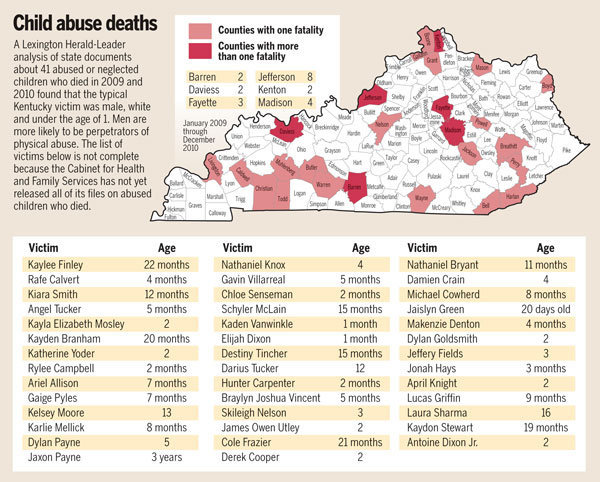
Six of 41 child-abuse fatalities show improper follow-up by Cabinet for Health and Family Services, Herald-Leader analysis finds


The way child-abuse deaths are reviewed in Kentucky continues to be problematic. Looking at the 41 child fatalities in 2009 and 2010, Lexington Herald-Leader reporters Beth Musgrave and Bill Estep found at least six cases in which the Cabinet for Health and Family Services "did not do an internal review even though there were previous reports involving the family before the child died."

State law requires the cabinet to conduct such a review when a child dies or nearly dies because of abuse or neglect and the cabinet had prior involvement with the family.

That didn't happen in the case of 2-year-old Derek Cooper, whose father placed his hands over the crying boy's mouth "until the child was silent," a state report said. Cooper's father, Brandon Fraley, had had contact with the cabinet when he was a child himself, and in 2006 there was an allegation of domestic violence against him, Musgrave and Estep report. Cabinet spokeswoman Jill Midkiff said the cabinet doesn't do internal reviews when the contact with the cabinet occurred when the alleged abuser was a child, but Midkiff "provided no explanation about why the 2006 domestic violence investigation of Fraley didn't trigger an internal review," the newspaper reports.

The analysis also showed vast differences in the way internal reviews are conducted in different parts of the state. "Some of the reviews appeared to be thorough, but in others, child-protection workers produced only one-page reports with little detail on what happened to the children and no assessment of potential improvements," Musgrave and Estep report.

"The cabinet for so long has hidden everything it could," said state Rep. Susan Westrom, D-Lexington, who tried earlier this year to pass a bill that would create an external child-fatality review panel. Gov. Steve Beshear has issued an order to create such a panel, whose members will review cases and make recommendations. The panel will not have cabinet staff as members.

Westrom's bill got hung up partly over the cabinet's attempt to impose further restrictions on the sort of information it is required to make public. The newspaper's analysis the result of a long fight the Herald-Leader and The Courier-Journal have waged to make the child-abuse documentation available to the public. C-J lawyer Jon Fleischaker said on KET yesterday that the cabinet continues to redact more information that it should, in an effort to protect its own interests. The fight continues in the appellate courts. (Read more)

Wednesday, June 6, 2012

Herald-Leader dislikes mental health agency's 'clubby glow'

In an editorial today, the Lexington Herald-Leader criticized the "clubby glow emanating from the inner circle" of the Bluegrass Regional Mental Health-Mental Retardation Board, whose financial status was featured in Sunday's issue of the newspaper.

Though the paper didn't take issue with top executives earning large salaries, it did have a problem with the makeup of the board and its staff. First, the current CEO, Shannon Ware, is married to the former CEO, Joseph Troy. Troy's son-in-law is director of information technology. And at least eight of the 25 members of the board have served since the 1980s. Another three have served since the 1990s.

"Collectively, these offer the potential for an organization where the status quo is rarely challenged," the editorial reads. The editorial board took particular issue with the nepotism in place: "While it is theoretically possible that a supervisor might treat a family member exactly the same as an unrelated employee, in reality it is hard to imagine. Regardless, the very appearance of favoritism can be damaging to an organization." (Read more)

Monday, June 4, 2012

Couple shares 'horrible journey' of prescription drug abuse

Recovering pill addict Stacy Pennington
of Ashland is due to give birth next month.
(Courier-Journal photo by Matt Stone)
Stacy and James Pennington had to lose everything, including their children and home, before they were able to face their prescription drug abuse problem. Now in recovery at The Healing Place in Louisville, they spoke to The Courier-Journal's Laura Ungar of their downward spiral.

"It had gotten to the point where my prescription drugs were my everything. As long as I had them, I was OK," said James, 40, of Ashland. "Before, we had everything we could want. In the end, we were just feeding an addiction. We had lost everything."

Stacy Pennington said she took her first painkillers in 2002 after she cut her finger on a glass candle jar and needed two surgeries. "A year later, she was diagnosed with cervical cancer, then severe endometriosis, and she required several more surgeries," Ungar reports. "Each of her 14 operations brought another prescription for pain pills."

James Pennington took prescription drugs for the first time at age 14 after he dislocated his shoulder. After he broke his shoulder in a motorcycle accident when he was 25, he got a 30-day supply for Percocet and, later, was prescribed more of the drug after a knee injury. "Pain medications became my drug of choice from there on out," he said.

Soon, he was traveling to "pill mills" in Florida to fuel his addiction, pills he sold and shared with his wife. When Stacy gave birth to their daughter, she was heavily addicted and eventually lost custody of her. James' older daughter was also taken from the home. 

Before Stacy Pennington checked in to The Healing Place, she had sold her engagement ring, the Penningtons sold their home before they lost it, and they were spending $100 to $500 a day to feed their addiction. Now, Stacy is expecting another child and the couple is fighting for their sobriety. "It's a horrible journey. I had to absolutely lose everything. But I see that as a blessing," said James Pennington. "I'm so glad I'm on the other side today." (Read more)

Friday, March 23, 2012

Rural newspapers don't write a lot of health stories — but they should, expert says

“If a newspaper can’t stand for better health and better health care, then what in the world can it stand for?” This was the galvanizing statement of a talk today by Al Cross, director of the Institute for Rural Journalism and Community Issues, who keynoted the third annual Kentucky Health Literacy Summit. Cross discussed ways newspapers are — and aren’t — publishing health-related stories on their pages.

A research paper Cross presented with University of Kentucky graduate student Sarah Vos yesterday showed that with a few exceptions, rural newspapers in the state are not publishing many articles about health care and health. The vast majority of articles — 71 percent — run on the inside of the paper rather than on the front page. In large part, stories are institutionally oriented, Cross said, often pertaining to promoting the local hospital or reporting on problems with it.

Interviews with rural publishers and editors in Kentucky and Mississippi showed “while many of them believe health coverage is important, they are reluctant to be seen as crusading in the news columns for a cause, even if it is one that usually has no countervailing interest,” Cross said. He said Kentucky editors are specifically reluctant to point out health disparities comparing their community to neighbors, the state or nation, because they want to build up the community “rather than going out of their way to point out local problems that have no easy solutions.”

Another issue is that most of Kentucky’s 150 newspapers serve very small markets, which “mean less revenue, small staffs and low pay, so most of these newspapers lack the resources to do what we journalists call enterprise reporting,” Cross said. And with all but two Kentucky dailies owned by corporate chains, that can mean “less news space, fewer staff members, more focus on number of stories rather than quality, less focus on community service, more on bottom line,” he said.

However, rural newspapers continue to have considerable influence over their readership, with 60 percent of adults saying their local paper is their primary source of news. Their content is almost entirely local. Thus, Cross said, there are opportunities — and ones that don’t require a lot of legwork. A story about someone's life being saved because she got a cancer screening can make a big impact, he said, and sometimes an article written by an outside source, such as a local extension agent, “doesn’t need to be put on page 12.” Cross said. Newspapers can use social media, such as Facebook, to promote their stories and find local people willing to talk about a health issue.

Cross also recommended Kentucky Health News as a service editors can rely on for stories that can be used verbatim or be easily localized. Cross noted newspapers are using the service, and “We think we are moving the needle.”

Tuesday, February 28, 2012

Extensive series focuses on the many faces of mental illness

Mental illness in Rowan County is the subject of an eight-part series of stories written by Noelle Hunter for The Morehead News.

With Part 1 largely an introduction to the project, Part 2 gets into the facts and figures of the disorders that fall under the mental-illness umbrella. According to the Substance Abuse & Mental Health Services Administration, 45.9 million American adults — one in five — experienced some mental illness in the past year. In Kentucky, 180,000 people live with a serious mental illness, which includes schizophrenia, bipolar disorder, major depression, obsessive compulsive disorder, panic disorder and post-traumatic stress disorder.

Dr. Thomas Insell, director of the National Institute of Mental Health, described mental illnesses as "real brain disorders that result from complex genetic risks plus environmental factors." Neither prevalence nor mortality rates associated with mental illness have decreased over time. And though there have been advancements in treatments these disorders, most in the way of medication and therapy, there is still much that is unknown, Hunter reports.

That comes with larger cultural ramifications. In 2008, about 5,100 adults who have a mental illness were incarcerated in Kentucky prisons and almost 700 adults committed suicide, "almost always a result of untreated mental illness," Hunter reports.

The series is running on Tuesdays in the twice-a-week paper. Part 3 profiles a woman living with bipolar disorder; Part 4 will report on the views of clinicians and therapists; Part 5 will profile a man living with bipolar disorder; Part 6 will profile a person living with schizophrenia; Part 7 will focus on the effects on families; and Part 8 will look at treatment options and recovery. The website of the newspaper, part of Community Newspaper Holdings Inc., is here.

Friday, January 27, 2012

Cabinet files appeal to prevent releasing full child abuse records; Beshear backs decision

On the day the state was supposed to release unadulterated records on deaths and near deaths from child abuse, under a court order, it filed an appeal to stop the process. And though Gov. Steve Beshear had ordered the Cabinet for Health and Family Services to release the records, yesterday he sided with its officials, saying in an op-ed piece sent to Kentucky newspapers he did not "think the judge's order was protective enough" of informants who often want to remain secret, such as relatives, health-care providers, teachers and law-enforcement officials. (Getty Images photo)

“You teach in a small community and suspect a student is being abused,” Beshear wrote. “Can you come forward without the newspaper naming you as the accuser?" Jon Fleischaker, attorney for The Courier-Journal and the Kentucky Press Association, said Beshear was “fear-mongering,” and noted that Shepherd’s order to release records applies only in cases in which children were killed or nearly killed from abuse or neglect, following a state law designed to hold the cabinet accountable for its child protective services.

Beshear wrote, “The cabinet has been accused of 'operating under a veil of secrecy' in a supposed attempt to protect inept workers and a poorly designed system. But this is not about shielding the system from scrutiny. We understand the need to be more transparent than in years past.” In December, the cabinet handed over 353 pages of records, but the names of at least eight children who died from abuse or neglect had been redacted, along with all the names of children who had been seriously injured, as well as much other information. The Courier-Journal, the Lexington Herald-Leader and the Todd County Standard had sued the cabinet for refusing to release the records. Twice before, Franklin Circuit Judge Phillip Shepherd ordered the cabinet to turn them over. Last week, Shepherd fined the agency $16,000 for its secretive treatment and delays. He also found the cabinet should pay more than $57,000 in legal fees for the newspapers. (Read more)

Yesterday, the cabinet filed its motion with the state Court of Appeals and "asked the court to block Shepherd's Jan. 19 order to release records, starting today, with limited redactions," reports the C-J's Deborah Yetter. In the meantime, the cabinet released about 90 internal reviews of child deaths and serious injuries incurred by abuse but with deletions it feels is necessary "to protect the best interests of the state's child welfare system," its motion read. (Read more)

Wednesday, January 11, 2012

In front-page editorial, rural weekly in Adair County demands that board members of county-owned hospital resign

In our experience, most weekly newspapers don't have editorial pages, much less editorials, so when one puts an editorial on the front page and also runs an editorial about the decision, and the work is well-written and well-argued, it's worth noting.

The Adair County Community Voice in Columbia, Ky., noted county government's bailout of the "collapsing" county-owned hospital; elected officials' request that they have "a say in any final decision to sell the hospital" and that "the hospital administration will try just as hard to keep the hospital independent as they will to sell it;" and some appointed board members' dislike of the requests.

"It seems like little to ask of someone who is $13 million in debt and asking you for $1.7 million," the editorial said, noting that one member said the board had been "a rubber stamp" for agents who secured the bonded debt. That admission "saves us the trouble of trying to prove that board members acted irresponsibly in overseeing the hospital’s business," the editorial said. "Now the question has to be, 'Why are they still on the board?'" It said the board not only "ran the hospital into the ground" but is "in control of a document that will show if any criminal activity took place," a forensic audit that gives board members "a personal stake in any damaging evidence that may come out."

In her explanatory editorial, Editor-Publisher Sharon Burton said she put the editorial out front because "We believe this is a critical time for our community, and we believe bad decisions will continue if the board is left as it is. We believe it’s our job to bring the issue to the forefront, and there is no better place to do that than on the front page of the Community Voice." The explanatory editorial also included useful background and perspective, including: "At small newspapers we don’t have the luxury of separating the people who cover the news from the people who write opinion pieces. Instead, we work hard to provide fair and unbiased coverage of local news. Then, we look at how that news impacts the people in our community and take a stand as needed on our editorial page."

Burton told us in an email that the editorial generated responses by phone, emails, Facebook messages "and of course being stopped at church and the grocery store," all of them positive except a letter from the daughter of a board member, which is running this week. The Community Voice doesn't put editorials or most news online, but PDFs of the pages with the editorials are available on the Institute for Rural Journalism and Community Issues website. The front page, with color, is 3.5 MB; the inside page is 682 KB.

Thursday, December 22, 2011

Child abuse reviews show failed communication in agency

A picture of failed communication is developing as reporters sift through 86 internal reviews of incidents of child abuse, says an editorial in today's Lexington Herald-Leader. The Cabinet for Health and Family Services released the reviews last week under court order.

"This pattern of failed communication only came to light because this newspaper and Louisville's Courier-Journal have aggressively pursued these records in court and Franklin Circuit Judge Phillip Shepherd has relentlessly pushed the cabinet to open the records," the editorial reads.

The piece highlights several instances where communication breakdown led to tragic events, beginning with the case of 9-year-old Amy Dye, right, in which a school nurse had written six reports about suspected abuse or injuries. The cabinet's file only contained three of them.

Madaline Grace Reynolds died when she didn't get the medicine she needed to treat her cystic fibrosis. The review found the child-protection worker did not look into whether or not her parents had filled her prescriptions.

"But the faulty communication doesn't stop there," the editorial reads, referring to Tuesday's hearing by the Interim Joint Health and Welfare Committee in which legislators came down hard on the cabinet for "failing to inform them about regulations that prevented it from investigating abuse by a sibling, such as in Amy Dye's case," the editorial reads.

"The cabinet, indeed the entire executive branch, has shown it won't fully address these issues without the hot, bright light of outside pressure," the editorial concludes. "The courts have acted responsibly and forcefully. Now, the legislature must take up the painstaking and painful job of examining the cabinet's work, finding the missed connections and fixing them." (Read more)

Thursday, December 1, 2011

County data paint specific pictures of health; Ashland paper is one of first to pick up on it and do a story

More progress is needed to make sure children from low-income families are going to the dentist is just one of the findings of the 2011 Kentucky Kids Count County Data, released by Kentucky Youth Advocates.

The data paint a detailed portrait of each county's health for Kentucky's children, showing results of prenatal care, the percentage of mothers smoking during pregnancy, rates of preterm birth and low birthweight, breastfeeding, the number of children enrolled in Kentucky Children's Health Insurance Program and Medicaid, early-childhood obesity rates, asthma hospitalizations, and access to recreational facilities.

Statewide, the numbers show nearly one of every four children lived in poverty between 2005 and 2009, a 10 percent increase from 2000. The rates of preterm births and low-birthweight babies also increased. Overall, however, the numbers show improvement, particularly when it comes to children being covered by state or federal insurance. The number of children enrolled in KCHIP increased by 45 percent and in Medicaid more than 50 percent.

That data is supported by a reported released Tuesday by Georgetown University, which found the number of children without health insurance has dropped by 1 million nationwide in the past three years, Kelli Kennedy of The Associated Press reports. (Read more)

For an example of how to localize the data, click here. Mike James of The Independent in Ashland used it to assess the health status of children in Greenup, Carter and Boyd counties. He also spoke to a local school district and found officials will use the findings to bolster "requests for competitive grants that fund ... programs and ... identify gaps in services," he reports.

Friday, September 9, 2011

Is University Hospital public? Attorney general will decide; merger proposal raises question of church-state separation

Attorney General Jack Conway has been asked to decide "whether University Hospital is a public institution — an issue in the controversial plan to merge the University of Louisville’s main teaching hospital with two other health-care systems," Patrick Howington of The Courier-Journal reports.

ACLU of Kentucky and The Courier-Journal have appealed denials of of open-records requests they made to University Medical Center Inc., which does business as University Hospital. "UMC turned down both requests on grounds that it is a nonprofit corporation rather than a public agency and therefore isn’t subject to the act," Howington writes. An attorney general’s opinion on open records or open meetings has the force of law unless overturned in court.

Meanwhile, Howington also writes that "Some legal advocates and constitutional scholars say," citing court cases, that the hospital's "plan to follow Catholic health-care directives under a pending merger could violate the U.S. Constitution’s provision to keep state and religious matters separate." (Read more)

Sunday, September 4, 2011

The Courier-Journal, continuing to explore Louisville hospital merger, says many more questions still need answering

The proposed merger of the University of Louisville hospital with Jewish Hospital & St. Mary’s Healthcare and with St. Joseph Health System of Lexington, which follows the teachings of the Roman Catholic Church, continues to draw heavy attention from The Courier-Journal. Sunday's newspaper had a long column by editorial writer Pam Platt, and an editorial that online was packaged with a video discussion among the editorial board and U of L President James Ramsey, David Laird of Jewish and St. Mary’s, Dr. Daniel Varga of St. Joseph and James Taylor, CEO of University Hospital.

"On many levels, the merger . . . is appealing," the editorial began, saying the new system would be broader and more efficient and secure the three Louisville hospitals as they compete with Baptist Hospital-East and Norton Healthcare, which recently announced an affiliation arrangement with the University of Kentucky" hospital. "Two significant issues continue to make the merger problematic, however." In addition to the issues of reproductive care, the editorial wonders whether advances in medical science that conflict with Catholic teaching could cause the merger to "unwind," as hospital officials put it, and what the ramifications of that would be. (Read more)

In her column, Platt, right, focused on the merger's impact on women, saying it remains unclear. For example, "The partners say transportation will be provided for pregnant women wanting tubal ligations, as well as for their infants. But what will be the process for them accessing that? What are the details? . . . Many of us need more answers to additional questions . . . before we know if this merger is the answer not only for the business end of things, but for all the people who depend on the hospitals for their care." The merger needs state approval to proceed. (Read more)