Showing posts with label Patient Protection and Affordable Care Act. Show all posts

Thursday, April 18, 2013

Business leaders discuss possibility of expanding Medicaid through private insurance

By Molly Burchett
Kentucky Health News

Some Kentucky business leaders are discussing a possible endorsement of expanding Medicaid through private insurance, in a plan similar to one the federal government approved for Arkansas.

The Health Policy Council of the Kentucky Chamber of Commerce discussed the idea last Friday. A talking paper for the meeting highlighted presumed benefits of the approach, in which people newly eligible for Medicaid could use federal funds to buy private insurance through the insurance exchange that the state is constructing.

The health council has yet to decide the chamber's position on Medicaid expansion, but the council's talking paper said expanding Medicaid privately might be a better option than expansion of traditional Medicaid, considering the state's tight budget and already problematic managed care system.

The paper says a private plan would be beneficial to Kentucky because it would allow market forces to control costs and ultimately result in better health care. Private expansion would also prevent a flood of newly eligible people from entering the managed care system. "If Kentucky accepts the traditional Medicaid expansion, everyone that qualifies would be put into the already struggling managed care system, which until changes are made, cannot support the influx," the paper asserted.

The Obama administration has encouraged states to consider the Arkansas approach, the paper says.  To do so, states need to apply for a waiver, and the administration has provided information on how a state would apply. "Florida, Ohio, Louisiana, Maine and Pennsylvania are all looking into this option," the paper said.

An estimated 181,000 uninsured adults would become eligible for Medicaid in 2014, if Kentucky decides to accept the funds offered by the health law to provide coverage to those earning up to 138 percent of the federal poverty level.

Gov. Steve Beshear has said he will make his decision about Medicaid expansion no later than July 1. His office has declined to say whether the privatized option is under consideration, saying, "The governor is considering multiple issues as he determines whether Kentucky will expand Medicaid eligibility.  Along with affordability for the state, he is also looking at potential economic impact through jobs and investment created by possible expansion, as well anticipated changes in health outcomes for newly-eligible Kentuckians."

Baucus sees a health-reform 'train wreck,' fearing insurance exchanges won't be ready

Max Baucus (J. Scott Applewhite, AP)
Senator Max Baucus, who as Senate Finance Committee chair helped write the health-care reform law, has become the highest-ranking Democrat to publicly voice concerns about its implementation, saying he thinks it’s headed for a collision with itself.

“I just see a huge train wreck coming down,” the Montanan told Health and Human Services Secretary Kathleen Sebelius during a budget hearing.

Matt Gouras of The Associated Press notes that polls show that Americans are confused by the complex law, which is designed to cover about 30 million uninsured people through a mix of government programs and tax credits. Baucus told Sibelius he’s “very concerned” that new health insurance exchanges will not open on time in every state and residents will not have enough information to make choices even if they do open on time, as Kentucky's seems likely to do.

"The administration’s public-information campaign on the benefits of the Affordable Care Act deserves a failing grade,” Baucus lectured. “You need to fix this.” Baucus’ office later told Gouras that the senator still thinks the Affordable Care Act is a good law, but questions its roll-out.

Sebelius said that the administration is on track to fully implement exchanges in January, and to be open for open enrollment on Oct. 1, 2013, reports Gouras. Kentucky is among the states that have chosen to build a fully state-based exchange. Others have chosen a state-federal partnership exchange, or defaulted into a federally facilitated exchange. The map below shows the lay of the land about that decision. Yellow states have defaulted to a federal exchange, light blue states are planning for a partnership and blue states have chosen a state-based exchange.
Map provided by the Kaiser Family Foundation

Monday, April 15, 2013

Beshear says he will decide in four to five weeks, or July 1 at the latest, whether or not to expand Medicaid

By Al Cross
Kentucky Health News
This story has been updated.

Gov. Steve Beshear said Monday that he will decide within the next four to five weeks, or maybe by July 1, whether to expand the Medicaid program under federal health-care reform.

Beshear, who has said he would expand Medicaid if the state can afford it, told reporters that he is considering other factors, which he did not name. He said his administration has not calculated the cost of expansion, which the state would not pay immediately.

The federal government pays about 71 percent of Medicaid's cost in Kentucky, and would pay the full cost of covering those newly eligible in 2014-16. The state would have to pay 3 percent in 2017, rising to 10 percent by 2020.

About 830,000 Kentuckians are covered by Medicaid, and at least 400,000 more could be added if Beshear expanded it to include households earning up to 138 percent of the federal poverty level, as required by the reform law.

Another possibility is that Beshear would seek approval from the federal government to use federal money to subsidize purchase of private health insurance by the poor, which has been approved in Arkansas but not in Tennessee.

The governor's office, asked if the administration was considering that option and what other factors Beshear is considering, has not responded had this response: "The governor is considering multiple issues as he determines whether Kentucky will expand Medicaid eligibility.  Along with affordability for the state, he is also looking at potential economic impact through jobs and investment created by possible expansion, as well anticipated changes in health outcomes for newly-eligible Kentuckians."

That is also the case with There has still been no response from Humana Inc., which does much of its business through government-financed health plans. The Louisville-based insurance company was asked if it has had discussions with the Beshear administration about the idea of a Medicaid expansion that would use federal money to buy, or subsidize the purchase of, private health insurance.

"Beshear said Monday that he is getting a lot of pressure from the medical field – particularly hospitals – to green-light the expansion," Beth Musgrave of the Lexington Herald-Leader writes. "Hospitals will lose additional money they receive through Medicaid on Jan. 1 as part of the Affordable Care Act. Hospitals in Ohio and other states have also put pressure on state governments to expand Medicaid rolls."

Beshear said, “I think they look at the expansion as a means to at least replace some of that (money) that they are going to lose.”

Many Republicans have opposed expansion, "saying that the state could not afford it," Musgrave writes. "The Republican-led state Senate passed a bill during the legislative session that would have required that the two-term Democratic governor get legislative approval before expanding the health care program. But the measure died in the Democratic-controlled House. Beshear could expand the program via executive order."

Beshear said today, “We have a very large uninsured population and we have a very unhealthy population. Anything that we can do — that we can afford — to make our population more healthy, I”m certainly in favor of doing.” He added, “We are looking long-term as well as short-term from a financial standpoint to see if it makes sense for us.”

While he said he would act within four to five weeks, Beshear gave himself some wiggle room, saying also that he would make the decision by July 1, the beginning of the state's fiscal year. (Read more)

Monday, March 11, 2013

Feds letting Arkansas privatize Medicaid expansion; idea could spread like wildfire, as in Florida, but cost questions remain

Arkansas has turned heads nationally with its preliminary plan to expand Medicaid using the private insurance market, showing that the Obama administration is willing to give states more flexibility than expected in expanding the program.

Health and Human Services Secretary Kathleen Sebelius has agreed to a proposal by Arkansas Gov. Mike Beebe to reject the Medicaid expansion but use federal money to buy private health insurance for the 200,000 people who would have been covered under ordinary expansion, reports Sandhya Somashekhar of The Washington Post.

States that have come down on either sides of the Medicaid-expansion issue may reconsider their decision in light of the Arkansas proposal, said Sara Rosenbaum, a health law professor at George Washington University. "If Arkansas is allowed to do this, I expect it to spread like wildfire," Rosenbaum told the Post.

The first place could be Florida, where a state Senate committee rejected Republican Gov. Rick Scott's expansion plan and proposed a privatization plan like that in Arkansas. Last week, a House committee voted to reject any expansion of the program. Scott "made it clear he was not going to lobby the Legislature on Medicaid," preferring to emphasize other issues, The New York Times' Lizette Alvarez reports. For coverage from the Tampa Bay Times and The Miami Herald, click here.

Could the wildfire spread all the way up to Kentucky?

Gov. Steve Beshear has said he wants to expand Medicaid in Kentucky if the state can afford it, but many Republican lawmakers oppose the idea, saying it would not be fiscally responsible. On the national level, 26 states and the District of Columbia have expressed a desire to expand Medicaid, 17 have said they reject it and seven are undecided, according to the nonpartisan Kaiser Family Foundation.

A more flexibile arrangement could be a game changer because it makes expansion more appealing, especially for states where expanding Medicaid has been politically unpopular and polarizing. in Arkansas, which has a Democratic governor and a Republicna legislature, officials say that from an ideological standpoint, using private insurance appeals to lawmakers from both parties, reports Somashekhar. She reports that even Democratic-led states might prefer this arrangement because it gets rid of some bureaucratic hurdles.

However, there are questions about cost. The Congressional Budget Office estimates that private insurance plans cost $3,000 more per person than Medicaid, reports Somashekhar. On the other hand, Arkansas officials say the move could ultimately save money in administrative charges along with other cost-control measures.

Although the Arkansas proposal is not concrete, it provides proof that the Department for Health and Human Services encourages innovative, state-based approaches to promote expansion. Many states may develop a new route best suited to their specific needs, without having to leave federal money on the table. (Read more)

Monday, February 25, 2013

Essential-benefits rule expands mental-health and substance-abuse coverage; Ky. needs more facilities to treat newly eligible

The Department of Health and Human Services has defined the 10 "essential health benefits" insurance plans must provide, and it included benefits for mental health and treatment of substance-abuse disorders..

Nearly 20 percent of Americans don't have access to mental-health services and over 30 percent have no coverage for substance-abuse treatment. This rule will expand mental health and substance-abuse treatment benefits to 62 million Americans, according to HHS.

Expanded coverage for mental health and substance abuse treatment programs in Kentucky could bring about a dramatic shift in the delivery of these services. There is already a shortage of treatment options and centers for Kentuckians, and those suffering from addiction have not had coverage for such treatment; the proposed rule will change that.

Recovery Kentucky, a public-private partnership with residential facilities, was created to help Kentuckians recover from substance abuse. It has 10 centers, in Campbellsville, Erlanger, Florence, Harlan, Henderson, Hopkinsville, Morehead, Owensboro, Paducah, and Richmond, according to the 2012 Justice & Public Safety Cabinet report, which included the map below. 

Health-insurance plans must cover the 10 essential benefits beginning in 2014, so the state must prepare for the newly insured in addition to newly covered services. The rule defines what must be covered in insurance plans and bans discrimination based on age or pre-existing conditions. Among the core package of items and services, known as “essential health benefits" are items and services in the following categories:
  1. Ambulatory patient services
  2. Emergency services
  3. Hospitalization
  4. Maternity and newborn care
  5. Mental health and substance use disorder services, including behavioral health treatment
  6. Prescription drugs
  7. Rehabilitative and habilitative services and devices
  8. Laboratory services
  9. Preventive and wellness services and chronic disease management
  10. Pediatric services, including oral and vision care
States are given flexibility in implementing the federal health-care reform law with a benchmark approach. The Kentucky Department of Insurance has recommended that the Anthem Preferred Provider Organization plan serve as the “benchmark” plan for the Kentucky Health Benefit Exchange. HHS will review the recommendation and accept public comments prior to making a final decision. (Read more)

Medicaid expansion brings primary care access to the forefront

The federal health reform law will usher at least seven million more Americans into Medicaid, and as states like Kentucky debate Medicaid expansion, policymakers are struggling with the question of whether there will even be enough primary care doctors to provide care, reports Michael Ollove of Stateline.

The country is already short of primary-care doctors. Although many primary-care physicians would take on new Medicare or privately-insured patients, only two out of three primary-care physicians surveyed in 2011 were willing to accept new Medicaid patients.

Why? Poor compensation is one reason; on average, Medicaid pays physicians 59 percent of the amount Medicare pays for primary care services, reports Ollove. Many Kentucky primary-care providers are also deterred by existing Medciaid problems. Providers report being burdened by a lack of or delayed payments from the new managed-care system.

Congress hopes to lure practitioners to primary care with a provision that raises primary-care providers' Medicaid fees to Medicare levels. This is only a temporary fix, which went into effect at the beginning of the year and will remain in effect for two years, reports Ollove.

The impact in Kentucky remains uncertain. Lawrence Kissner, Kentucky's commissioner for health and family services, says the state’s Medicaid pay raise in 2005 resulted in a 36 percent increase in the number of primary care doctors accepting Medicaid patients, reports Ollove. This is precisely what the health-law authors hope will happen now.

Kentucky is addressing the health coverage issue in other ways.  The General Assembly is considering a bill that would repeal a burdensome supervision requirement and encourage more independent physician assistants to remain in Kentucky to serve medically underserved areas.

Although Kentucky already allows nurse practitioners to practice independently, the Medicaid rate increase applies only to physicians who provide primary care services. It does not apply to nurse practitioners, who have been touted as a potential solution to the primary care problem and often provide care in underserved areas of the state. (Read more)

Wednesday, February 13, 2013

Frontier Nursing University in Hyden helps bring better family health care to rural America with distance learning

Midwives and nurse practitioners who recently graduated from Frontier Nursing University in Hyden address the unique challenges of rural areas, including shortages of health care providers, by bringing local health care to rural communities across the country. FNU was featured in a recent report from the Robert Wood Johnson Foundation.

FNU, a graduate program that offers distance education to nurses with an interest in nurse-midwifery and family nurse practitioner and women’s health specialties, aims to build a pipeline of highly educated nurses serving in rural or underserved areas, reports RWJF, one of its funders.  Many scholars and grantees sponsored by RWJF go on to spearhead projects to improve access to high quality nursing care in remote areas, the foundation says.

“We’re trying to introduce primary care providers into rural areas in such a way that they can provide high quality care and preventive services too,” says Suzan Ulrich, associate dean of midwifery and women’s health at FNU and an RWJF executive nurse fellow.

Demand for health care is rising nationwide because of an aging population that is living longer, but sicker, with multiple chronic conditions. The need for health care providers will intensify next year, when millions of new patients will become eligible for health insurance under the health-reform law.

Rural parts of the country face unique challenges and shortages of health providers, including nurses, can be particularly acute in rural areas, said Alan Morgan, CEO of the National Rural Health Association. These nurses and other providers have less access to education programs, which tend to be located in more densely populated areas. Programs that offer advanced degrees, from the baccalaureate to the doctorate, can be especially difficult to access for students living in rural areas, according to RWJF.

Identifying and educating nurses from rural areas is a key goal of FNU, which offers distance education programs that enable students to remain in their home communities and a “bridge” program that allows nurses with associate’s degrees to move more easily into master’s and doctorate programs. “These students really love where they live,” Ulrich said. “If we can educate them to stay within their communities, then those communities are going to have a provider who’s going to be there a long time." (Read more)

Tuesday, February 12, 2013

Beshear will expand Medicaid, Democrat and Republican say; D says governor believes the state can opt out if it's not affordable

State legislators in both parties say they expect Gov. Steve Beshear to expand Medicaid to cover several hundred thousand more Kentuckians who earn up to 138 percent of the federal poverty rate.

Rep. Tom Burch, chairman of the House Health and Welfare Committee, told Ryan Alessi of cn|2’s "Pure Politics" that the governor told him exactly that last week. And Sen. Tom Buford, R-Nicholasville, told Kentucky Health News that he expects Beshear to do the deed.

Burch told Alessi that Beshear has decided to move forward with the expansion because he believes the state would be able to opt out if state officials discover that Kentucky can’t afford it after 2017.

Beshear didn’t mention expansion in his State of the Commonwealth Address last week, and the governor’s office said the official decision hadn’t been made yet but didn’t dispute Burch’s statement, Alessi reports. Here is the salient part of his interview with Burch:


Buford said Beshear will be under much political pressure to expand Medicaid because it is President Obama's signature program and expansion will create jobs. However, Republican legislators generally  have opposed the expansion of Medicaid because the state can’t afford it. The federal government will cover the cost of covering the extra people from 2014 through 2016. Kentucky would have to kick in 5 percent of the costs starting in 2017 and 10 percent by 2020.  

The federal government covers roughly 70 percent of Kentucky’s $6 billion Medicaid program. It covers more than 800,000 Kentuckians and with the expansion, that number could grow to more than 1 million — or roughly a quarter of all Kentuckians, reports Alessi.

“I think it’s critical that we take a look at those to see how we achieve that. I’m not sure that this would be the way that would be best-suited to Kentucky and be fiscally responsible for the state of Kentucky,” Sen. Julie Denton, R-Louisville and chairman of the Senate Health and Welfare Committee, told Alessi in December (at 4:10 of the interview below). “Frankly, I don’t think we can afford to do it,” she said.

Tuesday, February 5, 2013

Kasich of Ohio is fifth Republican governor to accept Medicaid expansion; he and others cite need to protect rural hospitals, poor

Several Republican governors have decided to expand Medicaid under federal health-care reform, saying their conservative principles were outweighed by a need to protect their state's rural hospitals and low-income people. Yesterday, the governor of one of the biggest states got on the bandwagon.

John Kasich of Ohio joined Jan Brewer of Arizona, Brian Sandoval of Nevada, Susana Martinez of New Mexico and Jack Dalrymple of North Dakota in saying they will take heavy federal subsidies to expand the program to households with incomes up to 138 percent of the federal poverty threshold.

Democratic Gov. Steve Beshear of Kentucky has said he wants to expand Medicaid if Kentucky can afford it, and he expects to get cost estimates around the end of March.

While Kasich is not an "Obamacare" supporter, he said expanding Medicaid “makes great sense for Ohio” because it would save $235 million over the next two years and free about $100 million in local funds for mental-health and addiction services, reports The Columbus Dispatch.

Kasich said the decision could extend health coverage to as many as 578,000 uninsured Ohio residents, and could keep everyone else’s health insurance premiums down because there won’t be so many uninsured people going to emergency rooms for their medical care, reports David Nather of Politico.

Kasich emphasized that he would like to see the 2010 law repealed, but the federal money it would pump into the state — about $13 billion over the next seven years — was too much to pass up, reports Stateline. The federal government will pay the full cost of expansion through 2016; then  states will have to pitch in, rising to a limit of 10 percent by 2020.

Brewer likewise said it doesn't make sense for Arizona to pass up federal dollars, reports Howard Fischer of the Arizona Daily Sun. "We will protect rural and safety-net hospitals from being pushed to the brink by growing their cost in caring for the uninsured," Brewer said. She also said the expansion will create enormous economic benefit, inject $2 billion into the Arizona economy, save and create thousands of jobs and provide health care to hundreds of thousands of low-income individuals, reports Fischer.

Brewer said going along with expansion will save Arizona money because the costs of providing care to the uninsured are not simply absorbed by hospitals but passed along through increased insurance premiums. Supporters of the expansion hope the five Republicans' decisions will prompt more GOP governors to follow suit. Twenty governors from both political parties are still undecided. (Read more)


Tuesday, January 29, 2013

Feds plan to let states impose co-payments on Medicaid patients above poverty level to encourage them to expand the program

By Molly Burchett and Al Cross
Kentucky Health News

If Kentucky expands its Medicaid program, it will probably be able to reduce the cost by requiring patients whose incomes are above the federal poverty level to help pay for their care. That could make it more feasible for the state to expand the program to people with incomes up to 138 percent of the poverty line.

A proposed federal policy will let states charge co-payments and increased premiums for doctor visits and some prescription drugs and hospital care. Robert Pear of The New York Times reports that the policy is designed to encourage states to expand Medicaid under the federal health-care reform law, with generous federal help. By shifting costs to patients, the state and federal governments would pay less.

That adds a new perspective to the cost consideration in Kentucky's debate over expansion of Medicaid. It could influence the state's decision, Republican state Sen. Julie Denton of Louisville said Friday during a legislative panel at the Kentucky Press Association convention.

Denton cautioned that the state needs to fix its problems with Medicaid managed care before it expands the program. Democratic Gov. Steve Beshear has said he wants to expand Medicaid if the state can afford it, and since there is no deadline for deciding whether to participate in the expansion, the debate may carry over into 2014.

Some Republicans have said Kentucky can't afford the expansion. If the state expands Medicaid eligibility to 138 percent of poverty from its current threshold of 70 percent, the federal government would pay all the cost of the expansion until 2017, when the state would begin helping out, with its share reaching 10 percent in 2020. The federal share of the state's current program is 72 percent.

This proposed rule could have important implications not just for state finances, but for Medicaid patients. It means that a family of three with an annual income of $30,000 could be required to pay $1,500 in premiums and co-payments, Pear reports in the Times.

As published in the Federal Register last week, the rule proposes to "update and simplify Medicaid premium and cost sharing requirements, to promote the most effective use of services and to assist states in identifying cost-sharing flexibilities." It proposes "new options for states to establish higher cost sharing for nonpreferred drugs and to propose higher cost sharing for non-emergency use" of emergency rooms.

Barbara K. Tomar, director of federal affairs at the American College of Emergency Physicians, told Pear that the administration had not adequately defined the “nonemergency services” for which the poor might have to pay. "In many cases, she said, patients legitimately believe they need emergency care, but the final diagnosis does not bear that out," Pear writes.

The proposed rule has no limit on emergency department charges for "non-emergency use." It says the hospital will have responsibility to assess the individual clinically and ensure access to other sources of care before requiring payment, which could pose problems for hospitals.

The public has until Feb. 13 to comment on the proposed rule, which can be submitted at www.regulations.gov.

Friday, January 25, 2013

Health reform will let insurers charge smokers up to 50 percent higher premiums, which is likely to have a big impact in Kentucky

"Millions of smokers could be priced out of health insurance" because the health-care reform law will let health-insurance companies charge smokers as much as 50 percent more starting next year on individual policies, according to experts who are just now teasing out the potential impact of a little-noted provision in the massive legislation," The Associated Press reports.

The provision is likely to have a major impact in Kentucky, where 29 percent of adults are smokers, a figure exceeded by no other state, and where 25 to 30 percent of people under 65 are estimated to have no health insurance.

"For a 55-year-old smoker, the penalty could reach nearly $4,250 a year" AP reports. "A 60-year-old could wind up paying nearly $5,100 on top of premiums. Younger smokers could be charged lower penalties under rules proposed last fall by the Obama administration."

A state health insurance exchange, now being created under the law, will be a place to buy insurance with tax credits depending on income. Gov. Steve Beshear has said he wants to expand the state Medicaid program to cover people in households with incomes up to 138 percent of the federal poverty level, but many Republicans in the legislature are opposed to that because the state would ultimately have to pay 10 percent of the expansion's cost.

The provisions to discourage smoking would allow employees covered by employer plans to avoid penalties by joining smoking-cessation programs,"but experts say that option is not guaranteed to smokers trying to purchase coverage individually," AP reports.

There is concern about the provision's effect on older smokers who "could face a heavy hit on their household budgets at a time in life when smoking-related illnesses tend to emerge. . . . Several provisions in the federal health care law work together to leave older smokers with a bleak set of financial options," AP reports, citing Karen Pollitz, a health-insurance expert with the Kaiser Family Foundation and former deputy director of the Office of Consumer Support in the U.S. Department of Health and Human Services.

Pollitz notes that the reform law lets insurers charge older customers up to three times as much as their youngest customers; charge the full 50 percent penalty on older smokers while charging less to younger ones; and does not allow smokers to use tax credits to offset the cost of the penalty.

And there's a good argument to charge the full penalty, insurance consultant Robert Laszewski told AP: "If you don’t charge the 50 percent, your competitor is going to do it, and you are going to get a disproportionate share of the less-healthy older smokers,” said Laszewski. “They are going to have to play defense." (Read more)

Wednesday, January 9, 2013

Republicans moving to gain a say over Beshear's decisions about insurance exchange, Medicaid expansion; Democrat dismissive

Kentucky Senate Health and Welfare Committee Chair Julie Denton, R-Louisville, left, said yesterday that she would file legislation that would block Democratic Gov. Steve Beshear from setting up a health-insurance exchange or expanding Medicaid coverage without legislative approval, Joseph Gerth of The Courier-Journal reports. Beshear has already established an exchange under the federal health reform, but hasn't announced whether he will expand Medicaid.

Denton said the exchanges and Medicaid expansion would be too costly for the state and shouldn't be something Beshear can set up unilaterally. But her effort will likely face opposition in the Democrat-controlled House, Gerth writes. Liberal Rep. Tom Burch, D-Louisville, said Denton "should save the ink that it would take to print the bills," and House Democrats would not receive the bill favorably. Burch has been in the legislature longer than any other current member.

State health-insurance exchanges will allow the uninsured to buy insurance from private companies and perhaps get government subsidies to help pay for it. If Medicaid were expanded in Kentucky, hundreds of thousands of more people would be covered, with the fedreal government paying all the extra cost in 2014-16, decreasing to 90 percent by 2020. Gerth reports that Senate Republicans said they will make it a priority "to rein in Beshear on Medicaid," which they fear would be unsustainable if it were expanded. Denton said requiring legislative approval of these parts of "Obamacare" would give Kentucky citizens a greater voice in the process. (Read more)

Wednesday, January 2, 2013

Health reform drives hospital mergers and affiliations, and makes clinical collaborations more important

Is your community's hospital one of the many rural hospitals considering sale, merger or affiliation with a larger hospital or group of hospitals, all options that are becoming more common, partly due to federal health-care reform? A recent article in HealthLeaders magazine, which examines some of the considerations, may inform your coverage.

Basing decisions on past experiences "is difficult because the creativity surrounding partnerships among hospitals and health systems is expanding rapidly," writes Philip Betbeze, the magazine's senior leadership editor. For example, clinical collaborations have become more important in affiliations. "Whether they own or don't own each other doesn't matter as much as coming up with a structure for sharing those value-based purchasing points together," Joseph R. Lupica, chairman of Newpoint Healthcare Advisors, told Betbeze, who writes: "That's a sea change compared to prior affiliations or mergers. In the past, such deals were driven by traditional aims around increasing market share and increasing bargaining power."

Health reform will create incentives for better patient outcomes, which upsets the old "iron trangle" of hospitals: "volume, rates, and the ability to decrease unit costs," said Dr. Gregg Meyer, chief medical officer of Dartmouth-Hitchcock, a New Hampshire hospital group that recently affiliated with the Mayo Clinic, more than 1,000 miles away, "because we know that patients who come to us for care will often seek a second opinion. In the past, that meant going to Boston or New York, and we lost out on that because we lost the ability to keep that care local. Now we can have a virtual second opinion with arguably the most famous health system in the world."

The article has several more examples. to read it, click here.

Chart shows how to get coverage under federal health reform

The core of the Patient Protection and Affordable Care Act is helping people get health insurance, beginning next year. That will be relatively simple for some people, but complicated for others, as this infographic produced by the Kaiser Family Foundation for the Journal of the American Medical Association shows. For a larger, clearer, PDF of the chart, click here. In most states, including Kentucky, a key question remains unanswered: Will the state opt to expand Medicaid eligibility to households with incomes up to 133 percent of the federal poverty level (138 percent with a fudge factor)?


Wednesday, December 19, 2012

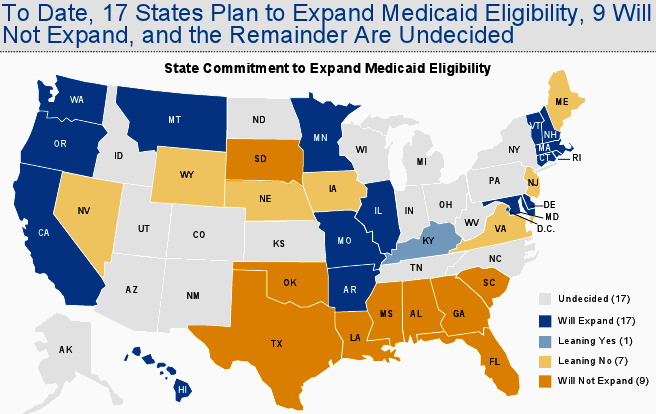
Feds tell states it's all or nothing on Medicaid expansion; Washington Post map shows Ky. is only state 'leaning' toward it

By Al Cross
Kentucky Health News

When the Supreme Court upheld federal health reform but said states could opt out of the expansion of Medicaid to people with incomes above the poverty line, to be funded with generous federal subsidies, one of the first questions was whether a state had to go all the way: to 133 percent of poverty (138 percent with an official fudge factor). Now the Obama administration has answered "no." And that could make the decision tougher for Kentucky, which is the only state The Washington Post listed this month as leaning toward expansion.


The Post's Sarah Kliff wrote, "The administration’s reasoning goes like this: The federal government was giving states a really, really good deal on the Medicaid expansion. It was footing the entire bill for the newly eligible enrollees for three years," 2014 through 2016, rather than the 72 percent it pays Kentucky for current enrollees. The subsidy for the new eligibles would drop to 95 percent in 2017, 94 percent in 2018, 93 percent in 2019; and 90 percent in 2020.

White House aides told Kliff that in passing the bill, Congress (which is to say the Democrats in Congress) "gave states that really high funding in the service of a very specific goal: Ensuring all Americans have access to insurance options." But "If a state decided to cover, say, everyone up to the federal poverty line, they would be working with a smaller, more manageable population," Kliff explains. "Those living above the poverty line, meanwhile, wouldn’t be left in the lurch. The Affordable Care Act allows them to receive very generous subsidies in the private insurance market."

However, Medicaid Administrator Cindy Mann told Kliff that if states could fall short of the 133 percent level, they wouldn’t be within the spirit of the law. Kliff paraphrases Mann: "They wouldn’t offer all their residents a way to purchase affordable coverage, and if they’re not going to do that, the White House says they don’t deserve the extra funding."

Gov. Steve Beshear said again today that Kentucky should expand Medicaid "if we can afford it" because so many people in the state have no health insurance and are in poor health, and improving their health would be good for the state's economy.

Kentucky now makes Medicaid available to people with household incomes below 70 percent of the poverty line, which varies by household size. The Urban Institute has estimated that expanding the program to 133 percent of poverty would cost the state about 5 percent more than it would otherwise spend through 2022. That would be $1.3 billion extra in 2017-22, and some Republicans in the legislature have said the state can't afford it. The state expects to spend $1.5 billion on Medicaid in the 2013-14 fiscal year.

While the Post lists Kentucky as the only state "leaning yes" to expansion, it seems likely to be joined by several others. "States have stayed mum on whether they will participate in the expansion, seeing first if they could get a better deal — the partial expansion," Kliff writes. "The federal government took a while to show its cards; it wanted to see if states would sign up for the full expansion, without giving them a scaled-back option." Only 17 states have said yes, and as many are undecided, the Post reports.

In setting a firm rule, the White House may think states "will decide the 100 percent match is too good to pass up and that the federal money will pull everyone in," Kliff writes. "Or, it could indicate the Obama administration is okay with not all states participating with the Medicaid expansion on day one. Again, this wouldn’t be unprecedented: Only six states initially signed up for Medicaid when it launched in 1965."

States should realize that expanding Medicaid is a long-term investment in the health of their people that will pay off in the long run, Dr. Wayne Myers, who once ran Kentucky's rural-health office and was the first director of the federal Office of Rural Health Policy, writes in the Daily Yonder. He says that if a state doesn't expand Medicaid, many of its people will remain or become uninsured.

"Medicaid is a rural issue because a higher percentage of low-income people live in rural communities, and rural families are less likely to have private health insurance," Myers writes, adding that the program is also "a major economic driver." According to the National Center for Rural Health Works at Oklahoma State University, Medicaid was responsible for 113,000 jobs and a total of $10.5 billion in economic activity in Oklahoma in 2010.

Myers cites studies showing that patients with insurance who are hospitalized after accidents are 40 percent less likely to die than those without insurance, because uninsured patients got less attention from medical staff. Opting out of the expansion "may get a governor a self-inflicted gunshot wound to the foot, some dead hospitals and a bunch of dead citizens who needn't have died," Myers writes.

Kentucky Health News is a service of the Institute for Rural Journalism and Community Issues at the University of Kentucky, with support from the Foundation for a Healthy Kentucky.

Tuesday, December 4, 2012

American Lung Association calls state's tobacco-cessation benefit inadequate now that Medicaid is under managed care

Kentucky added a robust tobacco cessation benefit to its Medicaid program, only to lose much of it in 2011 by putting the program under managed care by insurance companies, the American Lung Association notes in its annual report. Not only do their plans offer fewer treatments, explained the report, but information was confusing to patients and healthcare providers alike. The report also notes that the state -- which is not alone in this -- offers its smokers who desire to quit inadequate access to medications and counseling.

Robert Preidt of HealthDay reports that the U.S. Department of Health and Human Services late last month published a proposed rule that requires tobacco cessation as an essential health benefit under the Patient Protection and Affordable Care Act. The lung association report how states could put that rule to maximum use. "Giving all smokers access to a comprehensive cessation benefits is not only the right thing to do, it's the smart thing to do," Billings said. "The bottom line is that quitting smoking saves lives and saves money." One recent study, reports Preidt, showed that providing smokers with help to quit has a three-to-one return on investment, meaning $3 is saved for every for $1 spent. (Read more)

To see more about how Kentucky's tobacco cessation coverage rates, according to the American Lung Association, go here.

Monday, November 26, 2012

Expanding Medicaid in Kentucky would add 5 percent to the state's cost over the next 10 years, national study predicts

Expanding Medicaid to people making up to 138 percent of the poverty level under federal health reform and its heavy subsidies would cost Kentucky about 5 percent more for Medicaid over the next 10 years than doing nothing, the Kaiser Family Foundation said in a state-by-state analysis today.

According to the study done by the Urban Institute for the foundation's Commission on Medicaid and the Uninsured, the state would spend $25.1 billion from 2013 to 2022 if it and no other state expanded the program. If all states expanded it, Kentucky's cost would be $26.4 billion, the study estimated.

Under the Patient Protection and Affordable Care Act, the federal government would pays the full cost of the expansion from 2014 to 2016. The federal government’s share would drop to 95 percent in 2017 and to 90 percent by 2020. In the 2013-14 fiscal year, the state budget calls for $1.48 billion in state funds to be spent on Medicaid benefits. The federal government pays about 72 percent of the program's cost in Kentucky.

In human terms, the report says the law will reduce the number of people in Kentucky without health insurance in 2022, no matter what happens. It says that if the act had never passed, 740,000 Kentuckians would have been uninsured in 2022. It will reduce that number to 513,000 even if Medicaid is not expanded anywhere. If all states expand Medicaid, the number of uninsured Kentuckians would drop to 332,000, the study estimates.

The Kaiser report is an update of a study done before the U.S. Supreme Court ruling ruled that the law was constitutional but made Medicaid expansion optional for states. So far, eight states have indicated their unwillingness to participate in the expansion, though more are expected to opt out but are waiting until legislatures return in January to discuss the matter.

See the entire report here.

Monday, November 19, 2012

Lame-duck Congress could cut funding for critical access hospitals; more than two dozen in Kentucky

Critical access hospitals, which in most states are rural facilities with fewer than 25 beds, may be under attack in the lame-duck session of Congress, former national rural-health director Wayne Myers writes for the Daily Yonder. President Obama's "budget proposes to revoke CAH status and special payments for any such hospital within 10 miles of another hospital, and to cut the extra 1 percent payment for all of the critical access hospitals," Myers writes. (Census Bureau map of CAH locations)
This would "have enormous consequences," Myers writes. "Of the hospitals that lose CAH designation probably most will close or merge with another hospital. I've seen no estimates of numbers. There are more than a few congressional budget hawks in both parties who would like to eliminate the special payments to Critical Access Hospitals entirely. If these small hospitals dodge the bullet during the lame duck session, they'll continue to be targets in the next Congress. If they are successful in reducing payments to CAHs, the net effect will be to move health care capacity and jobs from smaller to larger towns."

The issue is complex. Rural areas have less political clout than ever, because of declining population, and many rural people use urban hospitals over CAHs, even for ordinary care. "Those who do use CAHs say their experience there is just as good as that in urban hospitals, even if the quality of care isn't as good as in larger facilities," Myers writes. "Elderly patients stay at CAHs because they know the nurses and doctors and their families live close by."

Issues for CAHs arise out of how Medicare payments are made to them, Myers writes. "A long list of arcane, special funding arrangements has accumulated to try to fit small rural hospitals into a Medicare payment system designed for large city hospitals." The largest program is the "Disproportionate Share Program," or DISH, which gives $15 billion a year to states to hand out to CAHs. The program is being phased out between 2014 and 2020, along with several other programs, as part of the Patient Protection and Affordable Care Act. (Read more)

Friday, November 9, 2012

Poll: A quarter of Cincinnati and Northern Kentucky residents skip doctor visits and are behind on their medical bills

Nearly one-quarter of adults throughout Greater Cincinnati and Northern Kentucky did not always go to the doctor when they needed to during the past year, according to a Cincinnati Enquirer poll. And of those that did seek medical attention last year, a little more than one-quarter (27.5 percent) said they were not able to pay all of their medical bills. The results may not be all that surprising but do highlight health care costs’ impact on the average American. “It’s very common to see people making decisions between food and medicine,” said Kate Keller, senior program officer at the local policy group the Health Foundation of Greater Cincinnati.

Local doctors say they’re seeing all sorts of ruses from patients to try to avoid even a $25 co-pay. Rob Tracy, a family doctor at St. Elizabeth Physicians in Cold Spring (left, with patient Kathy Schneider), said some patients call and ask him to call in a prescription to the pharmacy without a visit. That allows them to avoid a co-pay on the office visit. He said delaying such visits only deepens the impact of chronic conditions and ups the costs when those patients are forced to local emergency rooms when their symptoms fail to improve. (Enquirer photo by Carrier Cochran)

Peale notes that these issues are intrinsically involved with the Patient Protection and Affordable Care Act, which was cemented by President Barack Obama's victory Tuesday. It is set to go into full effect in 2014. "The law will help insure as many as 30 million more people by requiring every American to buy insurance or pay a penalty, requiring employers to offer benefits or pay a penalty, and requiring insurers to accept anyone who applies," Peale writes. With the new law in place, the average person will likely be paying $4,775 out of pocket, including premiums and co-pays. (Read more)

Monday, November 5, 2012

In Ky. and elsewhere, elections may decide Medicaid expansion

In Texas, Brandi DeFrank's Medicaid
coverage ended when her baby, Gabriel,
was born. His coverage continued.
Voters' choices on Tuesday about who sits in statehouses may matter more in the long run than who they have chosen for president. Two of the biggest provisions of the Patient Protection and Affordable Care Act -- offering Medicaid to more people and setting up state health exchanges -- are in the hands of state officials who can either disrupt implementation of the law or move it forward. In Kentucky, Republicans are pressing to take over the state House and their leader, Rep. Jeff Hoover of Jamestown, has said the expansion would be too expensive, even with heavy federal subsidies.

Maggie Fox for NBC News contrasts the approach of Texas, which has refused $76 billion in federal matching funds to help it expand Medicaid in the next five years, to that of Vermont, which is wholeheartedly embracing the expansion. Texas has 6.3 million uninsured, reports Fox, a quarter of the state's population and the highest percentage of uninsured people in the country. "We're not going to part of socializing health care," said  Texas Gov. Rick Perry, a Republican.

“There are states referred to as ‘Hell, no’states,” said David Smith, an analyst at Leavitt Partners, a health-care consulting firm. And while 11 governorships are on the ballot on Tuesday, “a lot of those states don’t necessarily have governors who are up for election,” said Smith. In those states, voters have to decide whether to help governors by electing members of the same party to the state house.

In other states, it's more straightforward. Alabama, Florida, Montana and Wyoming have ballot measures asking residents whether they want to block the mandate requiring people to get health insurance.  (Read more)