Showing posts with label Cabinet for Health and Family Services. Show all posts

Tuesday, February 19, 2013

Three Kentucky health departments in first group up for national accreditation; requires local health assessment, improvement plan

By Molly Burchett
Kentucky Health News

Three Kentucky health departments are among the first in the nation to be considered for national accreditation, a process that could help improve patient care and put the agencies in closer touch with their communities' needs.

The national Public Health Accreditation Board will make its first accreditation decisions next week. Among the first group being considered are the Franklin County Health Department, the Three Rivers District Health Department in Carroll, Gallatin, Owen and Pendleton counties, and the Northern Kentucky Independent District Health Department, in Boone, Grant, Kenton and Campbell counties.

The decision will be a historic one, and this is an exciting time for the board and Kentucky, said board Chair Dr. Douglas Scutchfield, professor of health services research and policy at the University of Kentucky College of Public Health.

The accreditation program was launched in September 2011 after a seven-year development process aimed at advancing quality and performance and value in the departments, and their accountability to stakeholders, Scutchfield said.

Departments are assessed by rigorous standards tested in 30 diverse health departments across the country to ensure essential public health services are provided in the community, according to the board's website. Two of the 12 "domains" of the standards deal with administration and governance. In Kentucky, state law makes county health boards responsible for the health of the county. Counties served by district health departments still have county boards.

Accreditation can help a board and department identify opportunities to improve performance and management, and to improve relationships with the community, since the process requires a community health assessment, a community improvement plan and a strategic plan to address the need of the community, said Scutchfield.

The process, often called "Mobilizing for Action through Planning and Partnerships," can help boards and departments be better prepared to proactively respond to emerging and re-emerging health challenges. For a PDF of Franklin County's MAPP document, click here.

The accrediting board has received 108 applications from health departments around the nation: 13 state health departments, 94 local health departments and one tribal agency. In addition to the three Kentucky agencies being considered in the first group, the other Kentucky departments that have applied for accreditation and are awaiting site visits are Lexington-Fayette County, Barren River District, Madison County and Christian County, Jill Midkiff, chief spokesperson for the Cabinet for Health and Family Services, said in an email.

The accreditation process encourages departments to move away from the "silo" model to collaborate with community programs. In Christian County, it has changed the way department employees view their jobs, because they have to continuously reflect on their methods and brainstorm for ways to improve, Health Department Director Mark Pyle told Nick Tabor of the Kentucky New Era.

"Accreditation will likely open new revenue streams," Tabor writes. "But in a way, the process matters more than the status designation."

Midkiff said, "In addition to benefiting from the process itself, our federal and state resources in public health are increasingly shrinking, we are being asked to do more with less. And there is a need for transparency within agencies."

Midkiff said accreditation "may make the agency more competitive for grants in the future. We are actually seeing quality improvement and performance management requirements being written in many federal grants now, so it is being expected at the national level."

Although accreditation is completely voluntary, it is being encouraged for local health departments by the state Department for Public Health, which is in the process of applying for its own accreditation in 2014. Midkiff said the department just completed its state health assessment, which is now being reviewed, and is beginning to assemble partners to write a state health improvement plan, which should take about a year.

Kentucky Health News is an independent service of the Institute for Rural Journalism and Community Issues at the University of Kentucky, with support from the Foundation for a Healthy Kentucky.

Tuesday, January 22, 2013

Health-care law addresses the most common chronic health problem in children, tooth decay, by requiring coverage for kids

Tooth decay is children's most common chronic health problem, and the 2010 federal health-care law addresses this problem by requiring insurers to cover pediatric dental services. But some advocates are concerned that the new benefits may not be sufficiently comprehensive or affordable, Michelle Andrews writes for The Washington Post.

She notes that by the time children enter kindergarten, more than a quarter of them have decay in their baby teeth. As they age, the problem gets worse and nearly 68 percent of those age 16 to 19 have decay in their permanent teeth, according the the Centers for Disease Control and Prevention
   
Beginning next year, the Affordable Care Act requires individual and small-group health plans cover pediatric dental services, unless a plan has a specific exemption under the law. Those services are already part of the Medicaid benefit package, but most Kentucky dentists don't accept Medicaid.
For the expansion to private insurance, "Coverage requirements will be determined by each state within guidelines set by the federal Department of Health and Human Services," Andrews writes.

Jill Midkiff, chief spokesperson for the Cabinet for Health and Family Services, said Kentucky is awaiting the publication of the final rule from HHS, which will define essential health benefits for each state and provide further guidance relating to coverage of benefits. Although no specific publication date for this rule has been announced, she said its release is expected within the next several weeks to allow insurers to modify existing health plans to be made available to individuals and small businesses for purchase through health exchanges by Oct. 1. (Read more)

Wednesday, October 24, 2012

Medicaid managed-care firm files suit, alleging the state's rush job resulted in unreliable financial information for bidders

Medicaid managed-care company Kentucky Spirit alleges in a lawsuit filed Monday that Gov. Steve Beshear so hurriedly privatized the service last year that he gave incorrect cost information to the bidders. The company said it relied on the bad information and thus has lost $120 million since its work began a year ago.

John Cheves of the Lexington Herald-Leader reports that Kentucky Spirit had hoped that it could let its contract terminate a year earlier than scheduled without paying the damages that Health and Family Services Secretary Audrey Haynes has now said the state will pursue. Cheves writes that Kentucky Spirit says they relied on a "data book" -- what managed-care companies used to estimate costs in their bids -- prepared by the accounting firm PricewaterhouseCoopers. (Read more)

Monday, October 22, 2012

Breast cancer awareness: Testing urged, guidelines explained, misconceptions explored

Women with BRCA1 and BRCA2, the
genes most commonly involved in breast
cancer, have up to an 80 percent chance
of getting the disease.
October is Breast Cancer Awareness Month. Although Kentucky's breast cancer rate is slightly lower than the nationwide rate, almost 600 women die every year from breast cancer in the Commonwealth. The American Cancer Society predicts approximately 3,160 new cases of breast cancer will be diagnosed in Kentucky this year. Early detection and prompt treatment can significantly reduce suffering and death from the disease.

According to the Cabinet for Health and Family Services, all health plans serving Kentuckians must, by law, cover mammograms. Medical guidelines strongly recommend that women older than 40 have annual mammograms and women younger than 40 with a family history of breast cancer should also have regular screenings. Through local health departments, the Kentucky Women's Cancer Screening Program provides breast cancer screenings, mammograms and Pap tests to eligible women in every county. During the 2011 fiscal year, KWCSP provided breast cancer screenings to 14,212 women. Services are provided to low-income women through the Kentucky Department for Public Health. Those women must be uninsured with incomes less than 250 percent of federal poverty guidelines.  For more information about breast cancer or screening services, call your local health department.

There are many misconceptions about the risks of developing breast cancer. Genetics, of course, is a well-documented factor but lifestyle issues have gotten a lot of talk. So what's true? Wendy Chen, MD, MPH, a breast cancer expert at Dana-Farber Cancer Institute in Boston, a principal teaching affiliate of Harvard University, tackles some of the more common questions here:

1) Soy may increase the risk of breast cancer returning.
False. Chen, who was part of a study that looked at over 9,500 American and Chinese breast cancer survivors who ate soy every day, says that eating soy may be linked to a lower risk of recurrence of breast cancer.

2) Alcohol consumption can increase the risk of breast cancer.
True. Dana-Farber researchers found that women who consume one alcoholic drink a day may increase their risk for breast cancer.  Chen and her colleagues analyzed data from over 105,000 women in the Nurses’ Health Study. Those who consumed three to six glasses of wine a week were 15 percent more likely to receive a diagnosis of breast cancer. Those who drank fewer than three drinks a week had no increased risk.

3) Fertility treatments increase a woman’s risk of breast cancer.
False. According to a recent study from the National Institutes of Health, ovulation-inducing fertility treatments like Clomid and follicle stimulating hormone (FSH) do not significantly increase a woman's risk of developing breast cancer.

4) Wearing deodorant can increase the risk of breast cancer.
False. According to the National Cancer Institute, there is no conclusive research linking underarm deodorants to breast cancer.

5) The bigger the baby the bigger the risk of getting breast cancer.
Possibly true. “This is a tough one because the research is still evolving,” says Chen. "But the latest research shows that women who have larger babies have more than twice the risk of developing breast cancer than mothers who give birth to smaller infants. Researchers say that having a heavier baby may create a hormonal environment in pregnancy that could lead to the future development of breast cancer. They found that during pregnancy in women who have heavier babies, the ratio of estrogen to anti-estrogen is unusually high. The greater the level of estrogen, the higher the risk of breast cancer. However, Chen emphasizes, women who have larger babies should not panic. There is definitely a need for further research.” (Read more)

Thursday, October 18, 2012

Kentucky Spirit to terminate Medicaid contract with state early; Cabinet assures recipients no interruption in service

Kentucky Spirit, a Medicaid managed-care provider, will terminate its contract with the state's Cabinet for Health and Family Services a year earlier than scheduled, effective July 5, 2013. The company serves approximately 140,000 Medicaid recipients in 104 Kentucky counties. According to the CFHS, Kentuckians enrolled in Kentucky Spirit coverage "will continue to receive health care with no interruptions, and the Cabinet will ensure a smooth transition for those patients to another managed care organization in the coming months."

Kentucky Spirit said in a statement Wednesday that it is committed to helping its clients it serves transfer to one of Kentucky's three other Medicaid contractors. In addition, the move will cut some 200 jobs in Lexington, representing $12 million a year in wages and benefits.

The Courier-Journal's Tom Loftus writes that Kentucky Spirit has been in months of discussions with the Cabinet for Health and Family Services about its contract. The company also said it has filed a formal dispute with the cabinet for damages it has incurred throughout the process. Gov. Steve Beshear issued his own statement informing the company that the state "will hold this company accountable to its contractual commitments through whatever means necessary on behalf of both the members and the taxpayers.”

Overall, Kentucky’s transition to Medicaid managed care has not been smooth, explains the Lexington Herald-Leader's Beth Musgrave. Many doctors, hospitals and other providers have complained about late payments and cumbersome reimbursement processes; some of which have had to be resolved in court.

To see the Kentucky Spirit statement, go here.

Monday, September 17, 2012

New state web portal eases non-emergency reporting of child and adult abuse and neglect

The state Department for Community Based Services has launched a web-based portal for reporting child and adult abuse and neglect in non-emergency situations. According to DCBS Commissioner Teresa James, the new system should enhance the current intake system, especially for those situations that do not require an immediate response from the department's staff.

Law enforcement and judicial officials, medical professionals, educators, child and senior caregivers and other advocates have been using the program since July, giving feedback to DCBS staff to help refine the system for the general public. According to the Cabinet for Health and Family Services press release, "Users of the portal are required to enter an email contact and will receive an immediate, automated response that their online report has been made. Centralized intake staff will review reports as they are submitted. Users will receive a response message within 48 hours only if their report has not been accepted because it doesn’t meet criteria for investigation. Reports that are accepted do not generate a follow-up email message. The reporting portal has several mandatory input fields so that intake staff can get adequate information about the incident, the alleged victim, the alleged perpetrator and any safety issues in order to screen reports effectively."

The site, https://prd.chfs.ky.gov/ReportAbuse/home.aspx, will be monitored from 8 a.m. to 4:30 p.m. ET Monday through Friday. Reports will not be reviewed during evenings, weekends or state holidays.

If situations arise during these times indicating a child or adult is at risk of immediate harm, these should be reported to 911, local law enforcement or 877-KY SAFE1. Calls are anonymous. If the report meets the criteria for abuse, an investigation is conducted within 24 hours in most cases or, if the child is suspected to be in immediate danger, they are conducted within the hour. Callers should try to know the child's name, approximate age, address, parents' names and location of the child when the call is made. They should also have names and phone numbers of other people who have information about the suspected abuse.


Wednesday, September 5, 2012

State health department says 381 cases of whooping cough puts disease at epidemic levels

The state Department of Public Health says whooping cough is now at epidemic levels. Department officials told Amanda Stephenson of WTVQ-TV in Lexington that 381 cases of the virus have been confirmed so far in 2012.  The Lexington-Fayette County Health Department is reporting 50 cases so far this year. That's double the 26 cases they'd seen in the previous five years. Estill County health officials have seen a quadrupling of cases since July. (Read more)

Mary Meehan of the Lexington Herald-Leader reports that Three Rivers District Health Department in Owenton, which serves Owen, Carroll, Gallatin and Pendleton counties, will offer shots at fall festivals in the district to stave off the spread of the disease. After 86 cases were confirmed in the area, the Northern Kentucky Health Department, which serves Boone, Campbell, Grant and Kenton counties, is offering vaccines for $4.

The Fayette County department isn't planning special clinics at this time, so people who are worried about the illness should contact their family physicians. Some pharmacies, such as Walgreens, are offering the shots in their stores. There is an adequate supply of vaccine for children and adults, said Beth Fisher, a spokesperson for the state Cabinet for Health and Family Services.

For more information on pertussis, and its symptoms, go to the CDC website.

Monday, August 6, 2012

Under scrutiny and criticism, cabinet changes way it handles reviews of children who die or nearly die from abuse or neglect

The Cabinet for Health and Family Services is now using a standard form when conducting internal reviews involving children who died or nearly died from abuse or neglect. Staff are now also being instructed to focus on specific topics in the reports. These are some of the ways the cabinet has changed how it handles the reviews since it came under "intense scrutiny from the state's largest newspapers," reports Beth Musgrave for the Lexington Herald-Leader.

A recent Herald-Leader analysis of 84 reviews from 2009 and 2010 showed there were vast disparities between how they were conducted in different parts of the state, with some of them lengthy and detailed and others just one-page reports that sometimes didn't even include the facts of a child's death.

Teresa James, acting commissioner of the Department for Community Based Services, said the standard form allows for "a greater amount of consistency." Recommendations that stem from the reviews, which are meant to zero in on ways the cabinet could have helped avoid the outcome, will also now require action plans.

Terry Brooks, executive director of Kentucky Youth Advocates, praised the effort. "This is a critical and significant step forward in terms of accountability, transparency and quality assurance," he said. (Read more)

Monday, July 23, 2012

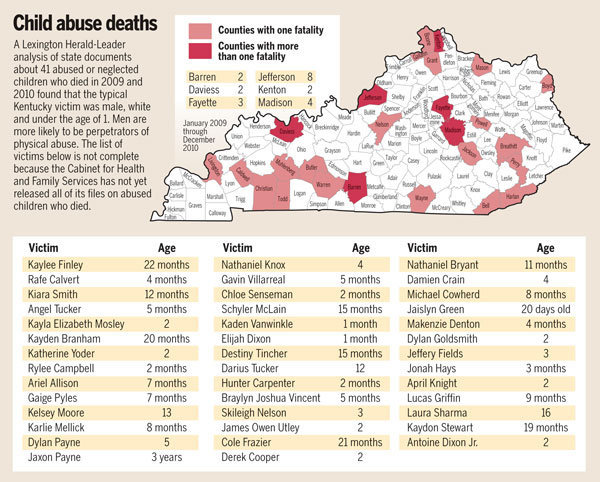
Six of 41 child-abuse fatalities show improper follow-up by Cabinet for Health and Family Services, Herald-Leader analysis finds


The way child-abuse deaths are reviewed in Kentucky continues to be problematic. Looking at the 41 child fatalities in 2009 and 2010, Lexington Herald-Leader reporters Beth Musgrave and Bill Estep found at least six cases in which the Cabinet for Health and Family Services "did not do an internal review even though there were previous reports involving the family before the child died."

State law requires the cabinet to conduct such a review when a child dies or nearly dies because of abuse or neglect and the cabinet had prior involvement with the family.

That didn't happen in the case of 2-year-old Derek Cooper, whose father placed his hands over the crying boy's mouth "until the child was silent," a state report said. Cooper's father, Brandon Fraley, had had contact with the cabinet when he was a child himself, and in 2006 there was an allegation of domestic violence against him, Musgrave and Estep report. Cabinet spokeswoman Jill Midkiff said the cabinet doesn't do internal reviews when the contact with the cabinet occurred when the alleged abuser was a child, but Midkiff "provided no explanation about why the 2006 domestic violence investigation of Fraley didn't trigger an internal review," the newspaper reports.

The analysis also showed vast differences in the way internal reviews are conducted in different parts of the state. "Some of the reviews appeared to be thorough, but in others, child-protection workers produced only one-page reports with little detail on what happened to the children and no assessment of potential improvements," Musgrave and Estep report.

"The cabinet for so long has hidden everything it could," said state Rep. Susan Westrom, D-Lexington, who tried earlier this year to pass a bill that would create an external child-fatality review panel. Gov. Steve Beshear has issued an order to create such a panel, whose members will review cases and make recommendations. The panel will not have cabinet staff as members.

Westrom's bill got hung up partly over the cabinet's attempt to impose further restrictions on the sort of information it is required to make public. The newspaper's analysis the result of a long fight the Herald-Leader and The Courier-Journal have waged to make the child-abuse documentation available to the public. C-J lawyer Jon Fleischaker said on KET yesterday that the cabinet continues to redact more information that it should, in an effort to protect its own interests. The fight continues in the appellate courts. (Read more)

Tuesday, July 17, 2012

Beshear to have outside panel review cases of children killed or life-threatened by abuse

An independent panel of experts will review cases of children who have been killed or severely hurt by child abuse or neglect, Gov. Steve Beshear announced Monday. The panel will have 17 members and be based in the Justice and Public Safety Cabinet. Its aim will be to assess if the state's child-protection workers did all they could to protect children who died as a result of abuse. It will also determine causes of death.

The Cabinet for Health and Family Services "released thousands of pages of documents Monday that detail the state's involvement with dozens of children who were killed or nearly killed as a result of abuse of neglect," reports Beth Musgrave for the Lexington Herald-Leader. "Still, the cabinet continues to withhold some case files and has redacted large portions of others."

The release is the result of a lengthy court battle between the cabinet and the state's two largest newspapers, the Herald-Leader and The Courier-Journal. The newspapers argued documents pertaining to these cases were subject to open record laws and Franklin Circuit Court Judge Phillip Shepherd agreed. The cabinet released 76 of about 140 files, but with key information omitted. In February, Shepherd ruled the cabinet had 90 days to hand over remaining case files, fined the cabinet $16,000 for withholding the records and ordered it to pay $57,000 in attorney fees for the newspapers.

The cabinet appealed the ruling in the Court of Appeals, but on July 9, the court sided with the newspapers, refusing to allow the documents from being withheld. More than 40 similarily-redacted cases were released yesterday but the cabinet filed an appeal with the Kentucky Supreme Court. "We disagree on how much personal information about the children and private individuals included in caseworker files should be made public," Cabinet Secretary Audrey Haynes said.

Also yesterday, Beshear issued an order to create the panel, which will meet four times a year and will issue an annual report that details issues it finds. "When a child dies or is critically injured because of abuse or neglect, we must carefully review the practices of all government entitites involved to make sure that our system performed as it was supposed to — and if not, that review allows us to take disciplinary action," Beshear said.

Panel members will include law enforcement, prosecutors and medical experts, Musgrave reports. While the meetings will be open to the public, the records consulted during them will not be subject to open records laws. (Read more)

Cabinet for Health and Family Services held in contempt over Medicaid services for Eastern Kentuckians

Hazard Appalachian Regional Medical Center, one of
eight ARH hospitals. Courier-Journal photo, copyright 2000
For taking "practically no steps to a comply" to a request to help thousands of patients transfer their Medicaid services, the Cabinet for Health and Family Services was held in contempt of court Monday.

U.S. Senior Judge Karl Forester said the Cabinet's refused to "process requests by patients to transfer away from Coventry Cares, a managed-care organization, in light of Coventry's impending termination of its provider contract with Appalachian Regional Healthcare," reports Valarie Honeycutt Spears for the Lexington Herald-Leader.

ARH and Coventry, part of Coventry Health and Life Insurance Co., battled it out in court earlier this year when Coventry wanted to terminate its contract in May — six months before its contract was set to expire — with the hospital chain, which covers 25,000 patients. In turn, ARH filed a lawsuit asking for a preliminary injunction to avoid the termination, which was ultimately granted. The injunction states Coventry must continue to pay ARH for services until Nov. 1. But the cabinet was supposed to help facilitate the transfer of patients from Coventry to Wellcare, the only other company that has a contract with ARH, in the meantime. Forester said in his order about 6,000 transfer requests "were being held by the Cabinet," Spears reports.

Mike Wynn of The Courier-Journal reports that 8,400 patients have sought to switch to Wellcare from Coventry since May.

Though Forester said he will decide whether to impose sanctions on the cabinet at a later date, but did not require "the cabinet to process transfer requests with the start of open enrollment only five weeks away," Wynn reports. The open enrollment window is between Aug. 20 and Oct. 19, Spears reports.

Cabinet attorney argued processing transfers was unnecessary since Coventry had been forced to pay for services through the open enrollment period. ARH argued stopping the requests creates confusion.

In response to the ruling, the cabinet praised Forester for acknowledging "the need to allow the Medicaid program to proceed with open enrollment so as not to cause a gap in service or confusion for members."

"Member support is extremely important and the cabinet remains committed to listening to concerns from Medicaid members about their managed-care company as well as medical providers," the statement continued.

Friday, June 29, 2012

New Kentucky Medicaid commissioner appointed

In the face of serious turmoil caused by the move to managed care for Kentucky's poor and disabled, a new Medicaid commissioner has been appointed. Lawrence Kissner starts his new job July 1.

Gov. Steve Beshear acknowledged the privatized system, now run by four managed-care companies, has run into some bumps and said he feels Kissner will "ensure that the Medicaid program is more cost efficient and, most importantly, more effective in providing high quality care to the Kentuckians we serve."

Kissner has nearly 30 years experience in the private insurance industry, 17 of which were specifically in managed care. Most recently he was president and CEO of Magnolia Health Plan in Jackson, Miss., a managed care company. In Kentucky, he will over see the program which serves more than 800,000 Kentuckians. He replaces acting commissioner Neville Wise, who has spent more than 22 years in various positions in the Medicaid program. He will remain with the department. (Read more)

Thursday, May 3, 2012

Beshear says he will create state health insurance exchange if federal health reform law is upheld

Gov. Steve Beshear said today that he will wait on creating a health insurance exchange under federal health reform until the U.S. Supreme Court rules on the constitutionality of the reform law, which is expected to happen in late June. He said in a press release, “The steps we have taken to date, and the planning process we are putting in place helps ensure the state is able and ready to follow the law.”

The exchange, a requirement of the Patient Protection and Affordable Care Act, would be a market for individual health-insurance policies. It would help small employers insure their employees in health plans and "enable individuals to receive premium tax credits and premium subsidies, and qualify small businesses for tax credits," the release said.

"The state has a $57.8 million federal grant to plan and implement of programs and systems required by the law, including "building an end-to-end eligibility and enrollment system to serve both Medicaid and exchange participants," the release said. "Kentucky previously received two federal health insurance exchange planning grants totaling $8.6 million." (Read more)

With time running short, why wait to issue an order? The court's decision "may impact the nature of the executive action," said Jill Midkiff, spokeswoman for the state Cabinet for Health and Family Services. "The timing of issuance of the executive order will not impact the current work or future work that is being completed to establish a state exchange. There is nothing that we need to accomplish at this point that requires an executive order to be in place."

Thursday, March 15, 2012

Beshear names Audrey Haynes secretary of embattled Cabinet for Health and Family Services

Audrey Tayse Haynes, who is a social worker by training but knows her way around politics, government and the nonprofit world, will be the new secretary of the state Cabinet for Health and Family Services. She will replace Janie Miller, who resigned last month after controversies over Medicaid managed care and release of child-abuse records.

"Audrey brings a dynamic mix of large-scale organization management, policy development, and government experience to this position," said Gov. Steve Beshear, who made the appointment. "This cabinet is a complex organization, with a broad range of programs that serve tens of thousands of our most vulnerable Kentuckians. Audrey has the right skills and resources to make sure our citizens continue to get the care and services they need."

Haynes, who starts her new job April 16, has spent the last 10 years as senior vice president and chief government affairs officer for the YMCA of the USA in Washington, D.C. During the latter part of the Clinton administration, she was chief of staff to Tipper Gore and an assistant to Vice President Al Gore. She first went to Washington on an appointment from Gov. Paul Patton as head of the state's policy office in the nation's capital.

Earlier, she was director of human resource development in the Department of Mental Health in the former Cabinet for Human Resources, and ran a literacy program with First Lady Martha Wilkinson in the administration of Gov. Wallace Wilkinson. She has bachelor's and master's degrees in social work, respectively, from Spalding University in Louisville and the University of Kentucky.

"From my experience working with Audrey Haynes, I know her to be a consummate professional," former state auditor Crit Luallen, who worked with Haynes during the Patton administration, said in the Beshear administration's press release. "She will bring strong management skills, as well as national leadership experience to this critical cabinet post."

Haynes said in the release, "I am excited to be back in Kentucky full time. CHFS impacts every single Kentuckian — whether through birth certificates, health departments, restaurant inspections or services to the elderly. I feel that I am returning to my roots of social work and mental health services."

One of her first areas of focus will likely be monitoring the new Medicaid system, which brought managed care to 560,000 recipients in November. During the current legislative session, lawmakers have heard complaints about the transition, including the manner in which those with mental illnesses are being treated. "Now that Secretary Haynes is in place, we can continue to make progress on major initiatives such as managed care and ensure that our citizens get the services they deserve," said Rep. Jimmie Lee, D-Elizabethtown, chairman of the subcommittee that writes the cabinet's budget. (Read more)