
Showing posts with label Search Engine. Show all posts

Thursday, April 15, 2010

Tools for Your Food Revolution - Wolfram|Alpha Lets You Compare Chicken to Corn Dog, Apple to Orange


Imagine if students had the opportunity to compare the nutritional values of lunch options and make informed decisions before ever hitting the cafeteria. For example, students can go online to Wolfram|Alpha and compare grilled chicken breast to a corn dog. Wolfram|Alpha provides them with a nutrition label for each item, and shows a side-by-side comparison of nutritional values such as fats, proteins, and vitamins in each food option.

More comparisons:

Compare egg to cod
http://www.wolframalpha.com/input/?i=compare+egg+to+cod

Compare shrimp to cod
http://www.wolframalpha.com/input/?i=compare+shrimp+to+cod

References:
Wolfram|Alpha Blog : Tools for Your Food Revolution
Comments from Google Buzz:

Dr Mike Cadogan - Some nice tools...
I also like the simplicity of fealth
http://www.fealth.com/nutrition

Ves Dimov, M.D. - Looks interesting... I was not aware of Fealth... http://www.fealth.com/nutrition

Dr Mike Cadogan - Original post was here:
http://lifeinthefastlane.com/2008/09/physician-feed-thyself/
I think I will repost...

Ves Dimov, M.D. - Isn't it nice - the way a blog serves as a personal archive... I have not read the post either. Will have a look. Thank you for taking the time to review the service back in 2008.

Image source: Wikipedia, public domain.

Friday, November 20, 2009

Google study: How physicians use the internet and search in their clinical practices

Embedded PDF: Google study: How physicians use the internet and search in their clinical practices.


Link via IgniteBLOG.

@amcunningham points out that the report is "unfortunately research carried out as market research for Google and doesn't help #meded very much."

Related reading:

Journal of Clinical Orthodontics published an article by SEO exert "MasterGoogle .com" on how to to outrank your competition... http://goo.gl/J8pzL

Thursday, November 12, 2009

Google "wonder wheels" are rudimentary mind maps

Update: The Google Wonder Wheel was discontinued by Google in 2011 http://goo.gl/9jdn2

Google "wonder wheel" for asthma looks like a rudimentary mind map: http://bit.ly/4tOOF (see below):

WikiMindMap provides better visual results http://bit.ly/2y4pnk (see below):


WikiMindMap is a website that organizes wiki content in a mind map format http://bit.ly/1ZV5rC and http://www.wikimindmap.org

See the "Web 2.0 and medicine" Google Wonder wheel http://bit.ly/3iHR1 - @giustini, @berci, @laikas and @DrVes make the top results:


Related:ICU Mind Maps http://bit.ly/1VIVOi and http://bit.ly/2EnZLi
Medical profession's use of mind mapping - WikIT http://goo.gl/1Kjd
Note taking with mind maps did not improve the scores of medical students (study) http://goo.gl/8qeQ
Study claims mind maps don't help learning - "you should just take tests" - NYTimes http://goo.gl/kvdSZ and http://goo.gl/6ql7n

Saturday, August 15, 2009

Embeddable Google Trends Gadget

This is an example of Embeddable Google Trends gadget:


Read more here: http://is.gd/xp10 and http://is.gd/zebt

"Search trends are a great way to see what's popular. Use this gadget to see what people are searching for on your own website.

Google Trends is based on search query volume and is updated daily."

Thursday, June 18, 2009

Wednesday, June 3, 2009

Create an automatic differential diagnosis list with Google Squared

"Google Squared is a search tool that helps you quickly build a collection of facts from the Web for any topic you specify. Facts about your topic are organized as a table of items and attributes (we call them "Squares" for fun). Customize these Squares to see just the items and attributes you're interested in. See the websites that served as sources for the information in your Square. Save and share Squares with others."

Nobody should use Google as a substitute for their doctor. Keeping this in mind, the search engines are evolving (Google, Bing and others) and can be interesting educational tools. See a few examples below:


Differential diagnosis of chest pain. Click here to see my shared "square."

The automatically generated list of differential diagnoses is incomplete and somewhat inaccurate (as expected). However, the concept is interesting and you can edit the list to remove erroneous entries and add new ones.


Google Squared differential diagnosis of shortness of breath, I added a CXR column. Click here to see my shared "square."

Medical educators can build their own "squares" and share them with residents and students. They can use the fields pre-populated with data by Google or create their own.

According to Google, "this technology is by no means perfect. That's why we designed Google Squared to be conversational, enabling you to respond to the initial result and get a better answer. If there's another row or column you'd like to see, you can add it and Google Squared will automatically attempt to fetch and fill in the relevant facts for you. As you remove rows and columns you don't like, Google Squared will get a fresh idea of what you're interested in and suggest new rows and columns to add. See it in action in the video below."


References:
Google Squared Live. Google Operating System.
Google Squared Is Live. Blogoscoped.
Square your search results with Google Squared. Google.
Topics Discussed During the Internal Medicine Rotation at Cleveland Clinic in May 2008
Topics Discussed During the Medicine Consult Service Rotation at Cleveland Clinic in April 2008
Using a Blog to Build an Educational Portfolio. CasesBlog, 1/2007.

Related:
Google Squared: quality improvements, sorting and exporting. Google Blog, 2009.

Updated: 10/09/2009

Thursday, April 10, 2008

Custom Search -- Create Your Own Medical Search Engine

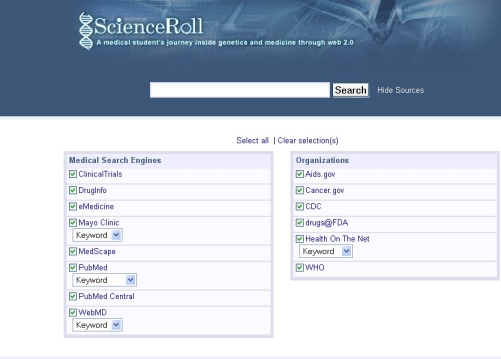
Google already gives you the option to create your own search engine and to share it with others. Berci Mesko used another service to create the interesting search engine ScienceRollSearch:

"You can choose which databases to search in and which one to exclude from your list. It works with well-known medical search engines and databases and we’re totally open to add new ones or remove those you don’t really like."

Give it a try to see if it works for you.


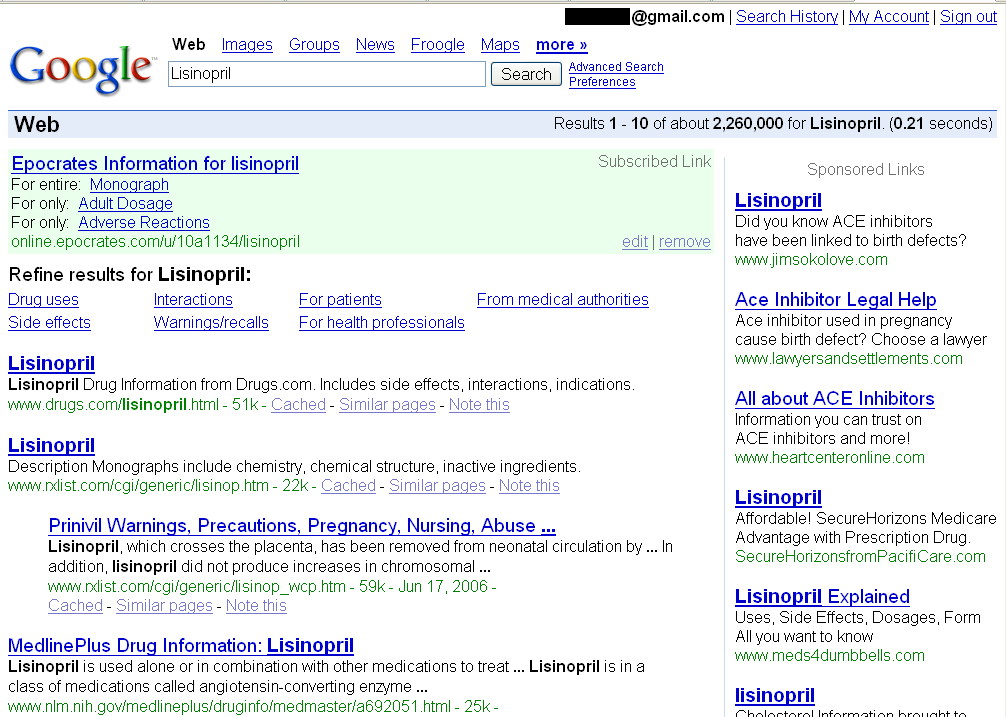
The future may be elsewhere though. Instead of switching to another search engine and learning a new interface, most people may be tempted to use Google Subscribed Links and to stay within Google. The usefulness of the service is still limited at the moment but if Google expands it to cover more sites of your choosing, and to prioritize the results at the top, this could be more useful than checking several search engines with one query. I really like the way it shows the Epocrates subscribed link in the first few results when searching for medications.

References:
Personalized Medical Metasearch Engine. ScienceRoll.
Do you hate Pubmed? Here is the solution! ScienceRoll.

Tuesday, March 11, 2008

NYC Nephrologist Finds Google Book Search Useful

Dr. Joshua Schwimmer is a New York City nephrologist and an author of several interesting medical blogs: The Efficient MD, KidneyNotes and TechMedicine. I have enjoyed reading Joshua's posts for years and have picked up some very useful ideas from them. In this video post on the official Google Book Search blog, he explains how he used Book Search as a teaching aid while in the emergency department with a group of students and residents.


Dr. Schwimmer's newest blog is called InfoSnack and is here: http://infosnack.net

Related:
Build An Online Version of Your Library and Share It Via Google Books

Updated: 10/06/2010

Friday, September 21, 2007

Visual Medical Dictionary Creates Mind Maps of Related Medical Terms

Visual Medical Dictionary by CureHunter Inc. can create mind maps of related medical terms. It is similar to WikiMindMap but somewhat more reliable since it is based on Medical Subject Headings (MeSH).

For example: a search for "obesity" will show a strong relationship with "insulin" and "exercise" among other terms -- see the image on the right.

Try other searches to see how the visual dictionary creates interactive network graph of related diseases and therapies.

It would be interesting to see if this type of visual tools and mind maps created on the fly will supplement regular PubMed searching strategies. Visual search engines like Kartoo are still far from replacing the plain Google interface.

Related:
Medical profession's use of mind mapping - WikIT http://goo.gl/1Kjd
Study claims mind maps don't help learning - "you should just take tests" - NYTimes http://goo.gl/kvdSZ and http://goo.gl/6ql7n

Thursday, April 19, 2007

A Medical Blogger Quoted in the Google Annual Report

Joshua Schwimmer of KidneyNotes was quoted in the Google annual report to shareholders. On page 5, he was commenting about the usefulness of Google search and Google Scholar for medical information. This is an excerpt from an interview Joshua gave to Dean Giustini in 2006. Dean interviewed 4 medical bloggers interested in using search engines for medical queries: Kevin, Joshua, Graham and me.

The fact that Google quoted Joshua proves 2 things:

- Google listens. They want feedback.

- Google became too big too fast and quality control suffers. They should have adhered to the the common practice of citing your sources. Joshua's quote was from Dean's blog and they should have linked to it as a primary source.

References:
I was quoted in the Google Annual Report. KidneyNotes.com.
Physician Bloggers Talk to a Medical Librarian
Image source: Tech Medicine.

Friday, January 12, 2007

Schmedley is Another Web 2.0 Start Page

I thought Netvibes was probably the slickest Web 2.0 start page (web desktop?) until I saw Schmedley.

As you can see from the screen shot on the right, Windows Live Search still has some catching up to do when you search for "clinical cases"...

Read the full review complete with useful screen shots on Go2web2.

References:
Schmedley: More Than Just A StartPage. Go2web2.
NetVibes is an example of what a web 2.0 desktop might look like
Pageflakes: The Teacher Edition. ScienceRoll, 12/2007.

Updated: 12/08/2007

Saturday, November 11, 2006

Google Finds Correct Diagnosis in 58 % of Cases Published in NEJM

According to a BMJ study, Google searches revealed the correct diagnosis in 58% of cases published in the case records of the New England Journal of Medicine in 2005. In each of the 26 cases studied, researchers selected 3-5 terms from each case and did a Google search without knowing the correct diagnoses.

In conclusion, "the use of web based searching may help doctors to diagnose difficult cases."

Hmm... I use Google multiple times every day but, in its current form at least, I am not sure sure I will let any search engine (which basically relies on "wisdom of crowds") to be my trusted diagnostic adviser.

Dr. Charles ran a few sample searches and was not very convinced either.

The Krafty Librarian points out that, "first, the authors just stated that Google only displayed results to the correct diagnosis 58% of the time, and now the they are ready to use it as a clinical decision tool! Those odds are slightly better than flipping a coin!"

"This is research?", asks one of the rapid responses, "I am amazed by the publication of this article. As a regular reviewer for numerous journals, this article would never have seen the light of day. The results actually show an extremely poor correct diagnostic rate even with trained personnel to filter and process the information. As doctors we would never accept the same level of diagnostic accuracy of a colleague. I am shocked that this has been published by the BMJ."

By the way, by naming their paper "Googling for a diagnosis" the authors violated one of Google "rules" which advises strongly against using the name of the search engine as a verb, e.g. googling.

I have covered the use of Google in medicine at length before -- you can review it here.

References:
Googling for a diagnosis--use of Google as a diagnostic aid: internet based study. BMJ.
Googling For A Diagnosis. The Krafty Librarian.
Is Google The Fastest Diagnostician On the Planet? UBC Academic Search - Google Scholar Blog.
This is research? BMJ. T C Winthrop.
Google 'aids doctors' diagnoses. BBC.
Attention: Paging Dr. Google! Dr. Charles.
Do you "Google?" Google Blog.
Google in Medicine
Adam Bosworth, Vice President of Engineering at Google Inc. covered similar topics in: How do you know you're getting the best care possible?
Google now wants to diagnose your disease, offers differential diagnosis based on 10 sites and Wikipedia http://goo.gl/SD1qM

Image source: Doctors Using Google by Philipp Lenssen, used with permission

Wednesday, November 1, 2006

Custom Google Search Engines to Help Patients Find Reliable Medical Information

Google brings blogs at the top of search results for many medical queries. This is good for bloggers but is it good for patients who search medical information online? Probably not, since many of them do not bother to check how reliable the source of the information is.

Micro Persuasion and The Krafty Librarian write about The Pew Internet and American Life research which shows that 75% of those who search for health information do not check the source or the date of the information they find.

If you are a doctor/physician group/hospital, you would like your patients to get reliable information online but you may not want to limit them to a few selected links listed on your website. The solution could be Google Custom Search Engine (CSE) which lets you include websites reviewed by you and found to be trustworthy. CSE either searches the selected sites exclusively or gives preference to them in the top results.

Philipp Lenssen writes that "CSE was just revealed this week, but there are already second-party directories built around the idea. Both CustomSearchGuide.com and Lurpo.com let you browse through different topics, and then search right on their site using the custom search engines." CSE is part of Google Co-op.

I found just 2 CSE for health information:
- Patient's Medical Info
- Health Professional's Medical Search

Summary:

Google CSE can help patients find dependable medical information online.

You can build your own Google Search Engine of reliable sources. Then just put a simple search box on your website and give a business card with the URL to your patients.

Update 03/28/2007:
Adam Bosworth, Vice President of Engineering at Google Inc. covers similar topics in: How do you know you're getting the best care possible?

Update 06/05/2007:
I use Google Custom Search Engines for the search function of ClinicalCases.org, CasesBlog and the related sites.

References:
Pew: Health Searchers Don't Check Their Sources. Micro Persuasion.
Growing Popularity of the Web to Solve Medical Questions. The Krafty Librarian.
Google Custom Search Directories. Philipp Lenssen.
Eureka! Your own search engine has landed! Official Google Blog.
Creating Your Own Search Engine using Google Custom Search. Google Tutor, 06/2007.
Creating Google Custom Search Engines. O'Reilly Media, 09/2007.

Related:
An easy way to add new features to Google. Matt Cutts: Gadgets, Google, and SEO, 02/2008.

Updated: 02/26/2008

Thursday, July 6, 2006

"Google Epocrates" Integrated in Search Results for Medications

Via Palmdoc Chronicles:

"You can now look up Epocrates drug info via Google. If you are a Gmail account holder, you can subscribe to Epocrates Online via Google Co-op... You will automatically see links to FREE Epocrates drug monographs at the top of your results list when doing Google drug searches."

This integration of Epocrates in Google search results is very useful. I am starting to see how Google Co-op will take off.

The interesting thing about Google is that sometimes they launch a service without an easy-to-understand purpose (take Google Base, for example) but with time, things seem to fit into place.

And pretty soon, everybody who wants to use the cool new services offered by Google has to register an account with them. Microsoft should have thought of that when they tried (unsuccessfully) to impose their "Passport" log-in to all users in the past: make people want to register instead of forcing them to do it. Hmm... "Don't be evil" motto seems even more important nowadays when Google will have (most of) your information.

Related:
An easy way to add new features to Google. Matt Cutts: Gadgets, Google, and SEO, 02/2008.

Updated: 02/26/2008

Thursday, May 11, 2006

BBC Search Adds Audio & Video

BBC award-winning website is one of the largest in the world and the challenge is to find what you want in this huge pile of information. They just launched a new search system which looks promising. The most useful addition seems to be the direct links to audio & visual content in the right sidebar. I wish Google provided something similar. This is a sample search for pneumonia on BBC.

Time-shift Your Favorite Programs

I have always enjoyed listening to BBC, especially since they launched their Listen Again page which allows me to choose when to listen to the programs I select. Time-shifting is the key to turning busy people into listeners and NPR knows it better than most -- NPR podcasting directory is one of the most comprehensive in the industry. See the section for Health & Science podcasts.

References:
BBC revamps website search system. BBC.
Text-to-Speech Programs and Continuous Medical Education
Image source: OpenClipArt.org, public domain.

Wednesday, May 10, 2006

Google Health is Part of Google Co-op

Google wants you to help organize the world's information

Google Co-op is human-powered vertical search, according to the press release:

"Google Co-op beta is a community where users can contribute their knowledge and expertise to improve Google search for everyone.

For example, a doctor can label web pages related to arthritis, and users who subscribe to that doctor's information will receive options at the top of the results for more specific information such as "treatment," "symptoms," or "for health professionals" when they enter a relevant query."

It sounds a bit complicated... If I want to direct my patients to a collection of trusted links, I prefer to list them on my own website.

Google Health

Nobody is certain what the best model for a health search/portal is. I tried the prototype of Google Health and I found it useful although on the surface it looks similar to the other health search engines. I would like Google to launch another game-changer rather than a "me-too" product.

See the search results for "pneumonia."

As usual, Google wins with speed, dept of page index and accuracy.

The source websites included in Google Health have been recommended by:

National Library of Medicine,
Centers for Disease Control and Prevention
Health On The Net Foundation
Harvard Medical School
Mayo Clinic
University of California, San Francisco
Kaiser Permanente

Google Health still covers blogs as you can see from the query for "pneumoperitoneum, sexual activity." It shows the clinical case I presented at the annual meeting of the Society of Hospital Medicine last week.

Google has a history of refining their beta products with users feedback. Even the current version of Google Health is better than the current search interface, so this is definitely a step in the right direction.

Final verdict:

The newly-launched Google Health is a helpful product with great potential. I am planning to use it and I would probably recommend it to my patients when they search for medical information.

Update 3/28/2007:
Adam Bosworth, Vice President of Engineering at Google Inc. covers similar topics in: How do you know you're getting the best care possible?

Update 5/31/2007:
A medical librarian does not find the health-related Google Co-op very useful: How Doctors Think and consumer health, Google.

References:
Medical Search Engines
Google Co-op First Look. Micro Persuasion.
How to Use Google Co-op. Google Blogoscoped.
Enoch Choi is an individual contributor to Google Health Co-op
Health care information matters. Google Blog, 11/30/2006, Adam Bosworth.
Image source: OpenClipArt.org, public domain

Related:
An easy way to add new features to Google. Matt Cutts: Gadgets, Google, and SEO, 02/2008.

Updated: 02/26/2008

Saturday, March 4, 2006

It's Brilliant: Continuous search engine queries for public health

Continuous search query means that you set up a search on GYM (Google, Yahoo, MSN) and subscribe to the RSS feed of it. The search engines perform the search continuously (every 20 minutes) and whenever they find something new, you get notified via RSS. Google and Yahoo offer the continuous search for their news section and MSN makes it available for everything, including plain search.


I use the continuous search queries to gather information whenever something new is published about the Cleveland Clinic or any other topic that interests me (from disease conditions to stock market). The IT department liked the idea so much that they now feature the RSS feeds for the Cleveland Clinic in the News on the front page: RSS Feeds for the Cleveland Clinic


Information is power. Dr. Brilliant is the newly appointed CEO of Google.org, the philanthropic arm of Google, and he is planning to harness some of this power to improve public health. He is reportedly working on a new Google spider which will continuously search the web for news stories that may signal an emerging epidemic. This is how the Global Public Health Intelligence Network found the first cases of bird flu last year.


TED Talks: Larry Brilliant: The case for informed optimism.


References:

Brilliant Google Exec to Use Internet to Prevent Disease. Medicalinformaticsinsider.com.

RSS Feeds for the Cleveland Clinic

Google Alerts Tutorial To Help You Stay Ahead of the Curve. DigitalInspiration.

Image source: Wikipedia


Further reading:

Q&A: Larry Brilliant. Nature News, 01/2008.


Updated: 07/26/2008

Monday, February 20, 2006

Medical Search Engines

A search engine that specializes in a particular field is called a "vertical" engine.

Only time will tell if the future belongs to "vertical" or "broad" search. Broad search is exemplified by Google where millions of websites fight for the coveted 10 spots on the first page of results.

If you tired of assembling queries like "pneumonia + eMedicine", go to one of the medical search engines where professional websites are included by default.

The list below shows some vertical search engines focused on medicine:

- Kosmix

- OmniMedicalSearch covers even Web 2.0 (whatever that means related to search results)

- Healthline

Notes from Dr. RW recently pointed out to Dermap: a Google Images enhancement for dermatology. Clicking on a body map generates a list differential diagnoses which can be entered into Google image search.

References:
Healthline, Kosmix & MammaHealth - Medical Search in the News. UBC Google Scholar Blog.
Image source: OpenClipart.org.

Monday, January 2, 2006

Epocrates Online Pharmacopeia is Now Free

Epocrates made its name as an easy to use free pharmacopoeia for Palm and Pocket PC. Now Epocrates offers the same features online:

https://rxonline.epocrates.com

After a free registration, you can access drug information from any computer connected to the internet. The most commonly used features are adult doses, price information and adverse effects.

Extra information, like pill photos and tables, is available to the paid subscribers.


Epocrates & iPhone. Link via Doctor Anonymous.

Related:
An easy way to add new features to Google. Matt Cutts: Gadgets, Google, and SEO, 02/2008.
(link via PalmDoc)
Review of Epocrates on the iPhone. Tech Medicine, 07/2008.

Updated: 07/18/2008

Monday, October 10, 2005

Google, M.D. In Action - Part II

We already know that googling can prevent unnecessary blood transfusions but this is something else - "Google, M.D." diagnosed the puzzling combination of "rash, adult, fever" without a flinch - with the first hit.

Otherwise it is the same old story again:

1. A patient googles a constellation of symptoms and asks her doctor what are the chances of her having the condition "x".

2. The doctor does not think that this is likely but decides to check a few tests anyway.

3. The test results confirm that the patient is having condition "x".

It makes you think "why don't doctors search Google from the beginning?"

We all know that it takes years to become a doctor, even longer to become a good one, so why does Google outsmart them? Actually, Google per se is not smarter than any physician (or any other person). It just has more information and is working hard to make it "universally accessible". No single person's brain can handle all the information on the "innumerable" Google servers.

In our case the diagnosis was RMSF - Rocky Mountain Spotted Fever, and the doctor was very honest: "I would have completely missed it if I hadn't listened to you", he told the patient. The patient does not blame her doctor "He didn't miss it. He was the first to think of it. And he sent off the test - even though it could prove him wrong. He just wanted to figure out what was going on. He listened to me. That's exactly the kind of doctor I want."

Dear doctor, next time when you are not sure what is going on, why don't you run a quick Google check? It won't hurt you to have one or two suggestions, no matter how crazy they look initially... Having UpToDate is nice but sometimes (just sometimes) Google offers the best answers. The problem is to differentiate between the false information and the valid suggestions produced by the computer algorithm, and this is where a physician has to step in. The doctors will never loose their job.

Update 3/28/2007:

Adam Bosworth, Vice President of Engineering at Google Inc. covers similar topics in: How do you know you're getting the best care possible?

References:
Sleuthing a Rash - NYTimes
Google, M.D. In Action
Who's your patient's best friend? Google!
Power of Google: A distinguished professor gets shown up by Google - MedPundit, NEJM
Evaluating Web Pages: Techniques to Apply & Questions to Ask - UC Berkeley
Checking medical facts online can be OK, but don't become a "cyberchondriac." TheJournalNews.com
Picture source: Google Blogoscoped by Philipp Lenssen, used with permission