Showing posts with label Career. Show all posts

Tuesday, November 22, 2011

A blog can help your career - and even if it doesn't, it's still good for you

From CNN:

There is strong evidence that people who use their blog as a career tool do better. In 2005, a Pew survey found that people who blog are generally higher earners. People who use social media end up finding jobs that are a better fit.

Changing your career and skipping entry-level positions can be easier if you have a blog.

Most importantly, a blog is a great platform for networking. Just look at this picture from the annual CME meeting Essentials of EM 2011.

A blog is a good way to meet other people who think like you do and who are in your field. It helps you to make real connections with them based on ideas and passions.

Social media use allows you to focus your connections on other top performers, since blogging about career topics probably self-selects for engaged and motivated people.

Social media in medicine: How to be a Twitter superstar and help your patients and your practice

The key concept is TIC, Two Interlocking Cycles:

- Cycle of Patient Education
- Cycle of Online Information and Physician Education

The two cycles work together as two interlocking cogwheels (TIC).
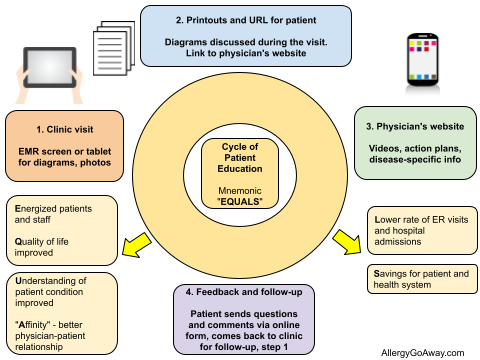


Cycle of Patient Education (click here to enlarge the image). An editable copy for your presentation is available at Google Docs.
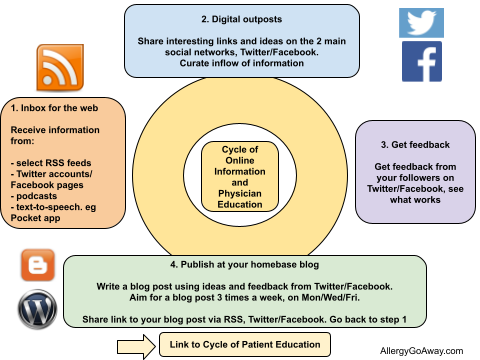


Cycle of Online Information and Physician Education (click here to enlarge the image). An editable copy for your presentation is available at Google Docs. Feel free to use the images in your own presentations with credit to AllergyCases.org.


References:

Blog your way to a better career. CNN.

Social media in medicine: How to be a Twitter superstar and help your patients and your practice

Patients directed to online tools don't necessarily use them: 25% checked website vs. 42% read same material on paper. Am Medical News, 2012.

Comments from Twitter:

Julie Meadows-Keefe @esq140: Challenge is finding time.

Tuesday, October 13, 2009

Job-hunting in a recession: Physician jobs are out there but they may not be easy to find

From American Medical News (AMedNews.com):

53% of companies hiring physicians said ability to sell a home is a significant barrier.

Physicians traditionally work within 100 miles of where they trained.

Physician recruiter: We have seen at least a 15% decline in the number of candidates applying for our positions.

85% of employers offer physicians signing bonuses with an average $24,850 (up from 58% in 2006).

Related:
Job Search: There's a feed for that?!
Image source: OpenClipArt, public domain.

Thursday, October 23, 2008

Using Twitter to Microblog a CME Meeting

Theresa Chan is family physician turned rural hospitalist with a widely popular blog and prolific Twitter posting. Her style of writing is no-nonsense, insightful and witty. Dr. Chan holds the dubious distinction of the doctor with the most Twitter posts (5,400 as of today, running head-to-head with @scanman) and in her case the quantity does not rule out quality.

Always a brave soul, Dr. Chan does not shy away from trying new gadgets -- from a portable scanner, to MacBook Pro, to Acrobat Pro to annotate presentation PDFs and save trees. She has colleagues turned informal Twitter advisers from around world to help her in the process.

Now, Dr. Chan is the author of another first (or close second, if somebody keeps track) -- she is live tweeting a CME meeting. The meeting is the 12th Annual Management of the Hospitalized Patient (in San Francisco, October 23-25th), arguably the most popular hospital medicine CME course, founded and chaired by the nation's top academic hospitalist Bob Wachter.

A few excerpts from the Twitter coverage are shown below and you can see all the posts here.

Bob Wachter is among the readers of my blog (honored to be listed in his favorite links) and he should definetly make a note of Dr. Chan's coverage which offers immediate feedback of this CME event.

I will be attending the NEJM Horizons Conference to push the boundaries of traditional medical publishing this weekend and was planning to live tweet from the meeting a few interesting observations if time permits. However, I do not expect the reach the level or volume of coverage of the meeting demonstrated by Dr. Chan.

See below Dr. Chan's coverage of the hospitalist CME meeting and a few comments from her "followers," the oldest posts are at the bottom, the newest at the top:

ruraldoctoring
ruraldoctoring Because, in Rural, I think the neurologists do maybe 2 inpatient EEGs at my hospital a year. OK, maybe 5.

ruraldoctoring
ruraldoctoring #SHM: Discussing need for urgent EEG, even if this requires transfer to another hospital. Trying not to laugh.

ruraldoctoring
ruraldoctoring #SHM: "When the EEG begins to look like the EKG, things are not normal."
ruraldoctoring
ruraldoctoring #SHM: "We don't think about [encephalitis] often enough." I do! Or at least I think I do.

ruraldoctoring
ruraldoctoring #SHM: "Delirium: A Stress Test for the Brain." I like it.

ruraldoctoring
ruraldoctoring #SHM: Now we're talking about my favorite hospitalist problem: Delirium.
ruraldoctoring
ruraldoctoring #SHM: Discussing reasons for readmit after pneumonia hospitalization:

ruraldoctoring
ruraldoctoring #SHM: Ah, the UCSF physician's demeanor. The brisk confidence, the articulate and slightly self-mocking humor. I'd forgotten.

ruraldoctoring
ruraldoctoring #SHM: Now talking about CA-MRSA pneumonia. Yes I've seen it, even in Rural.
ruraldoctoring
ruraldoctoring #SHM: Oh, and btw, I *am* using Acrobat Pro to annotate PowerPoint PDFs provided by speakers. It works.

ruraldoctoring
ruraldoctoring #SHM: I will say they choose excellent speakers for this meeting. Good thing, otherwise I'd be sitting with 700 other bored hospitalists.

ruraldoctoring
ruraldoctoring #SHM: Post-stroke management must include permissive HTN--up to at least 220/120 unless tPA is planned. I knew this but the struggle!
ruraldoctoring
ruraldoctoring #SHM: tPA decisions will probably be made on basis of perfusion patterns in near future, after identifying areas of salvagable tissue.

ruraldoctoring
ruraldoctoring #SHM: "A lot of you work at these stroke referral centers." Ah, not.

ruraldoctoring
ruraldoctoring #SHM: UCSF Stroke CT protocol: 1)noncon brain + 2)CT Angio from Ao arch to Circle of Willis, 3)CT perfusion study, 4)Post-contrast CT.

ruraldoctoring
ruraldoctoring #SHM: European SITS-MOST study suggests tPA can be effectively implemented in non-referral hospital settings safely. Gotta read it myself.

sandnsurf
sandnsurf Twittepathical interjection...we have many strange beasts and venomous creatures down under - but a neurohospitalist - woke me from my sleep

Vijay
scanman @ruraldoctoring No such animal in the entire Indian subcontinent. May never have been seen outside the US :)

ruraldoctoring
ruraldoctoring #SHM: We now move on to talk by "neurohospitalist" S. Andrew Jacobson. No such animal has ever been sighted in Rural.

ruraldoctoring
ruraldoctoring #SHM: We now move on to talk by "neurohospitalist" S. Andrew Jacobson. No such animal has ever been sighted in Rural.

ruraldoctoring
ruraldoctoring #SHM: Talking about orthopods disliking conventional post-op anticoag guidelines. They have their own guidelines, I didn't know this.

Ves Dimov, M.D.
AllergyNotes @ruraldoctoring @sandnsurf Re: "SHM live tweeting, I feel so cutting-edge now" Yes, you are. And you have followers :-)

Vijay
scanman @ruraldoctoring YOU ARE cutting-edge material, Theresa. The #1 tweeting Rural Doctor :)

ruraldoctoring
ruraldoctoring @sandnsurf @AllergyNotes Gee, I feel so cutting-edge now.

sandnsurf
sandnsurf @AllergyNotes @ruraldoctoring - this is really exciting - I have watched cricket on teletext (UK) but livetweeting is the real deal

ruraldoctoring
ruraldoctoring @AllergyNotes Yup, tweeting LIVE from the Grand Ballroom of the Fairmont Hotel, San Francisco.

Ves Dimov, M.D.
AllergyNotes LiveTwitting - a new/easy way to cover conference sessions! Readers can follow your session coverages in real time: http://livetwitting.com/

Ves Dimov, M.D.
AllergyNotes @ruraldoctoring Re: "Finally arrived at SHM meeting" Are you live twitting from the meeting?

Ves Dimov, M.D.
AllergyNotes @ruraldoctoring Re: "Finally arrived at SHM meeting after sweaty sprint up 16% grade San Francisco hills." Good job!

ruraldoctoring
ruraldoctoring Talk is about thromboembolic disease. Discussing thromboembolic therapy, which we don't use in Rural for PE.

ruraldoctoring
ruraldoctoring Think I've passed my stress test--no chest pain. Near-syncope a few times, but no chest pain.

ruraldoctoring
ruraldoctoring Finally arrived at SHM meeting after sweaty sprint up 16% grade San Francisco hills.

ruraldoctoring
ruraldoctoring OK, now that I'm up before 6am, going to this CME seems like the dumbest idea in the world.

ruraldoctoring
ruraldoctoring Going to bed. CME meeting starts tomorrow.


I think Dr. Chan should summarize her experience live blogging the CME meeting and getting immediate feedback from her followers in an abstract. This simple method of sharing public notes and professional interaction needs to be popularized beyond a niche product and deserves a wider adoption by physicians:

Ves Dimov, M.D.
AllergyNotes You have to love the term the Twitter team pioneered for social network buddies -- "followers." It makes you sound almost prophetic.

Ves Dimov, M.D.
AllergyNotes Easy and useful: Twitter can be used to take public notes and have you colleagues and followers comment on them in real time.

And the grand finale of this post is (drumroll)... a formal proposal to list Dr. Chan among the 50 Most Powerful and Influential Women in Medical Social Media:

Ves Dimov, M.D.
AllergyNotes 50 of the Most Powerful and Influential Women in Social Media http://tinyurl.com/3rh6fy


References:
I will be attending NEJM Horizons Conference to push the boundaries of traditional medical publishing, suggestions welcomed
A Doctor's Opinion: Why I Started Microblogging on Twitter
Selection of My Twitter Favorites

Thursday, September 11, 2008

BMJ Career Advice: CV Writing, Interview, Presentation and Networking Skills

Medical CV writing skills

Interview skills

Presentation skills: plan, prepare, phrase, and project ( 4Ps)

Networking skills—more than just self promotion

These BMJ articles look like a good addition to the The Efficient MD Wiki build by Joshua Schwimmer, MD, FACP, FASN. Joshua was very kind to invite me as a collaborator on that project and I try to contribute whenever I can. You can join too:

"Wikis — collaborative websites — are powerful tools for education. The Efficient MD Wiki is designed to help healthcare professionals and medical students discover clinical pearls, useful resources, life hacks, and strategies to improve the practice of medicine."

Related:
It's Interview Time Again for Future Residents -- See Helpful Tips
Image source: Image source: OpenClipArt.org, public domain.

Tuesday, July 29, 2008

Study: Future doctors share too much on Facebook. Way too much.

You can always rely on Joshua Schwimmer to find some interesting links and here it is:

Future doctors share too much on Facebook. University of Florida News Desk.

"Would it bother you to know that your physician smokes cigars and likes to do “keg stands”? That your gynecologist was a member of a group called “I Hate Medical School”? That your urologist is a fan of “The Texas Chainsaw Massacre”?

That is exactly the sort of information many people share on social networking sites such as Facebook and MySpace. According to a new University of Florida study, many medical students are sharing far too much."

The study was published in the Journal of General Internal Medicine (again?).

"Facebook is full of bluster and trash talk, and college-age users may feel that these items are not to be taken seriously. Yet patients and future employers, the researchers say, may not have quite so strong a taste for irony.

“Doctors are held to a higher standard,” Thompson said. “There are stated codes of behavior that are pretty straightforward, and those standards encourage the development of a professional persona.

The medical profession isn’t the only career that requires young people to develop a professional identity."

One of the best ways to establish an online identity is to buy a domain for your own name, start a blog and link them together. Then, you can be sure that when people Google your name, they will find you and not "bad_goat457," for example.

A domain name costs $ 10 per year. Most students are short of money but if you decide to place AdSense ads on your blog, the tiny income ($ 2 a month?) will pay for the domain name. Please note: this is not a product endorsement for Google AdSense.

Of course, as a future physician, it is probably better to blog if you have something valuable to say, or if you are planning to create a personal learning archive of sort. Google is already plenty busy indexing those trillions of web pages as it is.

Tips for Medical Bloggers

  • Write as if your boss and your patients are reading your blog every day
  • Comply with HIPAA
  • List your name and contact information
  • If your blog is work-related, it is better to let your employer know
  • Inquire if there are any blogging guidelines. If there are, comply with them strictly
  • Use a disclaimer, e.g. "All opinions expressed here are those of their authors and not of their employer. Information provided here is for medical education only. It is not intended as and does not substitute for medical advice."
  • Get your blog accredited by the Heath on the Net Foundation

Twitter updates:

  • Woman gets fired for calling in sick, but employer catches her online at home on Facebook. http://bit.ly/zGQjq

  • Omaha Herald: "Party busted for underage drinking after event posted on Facebook" http://bit.ly/UESdo

References:
Make Yourself Google-able
How Can a Doctor Use Google Page Creator?
Geek to Live: Have a say in what Google says about you. Lifehacker.com, also image source.
Content of Weblogs Written by Health Professionals: More Bad than Good?
Using a Blog to Build an Educational Portfolio
Becoming a Clinical Assistant Professor of Medicine and Web 2.0 Projects
How to manage your reputation online. Medical Economics, 01/2009.

Updated: 04/27/2009

Wednesday, June 11, 2008

Job Search: There's a feed for that?!

An example of power of RSS feeds from Google Reader blog:

"I was having a hard time finding the right job here in Houston. Days would go by without talking to a single recruiter. But then I started using Google Reader to subscribe to custom-made job search feeds for Craigslist, and for oodle.com (which already aggregates feeds from thousands of other classified ad websites).

Soon I found myself flying all over the country interviewing for jobs. The employers always pay for the flights, hotels, rental cars, etc. My job hunt became like an exciting vacation! I've been to New York twice, Milwaukee, Austin, Los Angeles, and Miami. I just accepted an offer in Manhattan with a very competitive salary offer. Google Reader saved me a huge amount of time and effort with the job hunt."

I wonder if you can use the same approach when searching for a job as a physician.

References:
There's a feed for that?! Google Reader blog.

Saturday, February 23, 2008

Too many feeds to read? Time to trim down RSS subscriptions

Web feeds readers have truly become an "inbox for the web." Until recently, I was subscribed to about 600 web sites, blogs, medical journals, podcasts and persistent searches. With so many feeds to read, information overload became a real issue, and I trimmed down the number of RSS subscriptions significantly this month.


Image is licensed under Creative Commons.


Video: RSS in Plain English

Related:
Dealing with Information Overload. LifeHack.org
Best Web Feeds Reader for Medical and General Information
How to Read Blog Articles Written Only By Your Favorite Bloggers. Digital Inspiration, 02/2008.
Troubleshooting RSS addiction: a blogger finds freedom in a world without feeds. Download Squad, 04/2008.
Check the series "What I Read" by different people in The Atlantic (scroll to the bottom of the page to see other links) http://goo.gl/xWUb

Updated: 04/23/2008

Sunday, February 10, 2008

UK closes its doors to foreign doctors

According to the The Times, the National Health System (NHS) is closing its doors to foreign doctors in an attempt to preserve jobs for British graduates.

What is the reason?

Since 1997, the number of medical schools in Britain has doubled. There are now enough home-grown graduates, thus reducing the need to import doctors.

Currently, half of Britain's 277,000 registered doctors were trained overseas. Last year, 10,000 foreign doctors applied for 20,000 posts.

What will happen to the foreign doctors currently in the UK or planning to relocate there?

Many international medical graduates (IMGs) will plan to continue their training in the U.S. or Australia. According to anecdotal evidence, it is much more difficult for the IMGs to find residency positions in the U.S. nowadays due to the influx of competition from Britain. The situation is worse in Australia where IMGs have to wait months just to take the board exams required to start training -- see this recent NEJM article.

References:
NHS closes its doors to foreign doctors
Foreign doctors face competence inquiry
Comment: prejudice against overseas doctors
A Bridge to Nowhere — The Troubled Trek of Foreign Medical Graduates in Australia. NEJM, 01/2008.

Related:
A Guide for Doctors Planning to Relocate Abroad. Clinical Cases and Images - Blog.
A good doctor with a "bad" accent? Clinical Cases and Images - Blog.
Image source: Openclipart.org, public domain.

Wednesday, January 30, 2008

A Person Who Loves His Job

Steve Rubel is a public relations executive at Edelman and a well-known blogger. These are excerpts from his life stream:

steverubel: Work is my big hobby. I am truly lucky to have found a nexus between my passions and profession. (via Twitter / steverubel)

steverubel: I love days when I get into the office before the sun comes up. You feel like you're ahead of the game. (via Twitter / steverubel)

steverubel: You know you're getting old when you get up before 6 am (even on weekends) and get very sleepy by 9:30 or 10. (via Twitter / steverubel)

steverubel: The downside of getting up at 4 is being wiped out by 8.

Update 01/31/2008:

You have to love Steve's reply:

"A blogger notices from my lifestream that I love my job, which I do! Downside? It’s the Clinical Cases blog!"


A CommonCraft video explains what a microblogging platform is by using Twitter as an example.

Related:
Aggregated Lifestream Combines All Content Created by You Into One Site/Feed
Are you obsessed with your job? CNN.
Chronic stress at work can make you sick. Clinical Cases and Images - Blog, 03/2006.

Updated: 03/10/2008

Sunday, October 7, 2007

It's Interview Time Again for Future Residents -- See Helpful Tips

During this time of the year U.S. medical students and international medical graduates (IMGs) are preparing their ERAS applications and waiting for interview offers from residency programs. A selection of helpful (and funny) blog posts is collected below:

It's Interview Time for IM Residency -- Avoid Top 10 Mistakes

Residency Interview Advice from Big Mama Doc

A Guide for Doctors Planning to Relocate Abroad

UK Medical School Interview Technique on YouTube

Related reading:
Image source: Image source: OpenClipArt.org, public domain.

Monday, September 17, 2007

Salary Stories: Hospitalist

Salary Stories Blog has an interview with Frank L. Urbano, MD, FACP who is also the author of several case studies on PrimeInc.org:

"I typically see between 20 to 30 patients per day, and that allows me to have a generous hospitalist compensation package. Hospitalist practices generally have very small overhead compared to outpatient offices, so hospitalist salaries can be higher."

Another hospitalist by the blog name of FatDoctor writes: "My work at urgent care and as a hospitalist is like the Jiffy Lube of healthcare. We can change your oil, but for real care, better see your PCP."

Related:
Definition of "Hospitalist" Added to Merriam-Webster Dictionary
Another Study Questions the Value of Hospitalists
Physician Assistant Salaries: A Day in the Life of a Physician Assistant. Salary Stories.
Lube Job. FatDoctor.

Updated: 10/02/2007

Friday, September 14, 2007

5 Quick Fixes for Physician Resume and More Career Advice from Doctor Job Blog

The Doctor Job blog has some useful tips for making physician resumes more attractive to prospective employers. According to them, of the two examples below, B is a much better format than A.

Example A:

1999-2003, St. Francis Hospital, Queens, NY, Internal Medicine Resident

Example B:

Internal Medicine Resident, 1993–2003
St. Francis Hospital, Queens, NY

More links:
Structuring Your Resume for Success
Resume advice for visa holders
Why your resume annoys employers. CNN, 08/2007.
How to Construct a Killer Resume, From Start to Finish. The Simple Dollar, 11/2007.

Updated: 11/09/2007

Wednesday, September 5, 2007

Stock market is not working well for an oncologist/amateur investor

WSJ/Yahoo Finance:

"By day, Brian Abbott is a doctor at a cancer institute in Great Falls, Mont. In his off hours, he invests with borrowed money, shorts stocks and has taken a complex options position called a "short strangle" on wheat. Rather than protecting his $1 million or so in holdings, the 35-year-old physician says he left it vulnerable.

"Things that should have protected me weren't working," Dr. Abbott says of the market in recent weeks. "Everything was seeming to go down."

References:
Small Investors, Too, Get Nailed by Arcane Trades. Wall Street Journal, 08/2007.
When Bad Strategies Outperform. Seeking Alpha, 11/2007.
After a Devastating Trading Loss. TraderFeed, 11/2007.
Image source: Wikipedia, GNU Free Documentation License.

Related:
How Much Do You Save? The Happy Hospitalist, 01/2008.
How to become a stock broker. The Independent Urologist, 02/2008.

Updated: 01/24/2008