Showing posts with label Twitter. Show all posts

Thursday, April 12, 2012

Will traditional scientific journals follow newspapers into oblivion, asks former BMJ editor

Richard Smith is a former editor of the BMJ and chief executive of the BMJ Publishing Group. He is well-known for provocative editorials. Here is an excerpt from one, published recently in The Scientist:

"Elsevier, the world’s largest publisher of scientific journals, has seen broadly stable revenues (€2,236 million in 2006, €2,370 million in 2010) but growing profits (€683 million in 2006, €847 million in 2010).

Scientific journals remain very profitable. Few industries manage a profit margin of 35.7% (that for Elsevier in 2010), but then few industries are given their raw material—in this case, scientific studies—not only for free, but also in a form that needs minimal processing."

It is nice to see that the current and a former editor of the two most famous British medical journals, The Lancet and BMJ, are now on Twitter:


References:

Reading Into the Future | The Scientist, 2012.
The scientific journal throuh the centuries - a little bit of history from Health Librarian (HL) Wiki http://buff.ly/WZqP2S

Tuesday, March 27, 2012

The Number of Tweets Predicts Future Citations of a Specific Journal Article

Citations of journal articles and the impact factor are widely used measures of scientific impact. Web 2.0 tools such as Twitter, Facebook, blogs and social bookmarking tools provide the possibility to construct article-level or journal-level metrics to gauge impact and influence.

Between 2008 and 2011, all tweets containing links to articles in the Journal of Medical Internet Research (JMIR) were data mined.The tweets were compared to subsequent citation data 17-29 months later.

4,000 tweets cited 280 JMIR articles. The distribution of tweets followed a power law, with most tweets sent on the day when an article was published (44% of all tweets in a 60-day period) or on the following day (16%), followed by a rapid decay.

The Pearson correlations between "tweetations" and regular citations were moderate and statistically significant (0.42 to 0.72).

Highly tweeted articles were 11 times more likely to be highly cited than less-tweeted articles.

Top-cited articles could be predicted from top-tweeted articles with 93% specificity and 75% sensitivity.

Tweets can predict highly cited articles within the first 3 days of article publication.

Social media activity may:

- increase citations
- reflect the underlying qualities of the article

Social impact measures based on tweets are proposed to complement traditional citation metrics. The study author proposed a "twimpact" factor that measures uptake and filters research resonating with the public in real time.

After the initial publication, some science blogs have pointed out potential issues and conflicts of interests in relation to the topic and the single author who is also the founder, owner, and Editor-in-Chief of the journal. You can find more by performing a Google search for "twimpact" factor or checking the references section at the end of this post. Overall, I think this is an interesting concept and Gunther Eysenbach did a great job focusing the attention of the journal publishers on Twitter and Facebook as distribution channels that can also guide in measuring the impact of their articles.

References:

Can Tweets Predict Citations? Metrics of Social Impact Based on Twitter and Correlation with Traditional Metrics of Scientific Impact. Gunther Eysenbach. J Med Internet Res 2011;13(4):e123.

New research plus twitter. Does it make a difference in the clinic. Heidi Allen Digital Strategy in Health.

'Highly Tweeted Articles Were 11 Times More Likely to Be Highly Cited'. The Atlantic.

Twimpact factors: can tweets really predict citations? BMJ.

Tweets, and Our Obsession with Alt Metrics

Image source: Twitter.com.

Comments from Twitter:

@paediatrix:  Interesting. Makes sense

Harris Lygidakis @lygidakis: And Twimpact Factor is a good sign of what's ahead!

Wednesday, December 14, 2011

Best Tweets - Selection of Twitter Favorites


The inclusion of a Twitter update (tweet) in Best Tweets - Selection of Twitter Favorites does not represent endorsement or agreement of any kind. If you are included in this post but you would like to have your tweet removed for any reason, please email me and will comply with your request the same day.

Tuesday, November 1, 2011

Why you shouldn't close your blog and Twitter account

A few months ago, @Doctor_V and an anonymous doctor on Twitter had an argument, she closed her account and now DrV's blog is the only one left to tell the story: http://goo.gl/mIS3N

I understand and appreciate the arguments of both parties. However, when she deleted her Twitter account, we lost one side of the story forever.

All doctors should consider having online presence because they need to tell their side of the story.

For example, if the majority of pediatricians had blogs, the false autism/immunization link would not have become accepted by celebrities and misled a large part of the general public.

Comments from Google Plus:

Arin Basu: Excellent point by Ves about how false findings spread (read the bit about immunization and autism). I think by the same stretch of logic, I'd strongly vouch for clinician-epidemiologists, and epidemiologists should have their own blogs, and take part in social media more often and raise awareness about findings and interpretation of studies. Well said, Ves.

Related reading:

Why blog? Notes from Dr. RW. A perfectly reasonable list. All doctors should consider blogging. It's do-it-yourself CME.

Tuesday, October 25, 2011

Social media in medicine: How to be a Twitter rockstar and help your patients and your practice

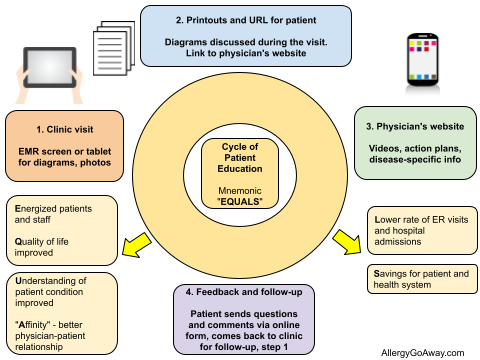
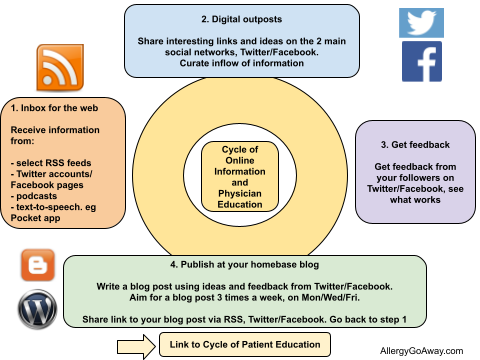
This is the key concept from a series of talks that I presented at several national and international meetings in 2011-2012 (CSACI, AAAAI and WAO) - TIC, Two Interlocking Cycles:

- Cycle of Patient Education
- Cycle of Online Information and Physician Education

The two cycles work together as two interlocking cogwheels (TIC).

Cycle of Patient Education (click here to enlarge the image). An editable copy for your presentation is available at Google Drive:


Cycle of Online Information and Physician Education (click here to enlarge the image). An editable copy for your presentation is available at Google Drive:


The first presentation was during the annual meeting of the Canadian Society of Allergy and Clinical Immunology (CSACI) and brought a lot of engaged, useful, and interesting questions. Feel free to use the images in your own presentations with credit to AllergyCases.org.

The two cycles work together as two interlocking cogwheels. Here is how to facilitate the Rise of the ePhysican who works hand in hand with the ePatient:


Products of the Cycle of Patient Education: EQUALS

- Energy!
- Quality of life is improved
- Understanding of patient condition is improved
- "Affinity" - better physician-patient relationship leads to increased referrals to the practice, e.g. 2-5 new patients per week per physician, increased revenue
- Lower rate of ER visits, hospital admissions, phone calls
Savings for patient and health system

What is Return On Investment (ROI) of Cycle of Patient Education?

Calculated ROI:

- 2 new patients per week who come to the clinic directly from the blog/Twitter account
- $500 reimbursement for 2-3 visits (initial visit and 1-2 followup visits)
- 50 weeks x 2 patients = 100 new patients per year
- 100 patients x $500 = $50,000 per year

The best interest of the patient is the only interest to be considered

The purpose of the cycle is not to make money. As the Mayo Clinic CEO pointed out recently, Mayo Clinic intends to be the leader in social media in healthcare but this is not about competitive advantage, it is about the patient. The best interest of the patient is the only interest to be considered. Social media makes the union of forces more broadly practical than at any time in human history.

Social media for physicians: Do I really need to be on Twitter, Facebook and YouTube?

(the text below uses the specialty of allergy and immunology as an example, an edited version was published on the website of the World Allergy Organization where I write a monthly column)

It certainly looks like social media is taking over the world. Facebook is a “country” with more than 750 millions citizens. Twitter has more than 250 millions users. Google+ is the fastest growing web service and history and reached 25 million users in just one month after its launch. As an allergist, you may ask yourself, “Where is my place in all this? Do I have to be on Twitter? Do I have to use Facebook and YouTube to stay relevant?” The answer is yes.

With the recent update of Google called "Search Plus Your World", individuals, physician practices and organizations without social media presence will be pushed further down the page of search results. That means, unfortunately, that if your practice does not have a strong social media presence, when patients/physicians search for a health topic, they may not see the quality results they deserve.

Number of Tweets Predicts Future Citations of a Specific Journal Article

Twitter is becoming essential for both authors and publishers of scientific literature. Highly tweeted journal articles are 11 times more likely to be highly cited than less-tweeted articles. Top-cited articles could be predicted from top-tweeted articles with 93% specificity and 75% sensitivity. A "twimpact" factor is proposed that measures uptake and filters research resonating with the public in real time (Med Internet Res 2011;13(4):e123. http://www.jmir.org/2011/4/e123).

You can be a physician and a social media superstar at the same time

Social media can provide a focused and time-efficient learning experience. Sharing relevant medical news with patients is just a click away. The paramount is to protect patient privacy at all times and to comply with your employer and professional organization guidelines. You can be a physician and a social media superstar at the same time. Here is how in 3 easy steps.

1. Use of Internet to learn and stay up-to-date

- Web feeds (RSS and Atom) work great for for targeted updates from journals, websites, and allergy/immunology news. RSS stands for Really Simple Syndication and consists of updates pulled from a particular website whenever something new is published. RSS feeds can be separated in different categories, e.g. asthma, allergic rhinitis, etc. Web-based RSS readers (Google Reader, Feedly, Flipboard) function as “inbox for the web”. You can get all sources delivered in one location - a web-based reader

- Blogs and Twitter accounts. A selected list of high-yield blogs and Twitter accounts of board-certified allergists/immunologists includes: @JuanCIvancevich (Juan C. Ivancevich, Buenos Aires, Web Editor of the World Allergy Organization), @wheezemd (Michael Blaiss, MD, Past President of the American College of Allergy, Asthma, and Immunology), @DrSilge (Robert Silge, MD, allergist/immunologist, Salt Lake City, Utah), @AllergyNet ( John Weiner, allergist, clinical immunologist, Melbourne, Australia), @MatthewBowdish (Matthew Bowdish MD, allergist/clinical immunologist, Colorado), @allergydoc4kidz (Stuart Carr, allergist/immunologist, Canada), and the author’s own Twitter account at @Allergy.

- Podcasts for allergy and immunology education represent mobile-based MP3 files and services with automatic subscription. Free podcasts/videocasts are provided by COLA Allergy (ACAAI, http://childrensmercy.org/content/view.aspx?id=5979), Journal of Allergy and Clinical Immunology (AAAAI, http://jacionline.org/content/podcast), and World Allergy Organization (http://journals.lww.com/waojournal/Pages/podcasts.aspx).

- Persistent searches for topics of interests in allergy/immunology. You can subscribe to RSS feeds for "persistent searches" in PubMed and Google News for the topic of your interest, e.g. “oral immunotherapy for food allergy”.

- Text-to-speech (TTS). You can use text-to-speech to listen to journal articles at a later time. The text-to-speech programs convert the the text of a journal article into an MP3 file. A free program is Balabolka (http://cross-plus-a.com/balabolka.htm).

- Clinical cases and practical questions are available from the World Allergy Organization Journal, AllergyCases.org (disclaimer: the author is the founder of the website), AAAAI Ask the Expert (http://aaaai.org/ask-the-expert.aspx).

2. Use of Internet and computers for patient education

- Patient education diagrams - web- and iPad/tablet-based diagrams are well-received by patients and doctors in training. The the author's survey at the allergy clinic of the University of Chicago showed a 95% patient approval rate for iPad use for patient education. The diagrams used in the study are available here: Diagrams for Patient Education.

- Videos for patient education can be viewed on tablet or netbook. The videos can be streatmed from the physician's website or downloaded locally. Targeted videos can be used for patient education before and during the visit, for example, “what to expect from your visit at the allergist office”, “how to use an inhaler”, etc. There is a continuum of education - start at the office (tablet or netbook), then continue at home (web-based videos and selected educational brochures and links).

- Ready-made patient education brochures can be printed from allergist's website. A custom-made search engine can generate brochures on demand, e.g. Medline Plus.

3. Use of Internet to promote your practice and collaborate

- Start a website for free (WordPress.com or Blogger.com). Start a Twitter account and professional Facebook page for your practice.

- Setup persistent searches for your name/practice on Google, Twitter, etc. and subscribe to RSS for automatic updates. You can address questions and concerns whenever they arise.

- Use Google Docs for research collaboration, creating diagrams for patient education, office calendar, and spreadsheets.

Risks of social media use by physicians

Physicians must maintain appropriate boundaries of the patient-physician relationship in accordance with professional ethical guidelines just as they would in any other context. When physicians see content posted by colleagues that appears unprofessional they have a responsibility to bring that content first to the attention of the individual, so that he or she can remove it and/or take other appropriate actions. If the behavior significantly violates professional norms and the individual does not take appropriate action to resolve the situation, the physician should report the matter to appropriate authorities (Source: AMA Policy: Professionalism in the Use of Social Media, 2011).

12-Word Social Media Policy by Mayo Clinic: "Don’t Lie, Don’t Pry, Don’t Cheat, Can’t Delete, Don’t Steal, Don’t Reveal" (http://goo.gl/1Jwdo).

Advice for Physician Who Use Social Media for Professional Purposes

- Write as if your boss and your patients are reading your blog every day
- Comply with HIPAA, e.g. never publish any identifiable information without patient permission
- Consider using your name and credentials on your blog and other social media accounts
- If your blog is work-related, it is better to let your employer know.
- Inquire if there are any employee social media guidelines. If there are, comply with them strictly.
- Use a disclaimer, e.g. "All opinions expressed here are those of their authors and not of their employer. Information provided here is for medical education only. It is not intended as and does not substitute for medical advice."

Summary

Social media is here to stay and is fast becoming the dominant way of information consumption and sharing for the general population and patients. Allergists have to be on social media to stay relevant and to provide meaningful service to patients.

The author can personally confirm the benefits of the approach outlined above. Dr. Dimov has used social media for professional purposes for more than 7 years while on staff at Cleveland Clinic and the University of Chicago. During that time his websites have had more than 8 million page views and attract daily 16,000 RSS subscribers, 9,000 Twitter followers and 2,600 visitors.

There are other physicians who are even more popular on social media and make the stats above look minuscule. You can be one of them. It benefits both your patients and your professional life.

RSS bundles of medical news

You can use the following RSS bundles to subscribe to medical news items. The bundles are exported from my personal Google Reader page. They update automatically several times per day. When in Google Reader, just select the ones that you find interesting and share them on Twitter. Feel free to add your own comments to some of the tweets.


Top Twitter Doctors

This is a list of the Top Twitter Doctors arranged by specialty in alphabetical order - feel free to add your own suggestions. The list is open to anybody to edit:


Related reading

Should oncologists 'prescribe' accurate web sites in combination with chemotherapy? Ann Oncol. 2011 Nov 22.

How to Prepare For and Execute An Online Presence - by Howard Luks, MD http://goo.gl/zsg3m

What are the Downsides of Social Media for Doctors? Dr. Wes shares insights from 6 years of blogging

Patients directed to online tools don't necessarily use them: 25% checked website vs. 42% read same material on paper. Am Medical News, 2012.

Tuesday, September 6, 2011

Should a doctor block his/her patients on Google+ or Twitter?

According to the Guardian newspaper, the current UK guidelines state that "Doctors must not "friend" their patients on Facebook."

Should a doctor block his/her patients on Google+ then? What about Twitter?

Social media platforms, their use, and the perception of the ways they are used are all changing. The ban of professional use of the most popular services is not the way forward.

Doctors are natural communicators and should do very well on social media platforms. Patients, and society in general, would only benefit from physicians who share ideas and focus on education.

Simple guidance for social media use

The suggested guidance for social media use by health professionals is very simple and based on a recent book by a nurse and social media advocate:

1. Remember the basics:

- your professional focus
- the laws around patient privacy (HIPAA in the U.S.)
- the professional standards of regulatory bodies and of your employers

2. After that, explore all the different social media tools that are out there:


The Cycle of Online Information (click to enlarge the image).

12-Word Social Media Policy by Mayo Clinic: "Don’t Lie, Don’t Pry, Don’t Cheat, Can’t Delete, Don’t Steal, Don’t Reveal" (http://goo.gl/1Jwdo).

References:

Facebook friends a no-no for doctors. Guardian.
Doctors are natural communicators - social media is extension of what they do every day

Comments from Google+:

Steven Eisenberg - Create a circle of patients and share/filter as appropriate? Hmmmm... Thoughts?

Neil Mehta - In real life, what would you do if you run into a patient at a party? At a grocery store? Would BMA ask the docs to not talk with them? Turn their backs? Would that be professional? Do you ask you patients about their hobbies, interests travels? Does it help you become a more patient-centered provider?
Social Media is here to stay. Just as we have boundaries in RL we need to talk about appropriate boundaries in SoMe. The answer is probably use common sense and put the interest of the patient first. In some countries, it is routine practice to give your patient your cell phone number. So does the answer depend on your cultural and societal norms? It is a slippery slope and a number of issues need to be figured out - privacy, reimbursement, liability etc. What if the Social (professional) network exchange was behind appropriate firewalls/tunneled, what if the pts, PHR was accessible? What if we had a ACO model with no fee for service but the system was responsible for keeping their patients healthy?

Jeffrey Benabio, MD - Ves, here's the comment I put on David Lewis's post:

The difficulty is in how we define friends in this space. The doctor-patient relationship is unique and it's difficult (usually impossible) to have both a healthy friendship and healthy doctor-patient relationship without compromising both.

Patients depend on me, not as a friend, but as their physician. The expectations for a friend and a physician are different; it is difficult to have two sets of expectations for the same person.

As a physician, I'm privy to information that is personal, sometimes compromising, and often affects other people that both I and the patient knows. Patients must share things with me that they would never share with a friend. My duty as physician is only to care for her; if she and I were friends, then what she shared with me could be damaging to her in her social or personal life. I could not be both her friend and her physician.

Friends can also sometimes become romantic partners. This is verboten in a doctor-patient relationship.

The relationship between friends must be egalitarian and mutual. This is not true of doctor-patient relationships. I must advise patients what to do. I cannot tell my patients about my problems ("Boy you think that's a rash, look at this one on my leg!").

Their role as patient is to get and stay well. My role is to do everything in my ability to help them achieve that. They pay me to do this. They expect me to do this. There cannot be any reciprocity.

In fact, unlike friends, it's inappropriate for physicians to accept gifts from patients. Do patients who buy me a bottle of wine get special treatment? Do my "friend" patients have special access to me? Special privileges? It would be unfair to all my "non-friend" patients. This is where something innocuous in a friendship becomes unethical in medicine.

I examine, touch and sometimes hurt patients this is unique to medicine. Imagine that I must touch the genitals of a patient to treat him or her. This action has no place in a friendship and both the doctor-patient relationship the friendship would be compromised.

Imagine if a patient found that my political or religious beliefs were inconsonant with his beliefs. This could compromise my ability to be the best physician for him if he was unable to trust me because I was Jewish or Muslim or Catholic. This might force him to find a new physician at a time when he's sick or vulnerable and would compromise his ability to get the best care.

I have a great relationship with my patients; we are friendly and engage in enjoyable conversations about life, politics and the weather. But each of these relationships is a doctor-patient relationship that best serves the needs of the patient above all else.

The problem with social media friendships for physicians is that they're too close to real life friendships. All my online patient friends are "doctor-patient-friends" and I endeavor to keep it that way for their sake.

Steven Eisenberg - Jeffrey- SO well said. Very complex indeed.

Nancy Onyett, FNP-C - I totally agree with Jeffrey Benabio MD. The AMA and ANA for Advanced Practice has these points under the Code of Ethics for Professioal Conduct. Dr. Benabio breaks this down ito layman terms. Great post TY:)

Neil Mehta - Great discussion. Social Media (web 2.0) means a two way discussion as opposed to a static one way lecture (web 1.0). The facebook model is just one type of a social networking model which is one type of social media (medium). Seems professional bodies would not want us to "Friend" our patients and most people would agree. "Friend" is very much a FB term which has a connotation that means Friends see each others posts, photos, videos on Facebook. What do people think of doctor-patient communications using Online Social Media in the broad sense of the term?

Examples include:

A doctor posts some patient education material on YouTube that the patient sees and comments on.
What about the functionality of asymmetric circles? That prevents reciprocity.
We have seen how sending periodic SMS to pts with chronic conditions improves adherence. Is it possible to extend that model?

Nancy Onyett, FNP-C - I feel safer using my own EMR for patient correspondence through encrypted email. I am not sure if creating a circle of patients would be feasible unless it was for education and HIPPA/Privacy would not be violated --may be difficult to do.

Bader ALHablani - Great discussion...please allow me to ask a question here.Quote from the article: "Yet accepting Facebook friends presents doctors with difficult ethical issues," he said. "For example, doctors could become aware of information about their patients that has not been disclosed as part of a clinical consultation." End of quote. Suppose patient XYZ is one of my friends on Google+. And I am following Dr. ABC and vice versa. What would happen when I post an article (to my extended circles) and patient XYZ writes a comment/reply that contain an information which “could [make] Dr. ABC “aware of information about their patients that has not been disclosed as part of clinical consultation”, please? Dr. ABC would be able to see his/her comments, right please?

doc emer - I also have excellent friendship relationships with my online patient-friends in FB. I think it even helps in treatment/management. Problems may occur, as in any form of communicating, but are rare and isolated. A good doctor is friends with his patients, be it online or otherwise.

Michael Zelman - Psychologists have explicit rules about avoiding multiple relationships, being "friends" with patients falls under that category. The intent is to protect the patient and therapeutic relationship between client and professional. There are obvious parallels between physician and patient. This is not to say that every aspect of a social media relationship would be negative, but virtual friending can blur boundaries, change expectations, violate confidentiality, and lead to expectations of more out of the relationship than is healthy or allowed. It may be possible to navigate social media relationships while avoiding multiple relationships with a practitioner as a business; i.e., group practice, hospital, community clinic where patients and community members follow the entity (not individual), but in a 1-way, asymmetric manner as proposed above. Even with that much care is needed to protect patient rights under various Federal and State privacy laws.

http://www.apa.org/ethics/code/index.aspx

"3.05 Multiple Relationships

(a) A multiple relationship occurs when a psychologist is in a professional role with a person and (1) at the same time is in another role with the same person, (2) at the same time is in a relationship with a person closely associated with or related to the person with whom the psychologist has the professional relationship, or (3) promises to enter into another relationship in the future with the person or a person closely associated with or related to the person.

A psychologist refrains from entering into a multiple relationship if the multiple relationship could reasonably be expected to impair the psychologist's objectivity, competence, or effectiveness in performing his or her functions as a psychologist, or otherwise risks exploitation or harm to the person with whom the professional relationship exists.

Multiple relationships that would not reasonably be expected to cause impairment or risk exploitation or harm are not unethical.

(b) If a psychologist finds that, due to unforeseen factors, a potentially harmful multiple relationship has arisen, the psychologist takes reasonable steps to resolve it with due regard for the best interests of the affected person and maximal compliance with the Ethics Code.

(c) When psychologists are required by law, institutional policy, or extraordinary circumstances to serve in more than one role in judicial or administrative proceedings, at the outset they clarify role expectations and the extent of confidentiality and thereafter as changes occur. (See also Standards 3.04, Avoiding Harm, and 3.07, Third-Party Requests for Services.)

Sunday, August 28, 2011

Happy Chaos by Soleil Moon Frye AKA Punky Brewster

Not long ago I blogged about my Twitter Wins on my post : Thank You Twitter.  On the same day I got lucky and won Soleil's new book.  I wanted to share my news & wish you all luck with Twitter too!  Maybe you can score some cool winnings as well. While you're there look me up! @lifebycynthia.  Happy Tweeting.

I grew up watching Punky Brewster on Television. I can hardly believe that the spunky little girl played by Soleil Moon Frye is now a mommy of two!  Thanks to Twitter and @TargetBaby, I am happy to announce that I just won a copy of her new book Happy Chaos!  I'll be sure to share my review of the book.  I am a new mommy, so we shall see how long it takes me to find time to read!

Friday, August 19, 2011

Thank You Twitter

I have to admit that it was a slow go for me to fall in love with Twitter. At one point I HATED it.  I now think that I am starting to fall in love. And the feeling just might be mutual. Please read my post from March where I talk about hating Twitter: The Ex Factor.  It will provide a bit of a back story for you.

I want to apologize now for that comment.  I was wrong.  I am still in the courting phase with my Twitter relationship. Twitter is certainly wooing me in ways only topped by my dear husband.  Twitter IS paying attention.  Just like my attentive hubby.  No, I'm not all about gifts but Twitter is certainly bringing gifts my way (not candy & flowers).   Tell me what lady doesn't like a thoughtful gift?  OK, I could say that Twitter has given me the gift of new friendships -  because it certainly has given me some wonderful connections.  I actually mean GIFT-gifts (BTW, I would gladly take candy & flowers if you're listening Twitter).

Two of the biggies:
  • I was honored with the gift of a BlogHership.  I got word of it through a Tweet, applied, and won!

  • I received a FREE HP Veer 4G SmartPhone by Tweeting my phone woes to the #ATTPhoneFairy.


So I owe my BlogHer '11 experience and my new phone ownership in great part to Twitter.  We're friends now.  But on the verge of bigger and better things.

I do (an have) thank BlogHer and ATT for the gifts that I received from them.  I just now need to thank Twitter for giving me the chance to connect with them. So, THANK YOU  Twitter - my matchmaker.

Today, one little Tweet ago...I wrote this Tweet and NOW:  I am getting a case of  Metromint water sent to my office.  Just because I'm vocal.  These peeps in my office better be extra nice to me if they want me to share!

Happy Friday all! Be vocal! And don't forget to say THANK YOU. Do good, get good.

Wednesday, August 10, 2011

When are you starting a Journal Club on Google Plus?

One of the BMJ blogs recently asked if Twitter Journal Club is yet another ‘revolution’ in scientific communication.

I think Twitter Journal Club is an incremental change in the way the scientists and physicians communicate. It is a good idea but limited by the medium of Twitter.

Does anybody have plans for a Journal Club on the newly-launched Google Plus? It is the fastest growing social network in history (25 million members in month) and it seems like a natural platform for that.


Arin Basu - Google + is a very natural medium for hosting journal clubs or say even grand rounds! I am more than happy to start giving it a shot!

Ves Dimov - We first tried Journal Club on Twitter in 2008 but didn't like it that much:


This 2011 version is "Twitter-only" (with a blog that provides some background) but can't go beyond the natural limitations of the medium.

Google+ seems like a better fit for a more involved discussion with a richer background. And you can actually follow the conversation...

Related reading:

Virtual Journal Club for Hospital Medicine by the Washington University in St. Louis

Wednesday, July 27, 2011

What happens when you ask for medical advice on Twitter - CNN's Anderson Cooper knows from experience

What happens when you ask for medical advice on Twitter and you are CNN's host Anderson Cooper with 1.5 million followers:

Anderson Cooper
Anderson Cooper

Replies:

@thehighsign I generally just go with the opinion of a million and a half strangers.

@SashaTalebi Crazy times we're living in when @andersoncooper can crowdsource his bronchitis diagnosis via Twitter. Get well soon.

@JPLondon72 When a doctor says "You have bronchitis". Usually. Not always.

@emokidsloveme I feel like @andersoncooper has health insurance. Call me crazy, but I think he could afford to pay out of pocket too. #TwitterER

@Technikohler But why don't you just hit up good ole Gupta and ask him ?

@SadaoTurner hey @sanjayguptaCNN, do u know this guy @andersoncooper

@sherrybutlerpr Tight breathing, Burning in chest, fever. B careful, walking pneumonia

@LizaLizzieHalim i knew when i had troubled breathing&it makes sounds.Then i get the doctor checked&was diagnosed with it. Still have it now.

@lynngosselin I've had bronchitis many times so yes I know...but maybe a Dr. will pick up your post

@feathersong Two words - doctor, antibiotics. Make that three words - stat. Feel better soon, you've got a show to do!

@EldinaV And use a mist vaporizer in your dream and lots of OJ

@teresac8 fever, cough, wheezing and irritated breathing but to be sure see a doctor.

@cheeki3 well you want to the homeopathic route. Oregano oil (diluted in juice) will knock it right out.#justsaying

@sherrybutlerpr Also coughing up phlegm. Get on meds. U don't slow down, so will need that or will really go down. Take good care.

Acute bronchitis: Many patients expect to be treated with antibiotics and cough meds but this differs from guidelines


Mind map of differential diagnosis of cough. See more Allergy and Immunology mind maps here.

Cough is the most common symptom bringing patients to the primary care physician's office. The most common diagnosis in these patients is acute bronchitis, according to a recent review in the official journal of AFP, American Family Physician.

Acute bronchitis should be differentiated from other common causes of cough such as pneumonia and asthma - because the therapies are clearly different.

Symptoms of acute bronchitis typically last 3 weeks. As we already know, the presence of colored (e.g., yellow or green) sputum does not reliably differentiate between bacterial and viral lower respiratory tract infections. This statement was contradicted by a recent study: Green or yellow phlegm likely to be bacterial - confirming beliefs by doctors and patients alike (http://goo.gl/zff8X and http://goo.gl/cwKGs).

Viruses cause more than 90% of acute bronchitis, and therefore, antibiotics are generally not indicated. They should be used only if pertussis is suspected to reduce transmission or if the patient is at increased risk of developing pneumonia (e.g., patients 65 years or older).

The typical therapies that have been traditionally used for managing acute bronchitis symptoms have been shown to be ineffective. The U.S. Food and Drug Administration recommends against using cough and cold preparations in children younger than 6 years.

The supplement pelargonium may help reduce symptom severity in adults.

Many patients expect to be treated with antibiotics and cough medications but this differs from evidence-based recommendations.

References:
Diagnosis and treatment of acute bronchitis. Albert RH. Am Fam Physician. 2010 Dec 1;82(11):1345-50.

Saturday, July 16, 2011

Twitter epidemics - BMJ video


BMJ medical innovations: During the swine flu pandemic, Google showed that it was able to track the spread using the searches that its users were making. In this video Dr Patty Kostkova shows her work using twitter - and how the data from that could be used to track future epidemics.

Related blog post from ScienceRoll:

"Do you remember when Google Flu Trends was announced to be able to track and predict flu outbreaks in US states based on the search queries focusing on flu symptoms? Do you remember when a study pointed out although it was interactive and neat but was not as useful as CDC national surveillance programs? Well, now Twitter is meant to fill this gap. If you ask me, it won’t."

Wednesday, June 8, 2011

The First Journal Club on Twitter - Then and Now

The first journal club on Twitter in 2008

I think we started the first medical journal club on Twitter at the Allergy and Immunology program of Creighton University back in 2008. Please let me know if you are aware of an earlier journal club focused on medical articles and broadcasted or held exclusively on Twitter prior to that date. We published an abstract at the annual meeting of the The American College of Allergy, Asthma and Immunology (ACAAI) in 2009, with collaborators from Creighton University, Louisiana State University (LSU) in Shreveport and Cleveland Clinic. The abstract and the poster are embedded below:

The Utility of a Real-time Microblogging Service for Journal Club in Allergy and Immunology. Dimov, V.; Randhawa, S.; Auron, M.; Casale, T. American College of Allergy, Asthma & Immunology (ACAAI) 2009 Annual Meeting. Ann Allergy Asthma Immunol., Vol 103:5, Suppl. 3, A126, Nov 2009.

Purpose

Internet-based services are an important source for communication and reference information for fellows in training in allergy and immunology. Our aim was to explore the utility of the free microbloging service Twitter.com to make the journal club educational activity more interactive.

Methods

We used the text message and Internet interfaces of the free microblogging service Twitter (http://twitter.com/) owned by Twitter, Inc. to post updates and summaries from the journal club activities at an Allergy and Immunology fellowship training program at an academic center. The updates were posted on a web site provided free of charge at http://twitter.com/AllergyNotes and simultaneously distributed to the cell phones of subscribers via text messages. The web site was freely available and comment were open to visitors. One fellow in training was assigned to update the microblogging service from his cell phone with the label "#JCAllergy" for easy referral and later retrieval from the Internet search interface.

Results

Five articles were discussed during a 2-hour journal club teaching session and 24 updates with links were posted on Twitter.com. The updates were followed in real time by 2 fellows at an Allergy and Immunology training program in a different state (not physically present at the meeting). Five fellows (out of 7, 71.4%) at two training programs expressed a favorable opinion of the use of the microblogging service to post updates from journal club.

Conclusion

The microblogging service Twitter can be used to share information from journal club in allergy and immunology and thus serves as an easy to implement form of distant learning for trainees and community allergists. The service is free to use and requires minimal equipment limited to an Internet-connected computer or a basic cell phone (not a smartphone) with activated text messaging service. A potential limitation of this approach may be the distractions that the reporting journal club participant may experience while simultaneously sending text messages and listening to the presentations. Twitter allows an immediate feedback from the journal club participants, following the updates from remote locations, which can enhance the educational aspects of this activity.


The concept of a journal club on Twitter has its own limitations inherent to the publishing medium and the enthusiasm of the participants. After a few months, we decided that the concept was interesting but ultimately the discussion of a journal article requires more than 140 characters.


The worldwide journal club on Twitter in 2011

In June 2011, a medical student and a junior doctor in the UK launched the idea of a journal club exclusively on Twitter. The social network and publishing medium of Twitter has grown tremendously from approximately 40 million accounts in 2008 to 150 million in 2011. The networks mass effect and the infectious enthusiasms of the two founders ensured a large participation in this new journal club on Twitter: http://twitjc.wordpress.com

I wish them best of success in this new educational endeavor. I think it is a great effort and it should be strongly encouraged.

My general comment on the 2008 concept, and this new 2011 version of journal club on Twitter, was that “we need to go beyond this 1950s model rather than adapt it to social media”. To be exact, Sir William Osler established the first formalized journal club at McGill University in Montreal in 1875 (http://j.mp/aGEvB0), but the concept itself seemed to get traction after the 1950s.

I think it would be a good idea to ask the participants themselves what they would like to see in a journal club on Twitter, i.e. "crowdsource" the community. This can be done via a Google Forms poll with a free text option for additional suggestions.

Dr. Stuart Flanagan tweeted that this could be an opportunity to develop or even reinvent the Journal Club model, and it could be a very exciting project. I agree, and will try to add a few specific ideas in a future blog post.

If we stay just on Twitter, this may look like another topical Twitter chat. For example, what are the major differences between "Journal Club on Twitter" and a Twitter chat on a topic?

In addition, Twitter may not be the best way for article discussion. It is just the popular tool at this time. Google Buzz is an alternative service that works well for this purpose but the major problem is that very few people use it. Buzz is a better medium than Twitter for a journal club from a technical point of view. It is easier to follow the conversation threads - this is one its main advantages and Facebook has it too. The search function of Buzz works well while Twitter Search traditionally “forgets” tweets older than 7 days.

Please have a look at the transcript of the first edition of #twitjc and you will realize how challenging is to follow a conversation on Twitter: http://www.scribd.com/doc/57191306/TwitJC-Transcript-5-6-2011

Reading a 30-page Twitter chat transcript with all @ handles, hashtags and timestamps included is not for everyone. Some editing of the transcript would make it more readable. We tried this with the original journal club in 2008, on a much smaller scale of course: http://allergynotes.blogspot.com/2008/12/allergy-and-immunology-journal-club-on.html

How about Journal Club on Facebook? I don't think that JC on either Facebook or Twitter (or blog comments) take the concept to a fundamentally new level.

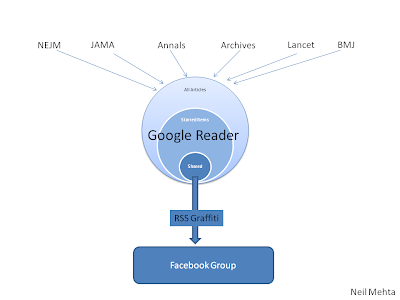
In any case, Cleveland Clinic, ever the innovator, actually has a Journal Club on Facebook. Dr. Neil Mehta wrote a great summary on their model, using Google Reader and Facebook, check it out here: http://goo.gl/rnw2P


In conclusion, from personal experience, I would say that you can only learn when people criticize your project - it is the most helpful kind of feedback that you typically get for free.

Please consider visiting the website and Twitter account of this new Twitter Journal Club (http://twitjc.wordpress.com), follow the hashtag #TwitJC and enjoy the new editions.

Comments from Twitter:

@DrVes: Did you find #TwitJC useful? @EugenieReich is looking for scientists to be interviewed in Nature. I think the second event was very engaging and useful. That said, #TwitJC is more a Twitter chat on a topic/article rather than a Journal Club as we think of it in the U.S. This brings me to the third tweet on the topic: Do we need separate #meded tags for different parts of the world? http://bit.ly/maPEwm

@amcunningham: well, it's a journal club the way we think of it in the UK... A noisy, hectic one!- but gets the job done :) #TwitJC

@DrVes: Right. Different from what we typically do here, e.g. discuss every detail of a recent (very recent) article, focused on one topic.

Related reading:

Twitter Journal Club: yet another ‘revolution’ in scientific communication? BMJ http://t.co/NrB7KAJ - Any plans for Google+ Journal Club now?

Virtual Journal Club for Hospital Medicine by the Washington University in St. Louis

Wednesday, May 25, 2011

Beware of online "filters" that hide the information you need


Eli Pariser: Beware online "filter bubbles", TEDtalksDirector, May 2, 2011: As web companies strive to tailor their services (including news and search results) to our personal tastes, there's a dangerous unintended consequence: We get trapped in a "filter bubble" and don't get exposed to information that could challenge or broaden our worldview. Eli Pariser argues powerfully that this will ultimately prove to be bad for us and bad for democracy.

Similarly, you don't want Twitter to replace your RSS reader - always get to the original source. When you see a medical news item on Reuters or WebMD, don't stop there - always go to the original journal article. More often that not you will find that the results reported in the original article are a quite a bit more nuanced and less certain than the layman language, SEO-optimized headline that you first encountered. Always go to the source. If you write a blog, always link to the source.


The circle of online information (full version) (click to enlarge).

Related:

Tuesday, May 10, 2011

28% of Vermont doctors "to stop practicing medicine" after single payer reform - doctors on Twitter disagree

According to BMJ, Vermont moves closer to becoming first US state to provide “socialised medicine”.

Vermont is set to become the first US state to launch a single payer healthcare plan after a bill passed both houses of the state’s legislature.

The plan is expected to be signed by Governor who originally proposed the idea that would abolish most insurance plans and would instead provide healthcare to all residents through public funding - a “single payer” scheme and is fiercely opposed by many conservative politicians as “socialised medicine.”

Some doctors in Vermont are unhappy about the proposed changes. In an online poll of 600 doctors conducted by a state representative and an ObGyn doctor, 28% said that they will stop practising medicine in the state if the plan is adopted.

Comments from Twitter:

@a_singledrop (Emily Lu): Seriously?

@movinmeat: calling their bluff.

@gruntdoc (GruntDoc): States as exp labs.

@backpackerchick (Hartley): In another era, doctors ****** about Medicare and found themselves richer than ever when it was enacted! What's good for the doctor (profits) is not necessarily good for the patient!

@RN_ing (Mary v. Seattle RN): Change is difficult... to be expected, but continue to want #singlepayor.

@irfandhalla (Irfan Dhalla): Single payer turned out to be well liked by docs in Canada. Will same happen in Vermont?

What do you think? Feel free to comment below, or post on Twitter.

References:

Image source: OpenClipArt.org, public domain.

Thursday, May 5, 2011

For doctors: How to be a Twitter superstar in 2 easy steps and 30 minutes per day

Warning: The purpose of this article is to inspire you to use Twitter, not to scare you. There are plenty of other blog posts and newspaper articles about doctors posting pictures of body parts on Facebook and getting fired. This is not it. Social media is amazingly useful for doctors and patients if you use the tools responsibly, have common sense, and never share the 18 HIPAA identifiers online or offline with unauthorized parties. The advice below is derived from extensive personal experience. I have used social media for professional purposes, as a physician, for more than 7 years, while working at some of the leading institutions in the U.S. such as the Cleveland Clinic and the University of Chicago. My account @DrVes was ranked #6 on the list of the Most Influential People from Chicago on Twitter (selected by Chicago Tribune and Klout.com). My blog websites have had more than 8 million page views. Just as an example, every time I hit the "publish" button of the sites, the message reaches more than 30,000 people every single day: 17,000 RSS and email subscribers, 9,000 Twitter followers, 3,000 daily visitors, and 1,500 Facebook fans (statistics for the sites ClinicalCases.org and CasesBlog, AllergyCases.org and AllergyNotes, and the Twitter accounts @DrVes and @Allergy).

This is somewhat of a typical example nowadays. There are many other physicians who are much more popular than me on social media and make the stats above look minuscule. You can be one of them. Here is how.

The basics of Twitter use for busy doctors

Most doctors are really busy. Several questions always come up when doctors consider the use of social media for professional purposes: Who has time for Twitter? What am I going to say there? To whom? And why Twitter, to begin with? What about Facebook or YouTube? My office is a mess and I always say "ehhh" when recorded -- I don't want to do video. Do I need a blog too?

Good questions. Here are the answers.

The circle of online information for me is as follows: Google Reader -> Share on Twitter -> Get feedback -> Write a blog post -> Share via RSS and Twitter -> Get feedback, go on. You don't need to use all services.

Here is how to facilitate the Rise of the ePhysican who works hand in hand with the ePatient:


1. Who has time for Twitter?

You do. Twitter should take no more 30 minutes per day and it will be beneficial for you, your colleagues and your patients. You will learn more and will feel better about it. Make it part of your normal routine - just like checking the news. In fact, Twitter is just that - checking the news - and then sharing the ones that you find most interesting with your followers. This takes a single click, and 2 seconds. Ten tweets per day, 2 seconds each. This is 20 seconds. You can do it.

2. Why Twitter?

Start on Twitter because it is quick and relatively easy. Twitter has the lowest barrier to entry among all social media services. "Being on Twitter" requires just 10 short sentences per day, with approximately 7 words each. You can reach thousands of people with a single sentence. Would you like to share the latest guidelines for food allergy? Just click and all your Twitter followers will know about them instantly. You will also get feedback to your tweets via replies and re-tweets.

3. What am I going to say on Twitter?

The answer is simple. You are an expert. There is a flood of medical news that hits the wires every day. I want to know what YOU think is important. Share the 3-10 news items per day that you find interesting. I will subscribe to read them. Many will do the same.

4. Who is going to read my tweets?

As a physician, you are an expert in your field. You provide valuable insight - just be selecting what you think it’s important from the news of the day. Embed this little personal news stream in your practice page. Your patients will appreciate the helpful updates, hand-picked by their doctor. Your colleagues may find it interesting too.

5. What about Facebook or YouTube?

Those are nice but I would start on Twitter first, and then expand if you see the need to do so. It may be a good idea to start a like/fan page on Facebook for your practice and re-post some of the tweets there. This is simple and not time-consuming. It can be done automatically.

6. Do I need a blog too?

Only you can tell if you need a blog. If you feel that you need to expand beyond 7-8 words on Twitter, by all means, start a free blog on Blogger.com by Google or WordPress.com and see how that works for you. Start on Twitter and expand to a blog as a natural extension if you need to write longer or provide some background. Post your blog items in your Twitter feed.

How to be a Twitter "star" in two easy steps

This is easy. It’s a two-step process for beginners and it takes about 30 minutes per day. The best time is just after your kids go to sleep.

1. Review the news of the day from Google Reader. I have ready-made subscription RSS bundles for you below. Alternatively, you can check a service such as Webicina.com for RSS feeds in your specialty.

2. Post the news items that you like best on Twitter. Don’t post all 10 tweets at once. Schedule them evenly throughout the next day. The first tweet goes on at 7:30 am EST and the last one at 8:30 pm EST. You can use Seesmic Web to schedule tweets - it is simple, free, and just works. The alternatives include HootSuite and any number of scheduling services (some of them have a limitation of up to 10 tweets per day).

This summary did no address the other Twitter activities such as listening, engaging, search, chat, HIPAA compliance, etc. They will be discussed in future articles.

RSS bundles of medical news

You can use the following RSS bundles to subscribe to medical news items. The bundles are exported from my personal Google Reader page. They update automatically several times per day. When in Google Reader, just select the ones that you find interesting and share them on Twitter. Feel free to add your own comments to some of the tweets.


Top Twitter Doctors

This is a list of the Top Twitter Doctors arranged by specialty in alphabetical order - feel free to add your own suggestions. The list is open to anybody to edit:


Related reading

What are the Downsides of Social Media for Doctors? Dr. Wes shares insights from 6 years of blogging

Tuesday, June 1, 2010

How Twitter Brings Patients to Mayo Clinic


From Mayo Clinic: May 11, 2010 — People use Twitter to share information: The latest news, current events, what people are talking about, even what's for dinner. Now, people are using it to get access to health care. Last year Mayo Clinic teamed up with USA today and scheduled a Twitter chat about a painful wrist injury. Today a woman who joined that chat is pain free.

If you work for Mayo Clinic, social media is not an option, it's a job requirement http://bit.ly/IHf3lM - Others will follow.

Cleveland Clinic is also active on Twitter by asking staff to participate in scheduled chats with patients on a variety of health topics.

See an example here: Heart numbers to know - by Cleveland Clinic

Here is how to facilitate the Rise of the ePhysican who works hand in hand with the ePatient:


Related reading:

Erin Turner's Mayo Clinic e-Patient Success Story

How Should Hospitals Use Twitter? This Twitter discussion in 2008 prompted @EdBennett to start his world-famous list.

Top U.S. Hospitals Are On Twitter

Social media in medicine: How to be a Twitter rockstar and help your patients and your practice

Friday, April 9, 2010

Why Twitter may not be good enough for scientific information and discussion

I appreciate the re-tweet below but I did not say anything remotely close to this sentence:

@sevinfo Reading "top" journals only distorts your world - Argument for scrapping peer review at BMJ blogs via @DrVes & @KentBottles

http://twitter.com/sevinfo/status/10929698882

My original tweet:

@DrVes The naïve concept that the “top journals” publish the important stuff and the lesser journals the unimportant http://goo.gl/utJ5

http://twitter.com/DrVes/status/10892767666

My expanded citation on Google Buzz:

The false idea that only the “top journals” publish the important stuff

From the former Editor-in-Chief of BMJ:

The naïve concept that the “top journals” publish the important stuff and the lesser journals the unimportant is simply false. People who do systematic reviews know this well. Anybody reading only the “top journals” receives a distorted view of the world. Unfortunately many people, including most journalists, do pay most attention to the “top journals.”

http://blogs.bmj.com/bmj/2010/03/22/richard-smith-scrap-peer-review-and-beware-of-%E2%80%9Ctop-journals%E2%80%9D/

http://www.google.com/buzz/110859855629071891085/TPmyVKjvZS9/The-false-idea-that-only-the-top-journals-publish

Please click the Buzz link above to see how much more "richer" the comments there are as compared to Twitter where the microblog updates (tweets) are limited to 140 characters.

This little example adds to the opitinion that many times Twitter is not good enough for scientific information and discussion.

Follow-up:

@sevinfo: yoicks! I was agreeing to need to read both "top" & less exciting ; not saying that reading science distorts your world! For record - @DrVes points out that text on last link open to misinterpretation - Keep reading science journals both top & less glamourous!

Comments from Google Buzz (March 23-24):

Kathy Mackey - Appreciate the followup Dr. Ves. I read the article yesterday on BMJ on scientific journals and felt I was missing something. It is true that 140 characters can be difficult to relay important information to the public

Brian Ahier - This is a problem that can not be adequately addressed because of the character limitation in Twitter. But it is an opportunity for a service like Buzz to be a bridge for longer commentary and discussion. I suggest we have more conversations in Buzz and then tweet a link to the post.

Ves Dimov, M.D. - Agree. Works very well with some posts. However, the Buzz adoption rate is significantly lower than Twitter and seems to have plateaued a few week after its launch.

Brian Ahier - Quality vs. Quantity?
I have found a much higher quality conversation seems to be happening on Buzz. Perhaps some of the adoption will not be missed. I have yet to be bothered by a spam account on Buzz and many of the followers on Twitter soon become inactive.

Ves Dimov, M.D. - True. People put more thought into Buzz comments - the accounts are often tied to their "real" identity after all. Participation fatigue is a common occurrence among all services.

Brian Ahier - I am also fortunate that many of my higher profile followers like Tim O'Reilly, Richard MacManus, and Robert Sconle are active on Buzz. As Buzz matures I think we will see some interesting applications. Then when Google buys Twitter we'll be all set ;-)

Ves Dimov, M.D. - Yes. Although Evan Williams keeps saying that Twitter is not for sale not matter what the price...

Brian Ahier - Yeah, Ev is an idealist :-D

Ves Dimov, M.D. - You have to respect the guy - he brought two very important services to popularity and success - Blogger and Twitter. Even one would be enough for the Internet history books... :)

Ves Dimov, M.D. - @Brian Ahier - I'm sorry I deleted your comment by mistake and there is no "Undo" in Buzz. "You" was meant in general not for you in person. And, yes, I share the same opinion.

Brian Ahier - Buzz does need an undo - but as I said, I admire people who old to their ideals. Ev has made some outstanding contributions and has an amazing talent.

Neil Mehta - Some of my best online experiences have been on Buzz - feels like a civilized sit down dinner with a conversation. Twitter can leave one feeling like everyone is rushing around on a big field shouting "hello" to the world, hoping someone will reply and start a conversation - it is great when to find that stranger with whom you share an interest but that happens rarely and the conversation is usually very unsatisfactory. Understand the Twitter functionality was not designed for conversations......

Vamsi Balakrishnan - @Neil Mehta: It's exactly as Dr. Ves said though; Buzz is tied to your real identity more or less, which is especially true for those who have verified profiles. It's also easier to have conversations since there's no 140 character limit...and it goes to those who use twitter anyway if you've enabled it. So, for me at least, it was a seamless transition.

The only problem that exists though, which truth be told hasn't affected me yet, is that there's a 300 comment limit. 300 replies to a post can exist, no more.