Showing posts with label Mnemonics. Show all posts

Saturday, April 12, 2008

Mnemonic: CHADS2 Score Determines Who Needs Anticoagulation in Atrial Fibrillation

CHADS2 (Cardiac failure, Hypertension, Age, Diabetes, Stroke [Doubled]) index is based on a point system in which 2 points are assigned for a history of stroke or TIA and 1 point each is assigned for age over 75 years and a history of hypertension, diabetes mellitus, or recent heart failure, as shown in this table.


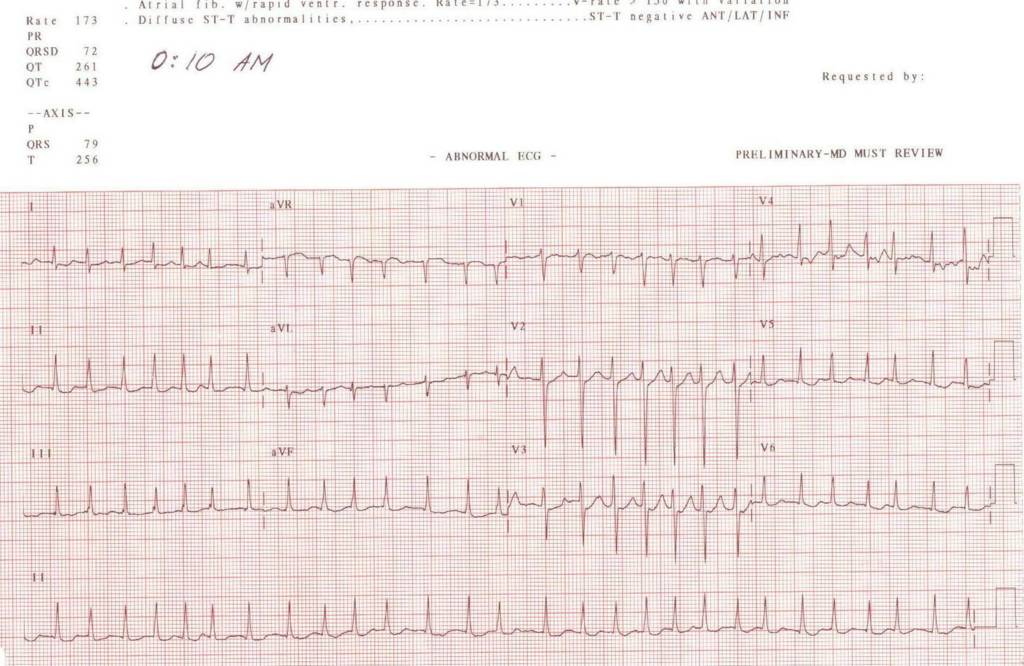
EKG of atrial fibrillation

CHADS2 score was included in the ACC/AHA/Physician Consortium 2008 Clinical Performance Measures for Adults With Nonvalvular Atrial Fibrillation or Atrial Flutter. Patients with a score greater than one typically are treated with warfarin.

MDCalc has an online calculator for CHADS2.

Generally, I find mnemonics useful and have listed some that I made up when studying for USMLE and ABIM at Medical Mnemonics. There are more than 1,000 mnemonics in my database and I hope to publish them online one day in not too distant future.


NorthShore University HealthSystem Cardiac Electrophysiologists Wes Fisher, M.D., Jose Nazari, M.D. and Alex Ro, M.D. discuss atrial fibrillation.

References:
Senator Warner Has Atrial Fibrillation Recurrence. Dr. Wes.
Should patients receive anticoagulation for paroxysmal atrial flutter?
Radiofrequency Ablation as First-Line Treatment for AFib
AFib with RVR after a TLC Placement
How to Score Well on the Boards?
Medical Mnemonics

Updated: 08/11/2009

Wednesday, April 2, 2008

Mnemonic for Revised Cardiac Risk Index: 4CD

The ACC/AHA 2007 Guidelines on Perioperative Cardiovascular Evaluation and Care for Noncardiac Surgery replaced the intermediate-risk category for patient risk with the factors from the Revised Cardiac Risk Index. I had to adjust my PAST mnemonic accordingly - generally speaking, there are 4 major variables in the preoperative evaluation, remembered by the mnemonic PAST:

Patient risk
Activity level - measured in METs
Surgical risk
Test (stress test) or Treat (beat-blocker)?

Revised Cardiac Risk Index (Circulation. 1999;100:1043-1049):

High-risk type of surgery
Ischemic heart disease
History of congestive heart failure
History of cerebrovascular disease
Insulin therapy for diabetes
Preoperative serum creatinine >2.0 mg/dL

4CD is a mnemonic to remember the risk factors in RCRI:

CAD
CHF
CVA
CKD
DM

References:
ACC/AHA 2007 Guidelines on Perioperative Cardiovascular Evaluation and Care for Noncardiac Surgery: Executive Summary. Circulation, 2007.
Preoperative Care of Patients with Kidney Disease. Clinical Cases and Images.
Medical Mnemonics

Tuesday, March 25, 2008

Remembering the ACGME 6 Core Competencies by a SIMPLE mnemonic

The Accreditation Council for Graduate Medical Education (ACGME) is responsible for the accreditation of post-MD medical training programs within the United States. The ACGME developed the so-called 6 "core competencies" that all residents should achieve during their training. When I was a chief resident, the concept was still new and not easy to remember so I made up a SIMPLE mnemonic for the 6 competencies:

SIMPLE

Systems-Based Practice
Interpersonal Skills and Communication
Medical Knowledge
Patient Care
Learning - Practice-Based and Improvement
Etiquette ~ professionalism

References:
General Competencies. The Accreditation Council for Graduate Medical Education (ACGME).
Medical Mnemonics
Image source: OpenClipArt, public domain.

Tuesday, September 25, 2007

Unconventional Medical Textbooks: Mind Maps and Visual Mnemonics

Generally, I find self-made notes, mnemonics and mind maps useful when studying but was surprised to find out the number of unconventional textbook published in the last few years focused on using such tools. A short list is assembled below:

Mind Maps Books

Mind Maps in Medicine by Peter MacDermott, David Norman Clarke. 1998, Elsevier Health Sciences.
Google Books, $35
Elsevier Health Sciences
Amazon.com, $ 45.

Mind Maps in Pathology by Peter A. Dervan, Michelle Harrison. 2002, Elsevier Health Sciences.
Google Books, $35
Elsevier Health Sciences
Amazon.com, $ 32.

Books from Visual Mnemonics Series (VMS)

Visual Mnemonics for Pharmacology by Laurie L Marbas - 2002.
Google Books.
Amazon, $ 25.

Visual Mnemonics in Pathology by Laurie Marbas
Google Books.
Amazon, $ 27.

Other books included in the VMS are Visual Mnemonics for Physiology and Related Anatomy, Visual Mnemonics for Microbiology and Immunology, Visual Mnemonics for Biochemistry, and Visual Mnemonics for Behavioral Sciences.

Mnemonics Books

Medical Mnemonic Comics - Respiratory Diseases by Sotiri Athanasakis.
Self-published on Lulu.com, $ 27.
Google Books.

Mnemonics for Medical Students by Khalid Khan.
Amazon, $14.

Differential Diagnosis Mnemonics by Thomas J. Donnelly and Christopher C. Giza.
Amazon, $ 26.

References

Developing the medical mind. BMJ 7159 Volume 317, 5 September 1998.
Modern Education: Mind Maps and Second Life. ScienceRoll.com.
Image source: Mind Maps in Medicine by Peter MacDermott, David Norman Clarke. 1998, Elsevier Health Sciences.

Related reading

Medical profession's use of mind mapping - WikIT http://goo.gl/1Kjd
Can images (mind maps, infographics) stop data overload? Symptom of the computer age: overwhelmed, we delay decisions http://goo.gl/URMKm

Medical Mind Maps by the Wikipedia user Madhero88, a 3rd year Medical Student from Jordan.
Note taking with mind maps did not improve the scores of medical students (study)http://goo.gl/8qeQ
Medical Mnemonics
Study claims mind maps don't help learning - "you should just take tests" - NYTimes http://goo.gl/kvdSZ and http://goo.gl/6ql7n
University of Cambridge shows high-resolution Newton notebooks online. He used mind maps - check Trinity College Notebook, image 5.