Showing posts with label Baseball. Show all posts

Thursday, January 3, 2013

Hypocrisy in the Hall of Fame

A rare exception to my abdication from Fair and Unbalanced.
-- Lovechilde

“Voting shall be based on the player's record, playing ability, integrity, sportsmanship, character, their contributions to the team on which the player played.” -- BWAA's Hall of Fame Rules
Spitballer Gaylord Perry
Racists and segregationists who conspired to keep African Americans out of baseball are in the Hall of Fame.  So are players who regularly used amphetamines to "enhance" their performance on the field and others who took illegal drugs off the field.  Cheaters are in the Hall, from spitballers to sign stealers.  The Hall includes adulterers, sexual assaulters, drunks and batterers.  But some of the greatest players of the past couple of decades, including some of the greatest in the game's history, will likely be denied induction into the Baseball Hall of Fame next week because they allegedly used steroids, probably used steroids or simply looked like they used steroids.

Such arbitrary application of the so-called "integrity clause" is seriously misplaced.  It is unquestionable that steroids were used by a large group of players --  hitters and pitchers -- from about 1995 until 2005, when the baseball establishment, under pressure, finally began to crack down on the use of performance enhancing drugs.  During this time, when offensive numbers (and players’ heads) were suspiciously inflated, the fans cheered and the owners gleefully looked the other way.  For better or worse, steroids were part of the game and unless we are going to disqualify everyone who played during these years, we simply have to accept it.  Moreover, with the exception of the few players who have admitted steroid use or where the evidence appears overwhelming, we have no way of knowing with any hope of accuracy who juiced and who didn’t. 

The best and most dominant players of every era should be enshrined in the Hall of Fame, and steroid use or other alleged character flaws should not be insurmountable barriers to entry.  Without Barry Bonds, Roger Clemens, and Mike Piazza -- who is apparently now suspect based on nothing more than hearsay and weak anecdotal information (as is Jeff Bagwell, perhaps a more borderline candidate)-- the Hall of Fame's avowed goals of "preserving history and honoring excellence" will be greatly diminished.

And don't get me started on Pete Rose.

Tuesday, July 3, 2012

All Star Outrage

I have always revered the All Star game.  When I was growing up, it meant seeing Willie Mays, Hank Aaron and Roberto Clemente in the same outfield.  It also meant getting to see how some of my favorite Met players measured up to the greats.  True, the Mets did not usually populate the team, but at least Tom Seaver could be counted on to dominate American League hitters, and occasionally Bud Harrelson at short, Jerry Grote behind the plate, Jerry Koosman or Jon Matlack on the mound were worthy additions. 

Beginning in 1969, fans have been given the privilege of voting for All Star starters.  I used to fill out two ballots as a kid.  I would diligently scour statistics and choose players based purely on merit.  Then I did a second one which included Met players, regardless of the season they were having.  On this second ballot I admit, I voted for Wayne Garrett over Ron Santo, Felix Millan over Joe Morgan, Tommie Agee over Cesar Cedeno, Jerry Grote over Johnny Bench, and even Ed Kranepool over Willie McCovey.

Over the years, the fans generally got it right.  The popularity contest and bias towards one's home team was, for the most part, outweighed by votes for the players having the best years.  What helped making this system relatively fair was the rule that each team received the same number of ballots to hand out.  But with the advent of internet voting and organized campaigns by the teams themselves, the process has gotten out of balance.

The San Francisco Giants' marketing department was particularly relentless and creative this year in urging their fans to vote for Giants players early and often.  As a result, the Giants can boast three starters in this year's game:  Pablo Sandoval, Buster Posey and Melky Cabrera.  Sandoval, who spent a good deal of time on the disabled list, is having a season that pales in comparison to David Wright, who is having an MVP-type year. Wright leads all third basemen in every offensive category.  (Padres' third baseman Chase Headley is also having a far better year than Sandoval.)

Giants' catcher Buster Posey is having an excellent season, coming back from last year's injury, but he should not be the All Star starter -- despite receiving more votes than any other player in history.  Phillies catcher Carlos Ruiz, who is having a remarkable year, is far more deserving.  So is Yadier Molina of the Cardinals.

Melky Cabrera is arguably worthy of a start in the NL outfield, but the outsized votes for Sandoval and Posey, and for other Giants such as 1B Brandon Belt and SS Brandon Crawford -- who just missed starting nods (and 2B Freddie Sanchez came in fourth despite being sidelined all year) -- demonstrate that the system is broken.

Fans have been disenfranchised before.  In 1957, an organized campaign in Cincinnati resulted in seven Reds players being elected as starters:  Johnny Temple (2B), Roy McMillan (SS), Don Hoak (3B), Ed Bailey (C), Frank Robinson (LF), Gus Bell (CF), and Wally Post (RF). (The only non-Red elected was Cardinal first baseman Stan "the Man" Musial.)  The Cincinnati Enquirer apparently printed up pre-marked ballots to allow fans to vote early and often.  After an investigaton, Commissioner Ford Frick substituted Willie Mays and Hank Aaron for Gus Bell and Wally Post as NL starters, and changed the system so that managers, coaches and players voted instead of fans.

It is time to take the vote away from the fans again.

Sunday, July 1, 2012

Mets Hit Parade

A player with the most hits in a team's history usually possesses two qualities:  greatness and longevity.  Several legendary stars lead their teams with 3000 or more hits, including Willie Mays (Giants), Ty Cobb (Tigers), Pete Rose (Reds), Carl Yastrzemski (Red Sox), Hank Aaron (Braves), Cal Ripken (Orioles), Stan Musial (Cardinals), Roberto Clemente (Pirates), and most recently, Derek Jeter (Yankees).

Even some of the 1960s expansion teams can claim players with 3000 or more hits:  George Brett (Royals), Robin Yount (Brewers), Craig Biggio (Astros) and Tony Gwynn (Padres).

Hall of Famers such as Mike Schmidt (Phillies), Cap Anson (Cubs), Sam Rice (Senators/Twins), Zack Wheat (Dodgers) and Luke Appling (White Sox), while not reaching the hallowed 3000, have the most hits on their long-time teams.

And then there are teams like the Mets, celebrating their 50th Anniversary this year, whose all-time hit leader can boast longevity but not greatness.  Except for the Marlins, Rays and Diamondbacks, who all came into existence in the 1990s, no team other than the Mets have a career hit leader with less that 1500 hits.

Ed Kranepool, who played for the Mets in their inaugural season of 1962, all the way through 1979, is their all-time hit leader with 1418.  For better or worse Kranepool played in far more games than any other Met and, as a result, is in the top 10 in most offensive categories.  But pretty soon we won't have Kranepool to kick around anymore.

29-year old David Wright, is in his ninth year with the Mets and having his greatest season.  After starting off his career in spectacular fashion, the five-time All Star has had an uneven last few years, which included a beaning and a concussion in 2009, and missing more than two months from another injury last year.  But he is putting it all together in 2012, with an MVP-type year.

David Wright is the Met all-time leader in runs scored, RBIs, and doubles.  He is about 75 hits behind Kranepool, and is sure to pass him sometime this year.  Hopefully, he will be a Met for many years to come, and if so, he will fit right in there with the great hit leaders of the other Major League clubs.

Sunday, June 24, 2012

Mets All Time

In honor of the Mets' 50th Anniversary (which I wrote about here), SNY, the Mets' TV network, aired a two-hour special on the Mets' All-Time team this week, naming the greatest Met at each position:


Catcher
Mike Piazza (C)
Infielders
Keith Hernandez (1B)
Edgardo Alfonzo (2B)
Jose Reyes (SS)
David Wright (3B)
Outfielders:
Darryl Strawberry (RF)
Cleon Jones (LF)
Carlos Beltran (CF)
Starters:
Tom Seaver (RHP)
Jerry Koosman (LHP)
Relievers:
Roger McDowell (RHP)
Tug McGraw (LHP)
Manager
Dave Johnson

I can't quibble with any of the selections (with the glaring exception of manager -- it is incomprehensible that Davey Johnson got the nod over Gil Hodges).  Admittedly, this is not exactly Ruth-Gehrig-DiMaggio, but everyone on this list has a special place in the heart of Met fans (even Beltran).

Monday, June 18, 2012

Acquittal On Steroids

Roger Clemens was acquitted today of perjury charges based on his testimony before Congress in 2008, in which he stated that he never used steroids or human growth hormone.  After an earlier mistrial, federal prosecutors decided to retry Clemens and, as the New York Times reports, the second trial was far more extensive than the first, with 46 witnesses over more than eight weeks.

 I have long despised Clemens for his petulance, his arrogance and not least, his beaning of Mike Piazza in 2000, followed in the the World Series of that year with his inexcusable heaving of a piece of  broken bat at Piazza after it was shattered by a pitch.   Nevertheless, for the reasons I explored in a piece re-posted below on the Barry Bonds trial (which also ended in embarrassment for the prosecution when it was able to obtain a conviction on only one count, an obstruction of justice charge) the case served no purpose and was a colossal waste of resources.
 

Trial On Steroids


So many people in and out of baseball hate Barry Bonds passionately.  He was a selfish player who focused unduly on his own statistics.  He is arrogant and unapologetic.  He has always treated the press with great disdain.  He had his own Barcalounger in the Giants' clubhouse.  Unlike, perhaps, more sympathetic marginal or fading players, he was a brilliant player in his prime when he felt compelled to cheat by using steroids.  He is a petty man who cheated because he was jealous of Sammy Sosa and Mark McGwire, and wanted to become not just the best all around player, but the home run king.  And it worked; he not only broke McGwire's single-season home run record, even more egregiously, he eclipsed the hallowed career home run mark of the beloved Hank Aaron.  Have I missed anything?  Oh, and he denied knowingly taking steriods when forced to testify under oath before a grand jury.

For the last of these, Bonds is on trial, charged with lying to the grand jury and obstruction of justice.  It seems, however, that those who hate Barry Bonds hope he is humiliated, found guilty, and sentenced to a long prison term for his many other other non-criminal offenses.

I am not one of the Barry Haters.  Watching Barry Bonds play for the Giants, both pre- and post-alleged steroid use was one of my greatest thrills as a baseball fan.  Every time I went to the ballpark I felt it was a privilege to be able to see one of the most amazing players to have ever played.  In 2001, the year he hit 73 home runs, he hardly ever got a decent pitch (he walked 177 times that year), but when he did he crushed it.  Maybe steroids added some distance to these blasts, but the discipline, focus, timing and beauty of these at bats can't be credited to drugs.  The dude could flat out hit.

OK, with that disclaimer out of the way, I think the issue is less about Bonds and more about whether the United States Government should be expending so many resources on the use of performance enhancing drugs in baseball. 


We now know that steroid use was rampant for about a decade, beginning roughly in 1995.  During that time, offensive numbers (and players’ heads) were suspiciously inflated, fueling a welcome fan resurgence after the devastating baseball strike of 1994.  Attendance soared and baseball ownership gleefully looked the other way.  While all other major sports put policies into place banning steroid use, baseball management did nothing.

I strongly believe that the federal government can play an important role in investigating and remedying many of our social ills, including, for example, poverty and hunger, discrimination, deceptive practices of financial institutions, unsafe food production, inhumane working conditions, environmental hazards and climate change. Steroids in baseball does not come close to making this list.  Nevertheless, we have had federal investigations, grand juries, and even Congressional hearings to address an issue that should have been -- and eventually was -- handled by baseball itself.  (Roger Clemens, for whom I have no warmth in my heart, will be tried this summer on allegedly lying to Congress; I take the same position on Clemens as I do on Bonds.)

In 2002, a federal investigation began into whether BALCO labs was providing steroids to athletes, including baseball players.  Barry Bonds and others testified before a grand jury which, in 2004, issued a 42-count indictment charging BALCO-related figures with running a steroid-distribution ring.  40 of these charges were eventually dropped.  The main target, Victor Conte, BALCO's founder, pleaded guilty to one count of money-laundering and served only 4 months in prison followed by 4 months' home confinement.  BALCO's vice president James Valente received probation.  Greg Anderson, Bonds' personal trainer, received 3 months in prison and 3 months home confinement, although he served additional time for refusing to testify against Bonds.

Given the relatively light sentences received by the major players in the scandal it is hard to see the dogged pursuit of Barry Bonds by federal prosecutors as anything more than vindictive, ego-driven and an attempt to justify the enormous waste of time and resources.  The scandal derailed the end of his career, when no team was willing to sign him.  His legitimate claim to being one of the greatest ballplayers of all time, even before his alleged steroid use, and all his remarkable records are considered tainted by many.  And, as I started this piece, he is reviled by all but the most die-hard Giants fans (and me).  Isn't that enough?

Thursday, June 14, 2012

Stranger Than Fiction: R.A. Dickey Is One Of The Top Pitchers In Baseball

Matt Cain, the great Giants pitcher, threw the 22nd perfect game in baseball history last night, the first ever for a Giant.  And then there is R.A. Dickey of the Mets who, but for a scorekeeper's call, may have thrown a no-hitter himself.  In the first inning the Rays' B.J. Upton hit the ball to third which David Wright tried to snag bare-handed and muffed.  It was scored a hit and proved to be the only hit Dickey gave up.  Wright's throwing error in the ninth and a couple of passed balls by the catcher led to an unearned run, the first run Dickey has given up in 32 2/3 innings, a Met record, by the way.

Dickey is now tied for the most wins in the Majors with 10, and is near the top in virtually every pitching category.  Although he throws almost 30 miles per hour slower than Justin Verlander, he is just as dominant.

Dickey, now 37 years old, is not your typical ace pitcher.  After he was drafted by the Texas Rangers in 1996, was it discovered that he was missing the ulnar collateral ligament in his pitching arm.  A mediocre pitcher with unconventional stuff, he developed a knuckleball, with which he finally gained some modicum of success as a Met over the last couple of years.

Even before this year Dickey endeared himself to Met fans with his intensity and his quirkiness (he is an avid reader and keeps a stack of books in the dugout) and by his fairly decent playing for a pretty dismal team (winning 11 games in 2010 and pitching well last year despite an 8-13 losing record.) 

He has also written a remarkably courageous book, Wherever I Wind Up, in which he discusses not only his baseball career and the knuckleball, but his painful and traumatic childhood during which he was sexually abused.

Over the winter, after Dickey climbed Mt. Kilimanjaro for charity (seriously) I wrote with only a little bit of irony that this would probably be the highlight of the Mets' season.  (See Dickey Reaches Peak of His Game.)  But not only are the Mets playing surprisingly well this year, R.A. Dickey truly is reaching new heights.

Monday, June 11, 2012

Antidote To The Mets Being Swept By The Yankees

It feels like a long time since Johan Santana's no-hitter. The Mets have lost six of their last seven games, including three over the weekend to the Yankees.  What to do?  Watch this video. It is shows a group of Kenyan students re-enacting the climax of Game 6 of the 1986 World Series in which the ball hit by Mookie Wilson finds its way through Bill Buckner's legs.  According to the YouTube information, the students wanted to make a move about a famous American sporting event.  They chose wisely.  I have a feeling I will be going back to this video quite often this season.

Friday, June 1, 2012

Joy In Mudville

From 1875 until tonight, there were 275 no-hitters pitched in Major League Baseball.

From 1962 until tonight, the New York Mets played 8,019 regular season games without a no-hitter.  (They often came tantalizingly close, with 36 one-hitters.)

Johan Santana, who won two Cy Young Awards for the Minnesota Twins, was traded to the Mets in 2008.  He was the superstar pitcher who came to rescue the team after their historic collapse the season before.  Not even Santana has been able to save the Mets.  But tonight he did something no other Met pitcher has ever done. 

Johan Santana has pitched the 276th no hitter in baseball history, and the first for the New York Mets.  He beat the Cardinals 8-0, striking out 8 and walking 5. He threw 134 pitches.  No hits.

Sunday, May 20, 2012

The Mets And Astros Celebrate 50 Years Together

If you read this admittedly Mets-centric blog, you already know that the Mets are celebrating their 50th Anniversary this year.  I've already done a Mets at 50 Tribute, a Top 25 Greatest Mets, as well as a more ignominious All-Time Met busts.

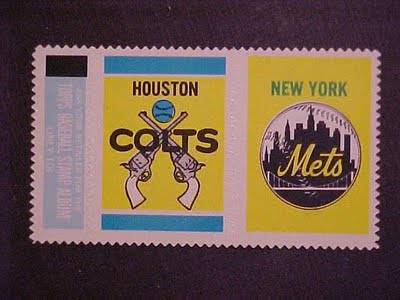
What shouldn't be forgotten in all the hoopla, is that in 1962, when the Mets came into being, they were joined by another team -- the Houston Colt '45s, who changed their name to the less violent and more cosmic Astros when they moved into the Astrodome -- the first domed, artificial turf sports stadium.

The Astros were not as spectacularly bad as the Mets in those early days.  In an attempt to appeal to erstwhile Dodger and Giant fans whose teams fled to California, the Mets stocked their team with over-the-hill but recognizable players like Gil Hodges, Don Zimmer and Duke Snider.  The result was an awful, but loveable team.  The Astros focused more on young talent and fielded such exciting players as Joe Morgan, Rusty Staub and Jim Wynn.  But it was the Mets who made the World Series first, winning it all 1969, and making three more appearances in the Fall Classic before the Astros finally made it in 2005, when they were swept by the White Sox.

The overall records of the two teams are pretty close, with the Astros/Colt 45s (3958-4044) having won just 129 more games than the Mets (3829-4162) over the 50 years.  In head-to-head competition, Houston has the edge as well, 304-256.  But the Mets have those two World Series wins (1969 and 1973), and came out ahead in their epic 1986 playoff contest.

Which team has the better All-Time roster?  Again, it's pretty close.  (The Mets I can do off the top of my head; I got help on the Astros from this cite.)

At first base, both have had great players, but Houston's Jeff Bagwell has the numbers over Keith Hernandez.  And at second base, Craig Biggio was the far better player than the Mets' Edgardo Alfonso.  The Astros never had a really great shortstop.  Neither Dickie Thon, whose promising career was cut short by a beaning, or Roger Metzger were as good as Jose Reyes.  An at third base, David Wright gets the nod over Ken Caminiti or Doug Rader. 

The Astros have had some truly great outfielders, led by Cesar Cedeno and Jimmy Wynn ("Toy Cannon"), as well as Jose Cruz, Lance Berkmann, and Moises Alou  This is a better collection than the Mets' best of Darryl Strawberry, Cleon Jones, Mookie Wilson, Lenny Dykstra and Carlos Beltran.

Catcher easily goes to the Mets.  The best catchers in Astros history, Alan Ashby and Brad Ausmus are not close to the great Met catchers, Mike Piazza and Gary Carter.

And then there's pitching.  The Mets franchise is known for their fabulous arms, starting with Tom Seaver, and including Dwight Gooden, Jerry Koosman, Jon Matlack and Ron Darling.  But the Astros are pretty impressive too.  The Mets gave up on Nolan Ryan early, and he later excelled for Houston  Add J.R. Richards (one of the most intimidating pitchers ever), Mike Scott (another ex-Met), Larry Dierker, and Joe Niekro, and you have a pretty formidable rotation -- just as good as the Mets.

How about intangibles?  Astroturf was an abomination (as Dick Allen once said, "if a cow don't eat it, I don't want to play on it") and the cavernous Astrodome was a horrible place to play ball.  Mr. Met -- the first and remains the greatest mascot,  in my objective opinion.  The Astros mascot is now something called Junction Jack, who replaced their prior mascot "Orbit," when the team moved from the Astrodome to Minute Maid Park.  The fact that I couldn't tells you what Junction Jack or Orbit look like tells you what you need to know.  And, finally, I would be remiss if I didn't mention that the Astros once wore the ugliest uniforms in baseball history.

The Astros will be moving to the American League next year as part of a re-alignment that will even the number of teams in each league and allow for a slightly expanded playoff system.   For the Mets and Astros, it will never be the same.

Wednesday, May 9, 2012

Another Trial On Steroids

After an earlier mistrial, Roger Clemens is being tried in federal court on perjury charges based on his testimony before Congress in 2008, in which he stated that he never used steroids or human growth hormone. 

I have long despised Clemens for his petulance, his arrogance and not least, his beaning of Mike Piazza in 2000, followed in the the World Series of that year with his inexcusable heaving of a piece of  broken bat at Piazza after it was shattered by a pitch.   Nevertheless, for the reasons I explored in a piece re-posted below on the Barry Bonds trial, the case serves no purpose and is a colossal waste of resources.

Trial On Steroids


So many people in and out of baseball hate Barry Bonds passionately.  He was a selfish player who focused unduly on his own statistics.  He is arrogant and unapologetic.  He has always treated the press with great disdain.  He had his own Barcalounger in the Giants' clubhouse.  Unlike, perhaps, more sympathetic marginal or fading players, he was a brilliant player in his prime when he felt compelled to cheat by using steroids.  He is a petty man who cheated because he was jealous of Sammy Sosa and Mark McGwire, and wanted to become not just the best all around player, but the home run king.  And it worked; he not only broke McGwire's single-season home run record, even more egregiously, he eclipsed the hallowed career home run mark of the beloved Hank Aaron.  Have I missed anything?  Oh, and he denied knowingly taking steriods when forced to testify under oath before a grand jury.

For the last of these, Bonds is on trial, charged with lying to the grand jury and obstruction of justice.  It seems, however, that those who hate Barry Bonds hope he is humiliated, found guilty, and sentenced to a long prison term for his many other other non-criminal offenses.


I am not one of the Barry Haters.  Watching Barry Bonds play for the Giants, both pre- and post-alleged steroid use was one of my greatest thrills as a baseball fan.  Every time I went to the ballpark I felt it was a privilege to be able to see one of the most amazing players to have ever played.  In 2001, the year he hit 73 home runs, he hardly ever got a decent pitch (he walked 177 times that year), but when he did he crushed it.  Maybe steroids added some distance to these blasts, but the discipline, focus, timing and beauty of these at bats can't be credited to drugs.  The dude could flat out hit.

OK, with that disclaimer out of the way, I think the issue is less about Bonds and more about whether the United States Government should be expending so many resources on the use of performance enhancing drugs in baseball.  We now know that steroid use was rampant for about a decade, beginning roughly in 1995.  During that time, offensive numbers (and players’ heads) were suspiciously inflated, fueling a welcome fan resurgence after the devastating baseball strike of 1994.  Attendance soared and baseball ownership gleefully looked the other way.  While all other major sports put policies into place banning steroid use, baseball management did nothing.

I strongly believe that the federal government can play an important role in investigating and remedying many of our social ills, including, for example, poverty and hunger, discrimination, deceptive practices of financial institutions, unsafe food production, inhumane working conditions, environmental hazards and climate change. Steroids in baseball does not come close to making this list.  Nevertheless, we have had federal investigations, grand juries, and even Congressional hearings to address an issue that should have been -- and eventually was -- handled by baseball itself.  (Roger Clemens, for whom I have no warmth in my heart, will be tried this summer on allegedly lying to Congress; I take the same position on Clemens as I do on Bonds.)

In 2002, a federal investigation began into whether BALCO labs was providing steroids to athletes, including baseball players.  Barry Bonds and others testified before a grand jury which, in 2004, issued a 42-count indictment charging BALCO-related figures with running a steroid-distribution ring.  40 of these charges were eventually dropped.  The main target, Victor Conte, BALCO's founder, pleaded guilty to one count of money-laundering and served only 4 months in prison followed by 4 months' home confinement.  BALCO's vice president James Valente received probation.  Greg Anderson, Bonds' personal trainer, received 3 months in prison and 3 months home confinement, although he served additional time for refusing to testify against Bonds.

Given the relatively light sentences received by the major players in the scandal it is hard to see the dogged pursuit of Barry Bonds by federal prosecutors as anything more than vindictive, ego-driven and an attempt to justify the enormous waste of time and resources.  The scandal derailed the end of his career, when no team was willing to sign him.  His legitimate claim to being one of the greatest ballplayers of all time, even before his alleged steroid use, and all his remarkable records are considered tainted by many.  And, as I started this piece, he is reviled by all but the most die-hard Giants fans (and me).  Isn't that enough?

Thursday, May 3, 2012

The "Baseball Bat" Theory Of Climate Change

 A Fox TV commentator, midgame, links global warming to home runs, and fans on all sides of the climate debate call foul.

By Peter Dykstra, cross-posted from The Daily Climate

Fox baseball commentator Tim McCarver is a retired baseball catcher whose work as a TV analyst recently got him inducted into the announcers' wing of the Baseball Hall of Fame. He occupies the top TV perch in the sport, and fans either love him or hate him.

If McCarver truly wants to be loved and hated more, there's no better way to accomplish that than to link climate change to America's pastime, on national TV, in the middle of a Cardinals-Brewers ballgame. Following two home runs that barely cleared the outfield wall Saturday afternoon, McCarver offered this:
"It has not been proven, but I think ultimately it will be proven that the air is thinner now, there have been climactic changes over the last 50 years in the world, and I think that's one of the reasons balls are carrying much better now than I remember." [video]

McCarver's on-air partner, Joe Buck, offered peer review in the form of a half-hearted Al Gore joke. The game went on. And the blogs went wild.

Could warmer temperatures and thinner air actually make more homers? Or is an old announcer pulling facts out of thin air?
A blogger for DeadSpin called McCarver's remark "one of the stupidest things ever spoken on a television broadcast today." Predictably, climate deniers' sites like Watts Up With That? lit up with comments. A search of dozens of web items found little support for McCarver, and Major League Baseball, which owns the broadcasts, appears to have quickly invoked its copyright privileges, yanking the video clip from numerous websites.

But could warmer temperatures and thinner air actually make more homers? Or is an old announcer pulling facts out of thin air?


One extra foot

Robert Adair, a retired physics professor from Yale University, gained notoriety a few years back when his book, The Physics of Baseball, gave scholarly explanations for why a curveball curves and a knuckleball wobbles. He calculated that a two-degree temperature rise will add one foot to a 400-foot home run ball, increasing home run odds by about 1.75 percent. With that rise, Roger Maris's epic 61 home-run season might have been 62. And wispy Braves shortstop Rafael Belliard, who hit two home runs in a 17-year career, still would have hit two.

The National Academy of Sciences estimates that global temperatures have climbed about 1.4 degrees Fahrenheit in the past century, with about two thirds of that increase coming since George Brett hit .390 for a season (that was 1980 for the general public).

Another scientist, Simon Donner of the University of British Columbia, noticed a dramatic rise in home run production during the particularly hot summer of 1998. But as it turns out the discernible human influence on sluggers like Mark McGwire, Barry Bonds, and Sammy Sosa is widely believed to have come from steroids and other performance-enhancing drugs, not the weather.

The hockey stick

This is nothing new to Penn State climatologist Michael Mann, author of The Hockey Stick and the Climate Wars. He has lived through a combination of personal attack and scientific vindication for his climate work, which also invokes sports: Mann compares the recent sharp, upward turn of global temperature charts to a hockey stick.

As someone who has drawn fire for associating climate change with a large wooden sports implement, Mann said via email that he "did find this latest baseball/world climate change dust-up somewhat amusing."
Mann also threw a high, hard one at McCarver's theory, saying that the carbon emissions behind climate change may even lower home runs. "If anything, anthropogenic carbon emissions and global warming should make the atmosphere slightly heavier, because we're taking carbon that was trapped in the solid earth and releasing to the atmosphere (in the form of CO2), and a warmer atmosphere will hold more water vapor. Both CO2 and water vapor contribute (slightly) to the mass of the atmosphere."

Enough variables

A changing atmosphere may be a bit player in the myriad things affecting home run hitters.
Several baseball bean-counters have crunched the height and weight listings between now and a century ago. In 1910, the average major league hitter was 5 feet, 9 inches and 170 pounds, according to the roster listings of the day. In 2010, those numbers grew to 6 feet, 1 inch and 205 pounds. Ballplayers have grown steadily bigger and stronger. Diet, training and playing conditions have improved, bats and balls are precision-manufactured, the pitcher's mound has been raised and lowered, the strike zone shrunk and widened. Before we even get to the steroids, there are enough variables to manufacture legitimate doubt about climate change and home runs.

The science is overwhelming that we're experiencing the first impacts of what could be catastrophic climate change. It's doubtful that shaky evidence from an ex-catcher helps makes the case – even if McCarver may turn out to be the second-ever Fox personality to acknowledge climate change (Homer Simpson was the first). There's a reason that sportswriters call catchers' equipment the "Tools of Ignorance."

Peter Dykstra is publisher of DailyClimate.org, and a big fan of 29 of the 30 major league teams, especially the one in Boston. DailyClimate.org is a nonprofit news service that covers climate change.

Saturday, April 21, 2012

Happy 100th Birthday To Fenway Park

One of the charming things about baseball is that, unlike other major sports, no two fields are alike.   Every football field is 100 yards long and basketball courts have precise measurements, but baseball parks are all different from each other.  There must be 90 feet between the bases and the pitching rubber has to be 60 feet, 6 inches from home plate, but otherwise the dimensions of each one only has to conform to whatever space it happens to inhabit with its own signature characteristics and quirks.  Fans hope to visit as many baseball stadiums as possible (see below) but you don't hear that from fans of other sports.

Whether you love or hate the Boston Red Sox, you've got to admit that Fenway Park, which opened on April 20, 1912, and is the oldest stadium in the Big Leagues, is uniquely special with the Green Monster (the massive 37-foot high wall in left field, only about 310 feet from home), Pesky's Pole (the right field foul pole named after 1940s infielder Johnny Pesky), and 100 years of history.

My first game at Fenway, in September 1981, gave me plenty of time to take it all in as it turned out to be the longest game in Fenway Park history.  I was so excited to be there and loved the first few hours.  But the game was tied after nine innings and then neither team scored for another ten, and I must confess my relief when the game was mercifully suspended at 1 o'clock in the morning, after 19 innings, so we could go home.  (We didn't make it back the next morning for the completion of the game, and therefore didn't see the Sox lose to Seattle in the 20th inning.)

Last summer, you may recall, my friends Farnaz and Paul embarked on a two-month long road trip, stopping at major- and minor-league ball parks and writing about their experiences.  To celebrate Fenway's 100th birthday, I am re-posting Paul's piece about their visit there, originally posted on May 22, 2011:

Double Header

I. Bleachers

Boston for two days. Tigers lose to Red Sox 4-3, Chicago loses to Boston 15-5. That's seven games in a row the Red Sox have won. They've moved up to second in their division, 1/2 game behind Tampa Bay after an awful start that had the Red Sox nation howling about the apocalypse. We see Beckett v Verlander, and then Lester v Doug Davis. Beckett and Lester are off their game, but good enough: they get men out when they need to. Lester gives up 12 hits and 5 runs (not all earned), but the Cubs are awful. Soriano makes one of his classic Sorianos, letting a routine single bounce by his outstretched glove to the wall for a double. The Cubs leave 10 men on base in the first 7 innings. Maybe 10,000 Cubs fans are at the game, wearing regalia, cheering on their flatfooted warriors. The huge screen in Fenway's center field periodically declares the park "the most beautiful in baseball," and in the team store you can buy a green t-shirt that declares: "No ivy grows on our walls."

This is an historic event: the first time Chicago has played a game in Fenway Park since the 1918 World Series, 93 years ago. Fenway and Wrigley Field are the touchstones of old school ball: Fenway opened in 1911, Wrigley in 1914. Until 2004, both teams were the perennial almosts, victims it seemed of their own frustration as they struggled to win a World Series. Both are spendthrifts, though Boston seems to use its money more wisely. It's fun to be here, out in the bleachers surrounded by disappointed Cubs fans; fun to go back to our hotel and sit at the bar beside more Chicagoans, in town for this once-in-a-century event.

We sit in Section 41; in the next section over, one of the seats is painted bright red instead of green, and remains empty: a monument to Ted Williams' 502 foot home run on June 9, 1946. Boston bathes in nostalgia, from the slatted, flat-backed seats squeezed together in the grandstands to the between-innings videos on the screen; from honoring an old vet each night (Carlton Fisk last night) to singing "Sweet Caroline" in the 8th (fans wait to sing before streaming out). It's easy to be snide about all this luxuriating in the past. The Boston Nation identification drives me crazy when they assemble for a game at Oakland. But there's something sweet about sitting in the park, surrounded by fans who scream their appreciation for every out, every safe call. There's something to those remembrances, the old black and white films of Tris Speaker, Jimmie Foxx, Williams, Yastrzemski; color shots of Pedro Martinez and Roger Clemens. I sit in these stands, some of the seats older than my long-dead father. I feel the kid in back of me banging my seat with his feet; I'm unable to find a place for my arms; I'm struggling to keep my knees from straying to left or right or into the back of the man in front of me; I'm twisting my head from side to side to see the batter. And I'm reveling in the energy of this dinosaur of a stadium that makes me feel a part of something older, deeper, more sustained than today's game. It's seductive, that pull to identify with this rewritten baseball past where all is glory, Green Monster style.


II. The Agony and the Annoyance.

We return to our hotel from the Boston game, have a drink at the bar downstairs, go up to our room, listen to the A's/Giants' game on the iPad. This keeps us up until nearly 1 a.m., when we both give up as the game heads into the bottom of the 9th tied 1-1. I say the A's will lose in the 9th; F says they'll lose in the 12th. Instead they lose in the 10th.

During the game we hear that McCarthy and Ross have gone on the disabled list. Along with Dallas Braden, lost for the season, that makes three of the six pitchers who have started games for the A's so far this year on the DL. It happens. Fuentes, who lost a closer job with the Angels, gives up the winning run to the Giants on two hits and a walk, giving him a 1-5 record so far. It happens. The regular closer, Bailey, is still a couple weeks away from returning to his closer role. The A's starting lineup for most games features one hitter out of nine with a batting average over .250, and none over .275. The A's are 7-10 in one run games, which means that 17 of the 45 games they've played so far have been one run games. We could do a more detailed analysis and learn that 13 of those 17 games were low-scoring: 4-3 and under. But bad as these numbers are, they don't tell the whole story. The A's play lackluster baseball. They don't believe in themselves, in that impossible to define way that makes teams potential winners and not. They are stagnant, haven't put together more than three wins in a row. They are a majestically dull, solid .500 ball club, which keeps them from being an embarrassment and denies them the pride of being a winner. We listen to their games with that fan's fatalism that we've learned in the last five years. We watch Carlos Gonzales win games for Colorado. We see Andre Ethier win games for Los Angeles. And we wonder what we got in those trades. We hear manager Bob Geren's cliched comments and we shake our heads from side to side in despair. We see one outfielder, Sweeney, sitting in the dugout with his .317 average and skills in the field. We watch free agents refuse offers from the A's. We see Curt Young the pitching coach desert to Boston, Ron Washington manage the Rangers into the World Series. And we sigh.

Surely part of the baseball fan's psyche is drawn to suffering. And being an A's fan doesn't even qualify for the Suffering Finals next to fans in Pittsburgh, Kansas City, Chicago (the north side of town). What hurts this year is the way the starting pitching is so good we could win with just a little more hitting. What hurts this year is that we lose so many games we might have won with just a . . . or a . . . . What hurts this year is that the Angels and Rangers are, so far, lackluster too, so we hover near the top of our division even with this ineptitude. But what hurts most is the feeling that we're paddling water, circling the airport, twiddling our thumbs, going nowhere. Of course "we're" not doing any of those things: the players and coaches are. But once you settle into that passion for a team, you're in it, stuck with your body in the stands, in front of the TV, listening to the radio, poring over statistics online and in the newspaper down to the last out, even if you're as asleep as the players seem to be by the time the game ends.

Wednesday, April 18, 2012

Supreme Court Holds The Mets Have No Chance To Win World Series

In a decision involving copyright infringement of a brand-name drug by a generic manufacturer, Justice Elena Kagan, writing for a unanimous Court in Caraco Pharm. Labs. Ltd. v. Novo Nordisk, felt compelled to take a gratuitous shot at the New York Mets (Kagan is reportedly a Mets fan). 

The nasty blow came during a discussion of the meaning of "not an" as in "the patent does not claim an approved method of using the drug."
Truth be told, the answer to the general question “What does ‘not an' mean?” is “It depends”: The meaning of the phrase turns on its context . .. .  “Not an” sometimes means “not any,” in the way Novo claims. If your spouse tells you he is late because he “did not take a cab,” you will infer that he took no cab at all (but took the bus instead). If your child admits that she “did not read a book all summer,” you will surmise that she did not read any book (but went to the movies a lot). And if a sports-fan friend bemoans that “the New York Mets do not have a chance of winning the World Series,” you will gather that the team has no chance whatsoever (because they have no hitting). But now stop a moment. Suppose your spouse tells you that he got lost because he “did not make a turn.” You would understand that he failed to make a particular turn, not that he drove from the outset in a straight line. Suppose your child explains her mediocre grade on a college exam by saying that she “did not read an assigned text.” You would infer that she failed to read a specific book, not that she read nothing at all on the syllabus. And suppose a lawyer friend laments that in her last trial, she “did not prove an element of the offense.” You would grasp that she is speaking not of all the elements, but of a particular one. The examples could go on and on, but the point is simple enough: When it comes to the meaning of “not an,” context matters.
This is so disheartening.  With so little that the Court agrees on these days, they had to be unanimous about the Mets' World Series chances?

Saturday, April 14, 2012

The 65th Anniversary Of Jackie Robinson's Debut

By John Schachter, cross-posted from American Constitution Society

To many wise people, baseball possesses an importance beyond the comprehension of non-fans. Emotions and moods ebb and flow with the fate of our favorite teams. Baseball lingo fills our conversations, as we talk about a ballpark figure, a whole new ballgame, playing hardball, covering all the bases, stepping up to the plate and hitting it out of the ballpark. Or someone batting a thousand or being off base, something being bush-league or inside baseball. And, of course, people invoking the infield fly rule because of a routine and playable, if fair, pop-up in the infield with less than two outs and the bases loaded or runners on second and third. (OK, maybe that’s not as common.)

But baseball as hobby, diversion and pastime is merely one aspect of the game. The sport is sometimes so much more, a reflection of our times and our society, for better and for worse. This Sunday, April 15, will be a reminder of one of those “for better” examples. That day will mark the 65th anniversary of Jackie Robinson breaking the so-called color barrier and making his major league baseball debut. Teams and fans across America will celebrate Jackie Robinson Day to pay tribute to the son of Georgia sharecroppers who grew up to become an incomparable leader and symbol of civil rights challenges and advancement.

Humorist Dave Berry once pinpointed what he saw as a critical difference between the sexes. “If a woman has to choose between catching a fly ball and saving an infant's life,” Barry remarked, “she will choose to save the infant's life – without even considering if there are men on base.” While men and women may quibble over various aspect of the sport, there is virtual unanimity when it comes to recognizing the magnitude of Jackie Robinson’s role.

The Major League Baseball tribute to Robinson on his day includes all players wearing his uniform number 42, which has otherwise been retired by all teams. The league website devotes a page to Robinson’s story and his “immeasurable impact” on the game and beyond. The page salutes Robinson’s courage, commitment, determination, teamwork, persistence, integrity, citizenship, excellence, and quest for justice. Countless other adjectives could further describe Robinson.

Robinson’s career numbers are impressive enough. A .311 batting average, an on-base average of .409, nearly 200 stolen bases, a Rookie of the year Award in 1947 and a Most Valuable Player Award two years later when he hit a career-high .342 to go with 203 hits, including 38 doubles, 12 triples, 16 home runs, plus 124 runs batted in. But, of course, Jackie Robinson is so much more than his stellar statistics.

“If Jim Crow seems distant today, it is because of men like Robinson,” wrote Chris Lamb, a professor of communication at the College of Charleston. “We need to remember him for what he accomplished inside the white lines of baseball, but we also need to remember him for what he accomplished outside. His life teaches us that progress often depends on individuals willing to sacrifice themselves for something bigger.”

Few people can imagine the contemptible abuse Robinson faced when he joined the Dodgers, from fans, opponents, and even some teammates. Aside from the on-the-field challenges of beanballs and high-flying spikes aimed his way, Robinson had to deal with a steady flow of death threats in nearly every city to which the team traveled. But Robinson rose above the hatred and proved his critics and detractors wrong. His success made him an All-Star player and civil rights leader.

“There's not an American in this country free until every one of us is free,” Robinson said. He knew his success was but a small step toward a much grander goal. “The right of every American to first-class citizenship is the most important issue of our time.” Some 65 years after Robinson set foot upon his first major league field, the fight for freedom for all people continues. But thanks to his efforts along the way, we all have that much less to travel to see our ultimate goals achieved.

Robinson died far too early, at the age of 53 in 1972. He’s buried in Brooklyn next to his son and mother-in-law. His gravestone reads, “A life is not important except in the impact it has on other lives.”

John Schachter is the Vice President of Public Education and Outreach for American Constitution Society 

Thursday, April 12, 2012

Quote Of The Day

"You know, I feel like, one, trying to become a knuckleballer and work on something new and deconstructing what I once knew as a conventional pitcher and trying to relearn a mechanic, that helped me be a better human being. Going through counseling and trying to live in the moment well helped me be a better knuckleballer."
R.A. Dickey on Fresh Air, discussing his memoir "Wherever I Wind Up: My Quest for Truth, Authenticity and the Perfect Knuckleball."

Tuesday, April 10, 2012

Ozzie Guillen's Pro-Castro Speech Is Not Free

Peter Angelos, Fidel Castro and Bud Selig at the ball park
Ozzie Guillen, the manager of the Miami Marlins, was suspended for five games without pay for having the audacity to tell a Time Magazine reporter that he admired and respected Fidel Castro.  This is not a popular sentiment in this country and was guaranteed to offend many Cuban-Americans who live in Miami.  Guillen, an American citizen, originally from Venezuela, has since apologized profusely and attempted to clarify his remarks. 

Baseball Commissioner Bud Selig felt compelled to add his two cents, expressing support for the suspension and asserting that "Guillen's remarks, which were offensive to an important part of the Miami community and others throughout the world, have no place in our game."

This is not a First Amendment issue.  The First Amendment prohibits the government -- not businesses -- from interfering with free speech.  Nevertheless, it does seem rather remarkable that Guillen is being punished for merely expressing an unpopular opinion.  (Guillen didn't say anything about supporting Castro's policies but only that he respected him because "a lot of people have wanted to kill Fidel Castro for the last 60 years, but that son of a b—— is still here.”)

Such treatment is particularly ironic, as Matthew Rothschild points out, given "that critics of Castro stress Fidel’s own intolerance of dissent."  And even more ironic given that Commissioner Bud Selig, along with Orioles owner Peter Angelos, went to a game with Castro, when the Orioles played in Cuba in 1999.   

It remains to be seen whether the five-day suspension will be enough to assuage the Marlin fans, many of whom are calling for Guillen's resignation.  The New York Times aptly concludes in its editorial that "the Marlins may legally, be within their legal rights, but they should have thought harder before succumbing to the cries of a mob and punishing a political statement for business reasons."

Amazingly, as Rothschild states, more than five decades since Castro took power, "red-baiting is still a dangerous sport in America."  Or at least in South Florida.

Monday, April 9, 2012

The Mets At 50: The Agony And The Misery (And The Occasional Miracle)

There was a great piece in the New York Times Sunday Magazine by David Kamp several weeks ago about his "tortured relationship with the New York Giants."  I could completely relate, growing up in the 1960s and early 1970s, when the Giants were, for the most part, a very bad team.   I went to Giants games at Yankee Stadium with my father in those sad, losing years and watched as quarterback Fran Tarkenton invariably scrambled out of the pocket in a futile effort to buy time to pass the ball down field to Homer Jones, while on defense, Spider Lockhart and his cohorts tried in vain to hold off the opposition.

Personnel changed, as did the venue, but the Giants continued their uninspiring play for years, and rather than go to the Meadowlands, we stayed home and watched on TV.  Like Kamp, "whether it was in the stadium or at home, he and I watched every game in a sustained state of anxiety, forever envisioning worst-case scenarios."

Kamp describes this "miserabilism" as "clearly a hedge against heartbreak," and that even when the Giants started winning, with Super Bowl victories in 1987 and 1991, "we greeted them more with relief than with exultation."

I admit until the playoffs this year, I haven't really followed football  much in many years, but I was riveted by the Giants' march to the Super Bowl while simultaneously expecting the worst.  And when they won, as Kamp so aptly put it, I experienced a "whirl of joy, disbelief and remembrance of [my] absent patriarch."

Which brings us to baseball and my tortured relationship with the New York Mets, who provide enough misery for any sports fan.  It has been pretty unrelenting over the last five or six years, and if I think about it -- which I try not to -- over the 45 years I've been a Met fan, the frustration has far outweighed the brief moments of ecstasy

I was ten years old when the Mets won the World Series in 1969.  I had already been hooked a couple of years earlier (thanks to my father, who adopted the Mets after being abandoned by the Brooklyn Dodgers) and was inured to their lovable losing ways.  But, as David Searles wrote, in a compelling article for NJ.com, "the miracle year of 1969 changed everything."  Indeed. "It was the first year where legitimate excitement surrounded the team, when they "seemed to perform a new miracle every day down the stretch that season."   And after they won, it was never the same -- losing would no longer be lovable.

I will always cherish that 1969 team  -- Tom Seaver, Tommie Agee, Cleon Jones, Bud Harrelson, Tug McGraw, Jerry Koosman, Jerry Grote and the rest.  And, only a few years later, with many of the same players, minus a few (like Agee) and some key additions (like John Milner, Jon Matlack, Rusty Staub,  Felix Millan and even Willie Mays), they pulled off another miracle, winning the National League pennant and beating the mighty Reds in the playoffs before losing in seven games to the A's in the World Series.

But that was it for about ten years.  Things got so bad that in 1979, the 10th Anniversary of The Miracle Mets, my friend Michael and I went to Old Timers' Day at Shea Stadium and after watching our beloved 1969 stalwarts play a couple of ceremonial innings we left prior to the start of the "real" game.  We simply couldn't bear the stark contrast with the then-current team, led by the likes of Willie Montanez, Richie Hebner and the detritus from the catastrophic Tom Seaver trade two years earlier.

Finally, in 1983, despite another last place finish, there were some hopeful signs.  Darryl Strawberry, with his great name and incredible talent made his debut, and in mid-season the Mets acquired a star from the Cardinals, Keith Hernandez.  Then in 1984, after seven straight losing seasons, the Mets became a fun team to watch.  With a full year from Keith, and a youth movement led by Strawberry and phenomenal rookie sensation Dwight Gooden, the Mets won 90 games and finished in second place.  Things were finally, finally looking up. And then, before the 1985 season, the Mets acquired the great Gary Carter, who had succeeded Johnny Bench as the dominant National League catcher.

Of course, in 1986, the Mets won the World Series, with the help of Bill Buckner's wobbly legs, after a stunning playoff against Houston.  Miracles abounded once again, and so did expectation.  The Mets had a fabulous team filled with great young talent.  Alas, it was not to be.  1987 started with Dwight Gooden in drug rehab and 1988 ended with an excruciating loss to the Dodgers in the playoffs.  After that, the Mets began dismantling the 1986 team, replacing iconic players like Len Dykstra, Darryl Strawberry and Mookie Wilson with spectacular underachievers like Juan Samuel, Bobby Bonilla and Vince Coleman (see Mets or Bust), who led the team to six losing seasons in a row.

Even after signing Mike Piazza in 1998, the team would consistently cause heartburn and heartbreak.  The Mets lost their last five games in 1998 to miss the playoffs by one game and the next year lost to the Braves in the playoffs with Kenny Rogers walking in the winning run of the deciding game.  The 2000s were not much better, starting with the crushing loss to the Yankees in the World Series (Armando Benitez, anyone?) followed by several mediocre seasons.

An exciting 2006 team reached the playoffs but lost a devastating final seventh game to the Cardinals.  Two searing images from that game form the perfect Met microcosm:  Endy Chavez makes one of the most incredible game-saving catches ever in the post season in the 6th inning only to have Carlos Beltran strike out looking with the bases loaded three innings later to end the game.  And since then, historic collapses to miss the playoffs, baffling player moves (e.g., Ollie Perez, Luis Castillo), an unprecedented number of injuries to star and potential star players, and entanglement with Bernie Madoff culminating in the failure to re-sign perhaps the most exciting player in baseball, Jose Reyes.

So, to paraphrase their legendary announcer Bob Murphy, here's the (un)happy recap:  The Mets were laughably bad until they won in 1969.  By the mid-1970s they were awful again, and it wasn't so cute.  They peaked again in 1986, but couldn't sustain their greatness, and in the 25 years since, if anything could go wrong it invariably did.

This year, their 50th, promises more frustration and little hope.  But as our Met history tells us, miracles occasionally do happen.  That is what being a Met fan is about:  expect the worst, which will probably happen, although in ways that are unexpected.  And every once in awhile something spectacular, something miraculous will take place that makes it all worth it.  As David Kamp concludes, "miserabilism is a volatile compound. But a part of it is, I suppose, happiness."

Thursday, April 5, 2012

Quote Of The Day

"You spend a good piece of your life gripping a baseball, and in the end it turns out that it was the other way around all the time."
Jim Bouton

Time Begins On Opening Day

Originally posted on March 31, 2011

You spend a good piece of your life gripping a baseball, and in the end it turns out that it was the other way around all the time.  -- Jim Bouton 
The long-time sportswriter for the Washington Post, Thomas Boswell, wrote a timeless piece collected in a book of the same name, Why Time Begins On Opening Day, published in 1984.  Boswell muses on the "resolute grasp" that baseball maintains for so many of us" and why our "affection for the game has held steady for decades, maybe even grown with age."  He asks what baseball is doing among our other "first-rate passions."  And, indeed, when one looks over the posts on this blog, it could seem incongruous to have baseball up there with such serious and important issues as social justice, civil rights and capital punishment.

Boswell explains that "in contrast to the unwieldy world which we hold in common, baseball offers a kingdom built to human scale.  Its problems and questions are exactly our size.  Here we may come when we feel a need for a rooted point of reference."  It is not that baseball is an escape from reality, "it's merely one of our many refuges within the real where we try to create a sense of order on our own terms."

And here's the key, I think:  "Born to an age where horror has become commonplace, where tragedy has, by its monotonous repetition, become a parody of sorrow, we need to fence off a few parks where humans try to be fair, where skill has some hope of reward, where absurdity has a harder time than usual getting a ticket."

As Boswell points out, baseball "offers us pleasure and insight at so many levels and in so many forms."  There is history -- an "annual chapter each year since 1869."  At the ballpark itself there is "living theater and physical poetry."  And perhaps, "baseball gives us more pleasure, more gentle unobtrusive sustenance, away from the park than it does inside it," pouring over box scores, crunching statistics, debating players and teams with our cohorts, and watching games and highlights on TV.

"The ways that baseball insinuates itself into the empty corner, cheering up the odd hour, are almost too ingrained to notice."

Opening day is finally here.  Play ball!

Saturday, March 10, 2012

Wild Thing

Major League Baseball has announced that starting this season the playoffs will be expanded with two Wild Card teams in each league instead of one.  The Wild Card teams will play one elimination game with the winner going on to play one of the three division winners in their league.

This is not such a bad idea, as I wrote last summer.


Originally posted on July 12, 2011

 I consider myself somewhat of a baseball traditionalist.  I despise the Designated Hitter, as early readers of this blog know.  I believe former great Dick Allen was right about Astro Turf when he said, "if a cow don't eat it, I don't want to play on it."  I find inter-league play to be an unnecessary gimmick.  And I worry that instant replay will become more intrusive.

But, despite my distrust of  most proposals to mess with the Great Game, I am not so rigid that I can't accept any change.  After all, without change, we'd have 16 teams made up of all white players using tiny gloves and a mushy ball. 

Until the early 1960s, there were 16 teams, 8 in each league.  The season was 154 games long, and the teams that won the American League and National League pennants played each other in the World Series.  Then, beginning in 1961, new teams were gradually added and the regular season expanded to 162 games.  By 1969, there were 24 teams.  Each league was split into two divisions with six teams each and a round of playoffs was added with the division winners playing each other to determine who would play in the World Series.  This seemed to make sense since without dividing the 12-team leagues in half, there would be too many teams dwelling at the bottom half of the standings with no chance of climbing to the top.

In 1994, when the teams were split into three divisions in each league and the playoffs added a wild card -- a team with the next best record after the division winners -- it seemed that things had gone too far.  It would only be a matter of time before baseball became like the NBA, with endless rounds of playoffs that made the regular season meaningless.  But I was wrong.  There are now 30 teams in the two leagues, and the 3-division split and wild card has made for some very exciting races with teams that otherwise would have been eliminated from post-season play far earlier in the season.  The advent of the wild card has, thus, actually made the regular season more meaningful.

The problem with the wild card is that it gives a team that doesn't win its division the same chance in the post season as the other playoff teams.  The way it works now is that the wild card simply becomes one of four playoff teams in each league.  This doesn't seem fair to the other three teams who gain no real advantage for winning their respective divisions.  It also gives two teams battling for the division title less incentive to fight if out to the last game if one of them will get the wild card berth anyway.  So, while the wild card gives many more teams a stake in the regular season, it also has the potential as the season winds down, when the games should be most exciting, to undermine the pennant races.   


This is why I am actually in favor of the proposal to expand the playoffs.  The plan would be to include two wild card teams instead of one in each league, with each league's wild cards meeting in a playoff with the winner then joining the other playoff teams in the next round.  This system would give the division winners a decided advantage over the wild card teams while still giving other teams a chance at becoming the wild card and a shot at post season glory. Such a plan would only work, however, if the regular season is compressed -- through a shorter pre-season, scheduled double headers, reduction or elimination of interleague games - so that baseball is not being played in the frigid cold in November.

One plan that won't work, but is reportedly being considered, is moving a National League team to the American League, so each league has 15 teams, getting rid of divisions altogether, and having five teams in each league in the playoffs.  The most glaring problem with this scenario is that with an odd number of teams in each league, there would have to be one American League team playing a National League team throughout the season.  Now there are two brief intervals during the year with inter-league play, which is annoying enough.  As Keith Olbermann said in lambasting this plan, perpetual inter-league play would "shatter the concepts of the American and National Leagues as we know them."

Inter-league play dilutes some of the mystique of the All Star Game and World Series, which used to be the only times when players in each league played each other.  It forces National League teams to use a designated hitter when the AL team is at home, and forces American League pitchers who never otherwise hit to do so when the NL team hosts.  And since not all teams can play each other, it gives an arbitrary and unfair advantage to teams who get to play lesser teams in the other league. 

Another option would be to return to having 16 teams, 8 in each league, like the Old Days.  That might not be so bad if we could keep the other changes that have made the game so great, while getting rid of the gimmicks.