Showing posts with label military. Show all posts

Monday, January 9, 2012

C-J finds gaps in medical care for female soldiers, vets


Though women now account for almost 15 percent of active-duty troops in the U.S. military, the medical care they receive is often not on par with that of their male counterparts.

A 2007 Department of Defense report showed that "In half of focus groups, women expressed concerns about a lack of female-specific facilities and equipment, such as machinery to perform mammograms, in field hospitals," The Courier-Journal's Laura Ungar reports. Department of Veterans Affairs "hospitals don't provide obstetrics, for example, and most don't offer mammograms on-site."

Military officials acknowledge more needs to be done, but progress is being made. "Are we perfect? No. But we work our hardest to be," said Laura Boyd, public affairs officers for Fort Campbell's Blanchfield Hospital.

Efforts are being made to boost privacy for women and improve training. The VA has also hired managers to handle women's care and has launched an awareness program in which employers are reminded to assume that any woman who walks in is a veteran. Spending has also gone up, with the VA asking for $270 million in 2012, up $28 million from last year.

Still, the 2007 report found medical care was wanting in field centers. Women complained "about limits on access to gynecological exams, procedures and lab tests; and too few birth-control options in field pharmacies," Ungar reports. "In nearly half the focus groups, women said there was too little privacy in field facilities, and many felt they were seen as whiners for seeking care."

Officials at Blanchfield admit they can't provide all the care women need and do rely on outside providers, such as Vanderbilt University, for complicated cases and for routine wellness services. Most outside providers are within an hour's drive of a VA facility, which Patty Hayes, the VA's director of women's health, acknowledged is "not ideal." Still, there are no plans to provide obstetrics or other specialty care for women at VA hospitals. (Read more)

Monday, August 8, 2011

Louisville vascular surgeon provides 'hands on' support for troops

Dr. Andrea Yancey, a vascular surgeon from Louisville, has completed two weeks of volunteer service treating wounded American soldiers transported from Afghanistan and Iraq to the U.S. Army’s Landstuhl Regional Medical Center in Germany.

“I now have a better understanding and enhanced respect and appreciation for our military,” Yancey said in a press release from the Society for Vascular Surgery, which has provided continuous two-week rotations of vascular surgeons at LRMC for the past four years, the release said.

“The soldiers were young, polite, and grateful,” Yancey said. “Their mental and physical toughness and capacity for resilience were hard to comprehend. In spite of their injuries, they never complained or asked for pain medicine. They did not want to inconvenience anyone.”

Yancey is an assistant professor of surgery at the University of Louisville and a surgeon at the Robley Rex Veterans Affairs Medical Center in Louisville.

Tuesday, June 28, 2011

Generals in Kentucky, the national leader in young-adult obesity, say the 'too fat to fight' trend is endangering national security

Recent commanders of the Kentucky National Guard say the country could be at risk because America's youth is too fat to fight, and they urge Congress to take action. A study recently showed more than half of adults 18 to 24 in Kentucky are overweight or obese — the highest share of any state. Nationally, one in four young adults are too overweight to enlist.

"What can we do to combat child obesity and help expand the pool of young adults qualified for military service?" former Adjutant Gens. Donald Storm (right), Michael Davidson and D. Allen Youngman write in an op-ed piece for Kentucky newspapers. "School is a good place to start. Many children consume nearly half of their daily calories at school, and more than half of kids eat at least one meal served in school every day."

The Healthy, Hunger-Free Kids Act, which updates school nutrition standards for the first time in decades and provides more funding for each meal served in school cafeterias, is a step in the right direction, they say, "but more is needed to prevent our childhood obesity crisis from becoming a national security crisis."

Updating school equipment and personnel seem necessary. A recent survey of 13 southeastern Kentucky school districts found that nine use deep fryers and only five use salad bars. The survey also found that the vast majority of districts do not have the funds necessary to update or repair equipment that will be needed to comply with the new nutrition standards. Also, 11 of the 13 school food-service directors said their cafeteria workers need more training in order to be prepared for new standards.

"We are urging members of Congress to help schools meet the standards of the new child-nutrition law and provide additional support for kitchen equipment and training," they write. "These funds will help ensure that all of our children can lead healthy lives and that those who wish to serve their country are fit enough to do so." (Read more)

Friday, May 13, 2011

Fort Campbell using simulated battlefields to assess brain injuries

Doctors at Fort Campbell are using a mock battlefield to assess whether or not soldiers who have suffered a traumatic brain injury are ready to return to combat. The clinic has been recognized by the Department of Defense as a national model.

"Soldiers are making life and death decisions, so doesn't it make sense to use demonstrated competence as the standard for returning someone to duty?" Dr. David Twillie told National Public Radio's Blake Farmer.

In exercises meant to simulate scenarios they face when fighting in Iraq and Afghanistan, soldiers sweep a gravel road for possible roadside bombs, take fire from insurgents and are told to insert chest tubes and tie tourniquets while listening to sound from a scene in Saving Private Ryan. The goal is to assess how well the soldiers handle the stress of the situations. Patients must also take written tests that assess their competence. The combination of both simulated and written assessments is important.

"Very recently we had a soldier that had a desire to stay in, had done well in all our simulations," Twillie said. "But when all the different sights, sounds, smells came back, he just wasn't able to change his focus, and that's very important in combat."

Memory loss, mood swings and difficulties balancing are common symptoms of a traumatic brain injury. About 115,000 soldiers have experienced such an injury, the Defense Department estimates. (Read more)

Thursday, April 28, 2011

More than half of Ky. 18-to-24-year-olds have a weight problem

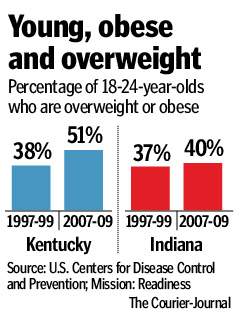
"More than half of 18-to-24-year-olds in Kentucky are overweight or obese — the highest percentage in the nation," The Courier-Journal's Laura Ungar reports. Their weight is not only bad for their health, but limits their ability to serve effectively in the military. (C-J chart)

These findings come from a report called "Too Fat to Fight," released Wednesday and compiled by Mission: Readiness, whose members are retired generals and other high-ranking military officials concerned about the physical fitness of the services' recruitment pools. The reports shows 51 percent of young adults in Kentucky were either overweight or obese in 2007-9, up from 38 percent in 1997-99. Nationwide, only about 1 on 4 17-to-24-year-olds were too heavy to serve in the military.

Another report released by the U.S. Centers for Disease Control and Prevention looked at what is being done to fight the obesity epidemic in each state, by examining behavioral indicators and environmental factors. The report showed nearly 36 percent of Kentucky students, such as those at Bloom Elementary in Louisville (C-J photo by David R. Lutman), drink at least one soft drink a day, compared to 29.2 percent nationwide. More than 68 percent of Kentucky middle and high schools allow the advertising of unhealthy foods, compared to 49 percent nationwide.

Both reports concluded schools can play a key role in helping children lose weight. "Mission: Readiness urges Congress to help upgrade school equipment such as freezers, ovens and salad bars and train cafeteria workers to prepare meals with fresh ingredients," Ungar reports. (Read more)

Wednesday, January 12, 2011

Fort Campbell soldier who went AWOL, and says his Kentucky PTSD treatment was inadequate, is set to return to Afghanistan

A Fort Campbell-based soldier who went absent without leave because of alleged post-traumatic stress disorder will return to finish his tour in Afghanistan.

"My family doesn't want me to go, but I am not disobeying a command order," Spc. Jeff Hanks, 30, told Kristin M. Hall of The Associated Press. Hanks, right, said his mental health issues date back to a 2008 deployment in Iraq. Last year, he spent six months in Afghanistan, during which he sustained a concussion when a mortar landed near him. Since turning himself in on Nov. 11, 2010, he said he has been treated for nightmares and headaches and was told to get counseling when re-deployed. Hanks told the AP he does not feel his PTSD has been treated adequately.

Hanks, a married father from North Carolina, said he will likely serve another four months in the country to complete his one-year tour. He has committed to serve in the Army another two and a half years. A Fort Campbell spokeswoman told the AP that Hanks is scheduled to re-deploy in the coming days. (Read more)

Hanks was deployed overseas in May 2010 and did not return after a mid-tour leave in October, reports Jake Lowary of The Leaf-Chronicle in Clarksville, Tenn. After turning himself in on Veterans Day, the Army opted to send Hanks for treatment at a facility in Hopkinsville, Ky., rather than send him back to Afghanistan. (Read more)