Showing posts with label Guantanamo. Show all posts

Wednesday, January 11, 2012

Un-Occupy Guantanamo

And give the land back to Cuba

By Meteor Blades, cross-posted from Daily Kos

Jonathan Hansen has written a bullseye piece for The New York Times. It may be of little interest to most of the Daily Kos community, but it's of considerable interest to me. Give Guantánamo Back to Cuba.

This is a history I know well, international relations with an emphasis on Latin America having been the subject of my undergraduate degree. The seizure of Guantánamo was justified the way many U.S. "interventions" were justified. The Caribbean, after all, was considered an "American lake," and those who used the term did not mean, in any way, Latin American. Hansen superbly condenses the sordid history of U.S. intervention on the island into the cramped space of an Op-Ed:
The circumstances by which the United States came to occupy Guantánamo are as troubling as its past decade of activity there. In April 1898, American forces intervened in Cuba’s three-year-old struggle for independence when it was all but won, thus transforming the Cuban War of Independence into what Americans are still want to call the Spanish-American War. American officials then excluded the Cuban Army from the armistice and denied Cuba a seat at the Paris peace conference. “There is so much natural anger and grief throughout the island,” the Cuban general Máximo Gómez remarked in January 1899, after the peace treaty was signed, “that the people haven’t really been able to celebrate the triumph of the end of their former rulers’ power.” Curiously, the United States’ declaration of war on Spain included the assurance that America did not seek “sovereignty, jurisdiction, or control” over Cuba and intended “to leave the government and control of the island to its people.”
But after the war, strategic imperatives took precedence over Cuban independence. The United States wanted dominion over Cuba, along with naval bases from which to exercise it.
Out of this desire for bases and an utter disregard for the self-determination of Cubans came the Platt Amendment. This allowed Washington to step into Cuban affairs whenever it felt like it and to forcibly lease land for naval bases. Cuban leaders naturally despised this. But what could they do? Resist the way Filipinos had done after the U.S. had kicked Spain out of their country and wind up being crushed? Under duress, they chose to incorporate the hideous amendment into their Constitution.

It was, as Hansen notes, as if the French had stayed around to run things after the American Revolution, which could not have been won without their help. Imagine if Paris had, after years of occupation demanded an amendment be included by the Founders in Philadelphia saying France could intervene whenever it wanted in U.S. affairs and, oh, by the way, we'd like to perpetually lease the Port of Boston. The argument for ratification with that in place might have made for interesting reading in the Federalist Papers.


The Platt Amendment was given up under the Good Neighbor Policy in 1934. But the 45 square miles around Guantánamo stayed under U.S. control. The annual lease, which cannot be ended unless both sides agree or the U.S. walks away, now costs about $4200 annually in rent that is indexed to U.S. inflation. Perhaps Fidel has pondered what he might do if the payment is late, but it never is.

It was just a naval base for a long time, an imperialist foothold in the American lake, ignored by history textbooks that asserted American never had colonies. Ten years ago, as we all know too well, it became something else when the Bush administration installed its military prison there, based on the clever idea that Guantánamo was not subject to U.S. law because it was leased foreign property and also not subject to Cuban or international law because, well, just because. A jurisdictionless playground for torturers who viewed the Geneva Conventions as quaint and the angry consternation of human rights organizations' as nonsense in the New American Century.

Today, on its 10th anniversary, three years after President Obama signed an executive order to close it, the prison at Guantánamo remains open and the indefinite detention of its remaining inmates is enshrined in the law, the product of another executive order signed in March 2011 and the recent National Defense Authorization Act. One of the prisoners still there is Suleiman al-Nahdi. Like several dozen others, he was cleared five years ago for release. The way things are going, he may well live out his life in the tropics.

Two evils in one. Our nation's imperialist past, denied, glossed over, rationalized and justified under American "exceptionalism" and, contradictorially, by its self-interested Manifest Destiny. And America's imperialist present, backed both by a core military budget that is larger in real terms than any since the end of World War II and slated to grow larger still over the next decade, and by a law that permits indefinite detention of anyone executively deemed a terror suspect.

While no new prisoners will probably ever be sent to Guantánamo, its unending presence as naval base and precedence as stolen foothold are a stain our leaders would excoriate were any nation not a U.S. ally operate such an facility on seized foreign territory.
Hansen is right to say that if the president
were to acknowledge this history and initiate the process of returning Guantánamo to Cuba, he could begin to put the mistakes of the last 10 years behind us, not to mention fulfill a campaign pledge. (Given Congressional intransigence, there might be no better way to close the detention camp than to turn over the rest of the naval base along with it.)
Despite the longevity of the Castro regime, it certainly is nearing its end, and what better way to begin building fair relations between sovereigns than to acknowledge that prying Guantánamo out of Cuban hands more than a century ago and using it in a criminal way is no way for 21st Century nations to interact. In other words, the United States should behave in the way that out leaders so often tell other leaders, including Cuban leaders, to behave instead of like outlaws and rogues.

But short of massive pressure from the American people, that's not going to happen any more than dismantling most of the hundreds of U.S. bases overseas will happen. Such pressure certainly won't emerge in an election year. The question is: Will it ever?

Unhappy Anniversary, Gitmo

Ten years ago today the first twenty prisoners arrived at Guantanamo.  As the ACLU writes, "since it opened, almost 800 men have passed through Guantánamo’s cells. Today, 171 men remain imprisoned there; 89 of those men have been unanimously cleared by intelligence and military officials, but remain at the prison camp."  Amy Davidson notes that "only six prisoners were ever convicted by a military commission."

A new ACLU infographic provides the disturbing facts and figures about Guantánamo.

For a more humanizing perspective, you can read this heartbreaking op-ed in the New York Times by Lakhdar Boumediene, a Bosnian citizen who  unfairly imprisoned at Guantánamo for seven and a half years without charge or trial.  And another by Murat Kurnaz, a man of Turkish descent who lived in Germany, imprisoned for five years.  There are countless other such stories that have received less prominence.

For good reason, as human rights activist Aisha Maniar writes at openDemocracy, Guantánamo "has become a synonym for torture, arbitrary detention and illegality. It is perhaps the most powerful and flagrant symbol of injustice this century."

While initially a product of the disastrous Bush Administration's War on Terror, Obama has hewed closely to his predecessor's policies.  Maniar asserts that "under Obama’s leadership, very few prisoners have left Guantánamo, military commissions have been reinstated, convictions have been made on the basis of torture evidence and the first war crimes tribunal involving offences allegedly committed by a minor since World War II has been held."  And then, last month, Obama signed a defense bill codifying indefinite detention into law.

Maniar concludes that it is up to us to demand a change to these shameful policies:
The passage of time, the apparent normalization of the abnormal and its codification in law do not suddenly make the indefensible defensible. The campaign to close Guantánamo will go on. The failure of politicians to rise to the challenge in over ten years means that ordinary people should take the lead in defending those values and principles protected by law for centuries which are far too precious to be undone in such a short space of time for what appears to be little more than political expediency. 
Indeed.  For a start, you can click here to ask President Obama to close Guantánamo, once and for all.

Monday, November 28, 2011

Just Say No To Indefinite Military Detentions

This week, and as early as tonight, the Senate will vote on the 2012 Defense Authorization Bill, which includes a truly awful provision that would permit indefinite detention.  If the bill becomes law, Congress will have given the President the power to order the military to pick up and imprison without charge or trial civilians anywhere in the world.

Chris Anders of the ACLU explains:

The power is so broad that even U.S. citizens could be swept up by the military and the military could be used far from any battlefield, even within the United States itself.  The worldwide indefinite detention without charge or trial provision is in S. 1867, the National Defense Authorization Act bill, which will be on the Senate floor on Monday. The bill was drafted in secret by Sens. Carl Levin (D-Mich.) and John McCain (R-Ariz.) and passed in a closed-door committee meeting, without even a single hearing.
While the Obama Administration may ultimately veto the legislation, the only way to ensure the bill doesn't pass is for the Senate to approve the Udall amendment, which would strip the detention provisions and require Congress to use an orderly process to consider whether any detention legislation is needed at all.

It is not too late to contact your senators and urge them to vote YES on the Udall Amendment to the National Defense Authorization Act.

Saturday, August 27, 2011

How Washington Lost Faith In America's Courts

By Karen J. Greenberg, cross-posted from Tom Dispatch

As the 10th anniversary of 9/11 approaches, the unexpected extent of the damage Americans have done to themselves and their institutions is coming into better focus.  The event that “changed everything” did turn out to change Washington in ways more startling than most people realize.  On terrorism and national security, to take an obvious (if seldom commented upon) example, the confidence of the U.S. government seems to have been severely, perhaps irreparably, shaken when it comes to that basic and essential American institution: the courts.

If, in fact, we are a “nation of laws,” you wouldn’t know it from Washington’s actions over the past few years. Nothing spoke more strikingly to that loss of faith, to our country’s increasing incapacity for meeting violence with the law, than the widely hailed decision to kill rather than capture Osama bin Laden.

Clearly, a key factor in that decision was a growing belief, widely shared within the national-security establishment, that none of our traditional or even newly created tribunals, civilian or military, could have handled a bin Laden trial.  Washington’s faith went solely to Navy SEALs zooming into another country’s sovereign airspace on a moonless night on a mission to assassinate bin Laden, whether he offered the slightest resistance or not.  It evidently seemed so much easier to the top officials overseeing the operation -- and so much less messy -- than bringing a confessed mass murderer into a courtroom in, or even anywhere near, the United States.

The decision to kill bin Laden on sight rather than capture him and bring him to trial followed hard on the heels of an ignominious Obama administration climb-down on its plan to try the “mastermind” of the 9/11 attacks, Khalid Sheikh Mohammed, or KSM, in a federal court in New York City.  Captured in Pakistan in May 2003 and transferred to Guantanamo in 2006, his proposed trial was, under political pressure, returned to a military venue earlier this year.

Given the extraordinary record of underperformance by the military commissions system -- only six convictions in 10 years -- it’s hard to escape the conclusion that the United States has little faith in its ability to put on trial a man assumedly responsible for murdering thousands.

And don’t assume that these high-level examples of avoiding the court system are just knotty exceptions that prove the rule.  There is evidence that the administration’s skepticism and faint-heartedness when it comes to using the judicial system risks becoming pervasive.


Pushing Guilt Before Trial

Needless to say, this backing away from courts of law as institutions appropriate for handling terrorism suspects began in the Bush-Cheney years.  Top officials in the Bush administration believed civilian courts to be far too weak for the Global War on Terror they had declared.  This, as they saw it, was largely because those courts would supposedly gift foreign terrorist suspects with a slew of American legal rights that might act as so many get-out-of-jail-free cards.

As a result, despite a shining record of terrorism convictions in civilian courts in the 1990s -- including the prosecutions of those responsible for the 1993 attempt to take down a tower of the World Trade Center -- President Bush issued a military order on November 13, 2001, that established the court-less contours of public debate to come.  It mandated that non-American terrorists captured abroad would be put under the jurisdiction of the Pentagon, not the federal court system. This was “war,” after all, and the enemy had to be confronted by fighting men, not those sticklers for due process, civilian judges and juries.

The federal courts have, of course, continued to try American citizens and residents (and even, in a few cases, individuals captured abroad) in terror cases of all sorts -- with an 87% conviction rate for both violent and non-violent crimes.  In fact, 2010 was a banner year for terrorism prosecutions when it came to American citizens and residents, and 2011 is following suit.  As could have been predicted, in the vast majority of these cases -- all the ones that mattered -- there were convictions.

You might think, then, that the courts had proved their mettle against mounting criticism and distrust of a system said to be insufficiently harsh. And initially, Obama's Department of Justice defended civilian courts as resilient and flexible enough to try terror cases.

But that didn’t last.  Recently, the Obama administration has reinforced a policy (begun under President Bush) which offers an ominous new twist on American justice: punishment before trial.  It has, for example, relied upon various extreme methods of pre-trial isolation -- including a version of restrictive orders known as Special Administrative Measures, or SAMs -- that reek of punitiveness and have often caused severe psychological deterioration in suspects awaiting trial on terrorism charges.

The most noteworthy case of this is Syed Fahad Hashmi’s.  An American citizen arrested while studying in England, Hashmi had allowed an acquaintance, Mohammed Junaid Babar, to stay in his apartment for two weeks. Babar, who testified against Hashmi and was later released, allegedly had socks, ponchos, and raingear intended for al-Qaeda in his luggage and allegedly used Hashmi’s cell phone to call terrorist conspirators. Hashmi, accused of “material support” for al-Qaeda, was kept under SAMs for three years without trial -- until he finally pled guilty.

The urge to punish before a verdict comes in reflects the same deep-seated conviction that the U.S. court system is simply not to be trusted to do its job.  Two recent cases -- that of whistleblowers Thomas Drake and Bradley Manning -- illustrate how, in cases where national security is believed to be at stake, Obama-era pre-trial treatment has taken up the distrust of the courts, civilian or military, that characterized the Bush years.

Drake, an executive for the National Security Agency (NSA), became a whistleblower over what he considered mistaken policy decisions about an ill-performing data-sifting program which, among other things, he thought squandered taxpayer money. Subsequently, he revealed his disagreement with the agency’s warrantless wire-tapping program, which he believed overstepped legal boundaries. Charged initially with violating the Espionage Act and threatened with a draconian 35-year jail sentence, Drake finally pled this past June to a misdemeanor count of “exceeding the authorized use of a government computer.”

In Drake’s four-year saga, his pre-punishment took the form not of pre-trial detention but of the destruction of his livelihood. He was initially fired from the NSA and from the National Defense University position to which the NSA had assigned him. Once indicted in 2010, he was forced to resign from a subsequent teaching post at Strayer University. All told, the formal and informal hounding of Drake resulted in the loss of his jobs and pension, as well as $82,000 in legal costs.

Ultimately, Drake was sentenced to a year’s probation and 240 hours of mandatory community service. By that time, he had been ruined financially and professionally, thanks to the government’s disparagement of him and the multi-year delay between its accusations and the lodging of formal charges against him. Drake now works at an Apple Store. In other words, well before the government took its chances in court, Thomas Drake was punished.

Another highly publicized case where punishment preceded trial has been the mistreatment of Army Private Bradley Manning while in military custody in a Marine brig in Quantico, Virginia, awaiting charges.  The Obama administration believes he turned over a trove of secret military and State Department documents to the website WikiLeaks.  Following his arrest, Manning was kept in subhuman conditions.  He was forced to sleep naked and to strip for daily inspections, though as news about his situation generated bad publicity, he was eventually allowed to sleep in a “tear-proof” gown.
There is something deeply disturbing about the very different ways Manning and Drake were pre-punished by the government -- both directly in the case of Manning and indirectly in the case of Drake -- before being given due process of any kind.  Like bin Laden’s killing, both cases reflect an unspoken worry in Washington that our courts will prove insufficiently ruthless and so incapable of giving the “obviously guilty” what they “obviously” deserve.

The Courts Take Notice

As it turns out, the judicial system hasn’t taken the government’s new attitude lying down.  Various judges and juries have, in fact, shown themselves to be unfazed by both public and governmental pressures and have, in terror and national security cases, demonstrated signs of balance and of a concern for justice, rather than being driven by a blind sense of revenge.

In the past year, there has been an unprecedented number of high-profile terrorism trials. All have resulted in convictions, which have nonetheless not reflected the unstinting harshness that critics of court-centered counterterrorism insist upon.  In the case of Ahmed Ghailani, the sole Guantanamo detainee to face trial in the nation’s criminal justice system, the jury, having done its work of assessing the evidence, acquitted the defendant on 284 of 285 counts, including all the murder charges associated with the 1998 bombings of the U.S. embassies in Kenya and Tanzania.  On the single count on which he was convicted, however, Ghailani was given a life sentence without parole.

Meanwhile, a high-profile terrorism case -- that of Tagawwur Rana -- ended in a jury acquittal on its most serious charge.  Rana had been accused of cooperating in the 2008 terrorist attacks in Mumbai, India, which resulted in the deaths of more than 160 individuals. The jury found Rana guilty of material support, but not of helping to coordinate the attack.

These cases and others like them have, of course, been fodder for all the usual critics who consider anything but a 100% conviction rate on all charges in all cases to be a sure sign not of the justice system’s strength, but of its fundamental weakness.  And yet, such cases have showcased just how effectively the system still works, in a more nuanced way than in the previous near-decade, as well as in a subtler and more just way than Washington has managed to approximate over that same period.  Despite the fears, pressures, and scare tactics that are entangled with all such terror cases, we now have living proof that juries can think for themselves, and guilt can be a partial matter, rather than a Washington slam-dunk.

Of late, federal judges on such cases also seem to have been signaling to the government’s representatives that they must be more restrained in their approach to national security cases, both in and out of court. In late June, for instance, during the sentencing of three of the men convicted of conspiring to bomb two synagogues in Riverdale, New York, and to launch a Stinger missile aimed at aircraft over Newburgh’s Air National Guard Base, Judge Colleen McMahon struck back at the government’s case.  “I believe beyond a shadow of a doubt,” she said, “that there would have been no crime here except the government instigated it, planned it, and brought it to fruition.  That does not mean that there was no crime. The jury concluded that you were not entrapped, and I see no basis to overturn their verdict.”

In the Drake case, Judge Richard Bennett was similarly distraught about the evident excesses in the government’s approach. At sentencing for the single minor count to which Drake agreed to plead, the judge bluntly refused to impose the $50,000 fine the prosecution was pushing for on the grounds that punishment had already been administered -- prior to the court process. “There has been financial devastation wrought upon this defendant,” said Bennett, “that far exceeds any fine that can be imposed by me.  And I'm not going to add to that in any way.  And it's very obvious to me in terms of some of the irritation I've expressed… not only my concern over the delay in this case… [but also the prosecution’s] inability to explain … the delay in this case… I think that somebody somewhere in the U.S. government has to say… that the American public deserves better than this."

In the recent jury decisions, as in the growing expressions of judicial dissatisfaction, an optimist might find signs that the system is finally starting to right itself.  On the other hand, a pessimist might come to the conclusion that the government will, in the future, simply put even more energy into avoiding the court system.

The bottom line is that the Obama administration, like its predecessor, defines success in terrorism prosecutions not by assessing whether or not due process and fair verdicts are administered, but solely in terms of what they deem proper punishment for those accused of violating national security -- especially when doing so minimizes partisan political clashes. By refusing to rein in its evident distrust of the judicial system when it comes to national security, the government is perpetuating a legal landscape that, to this day, lies in the shadow of Osama bin Laden.

Karen Greenberg is the executive director of the New York University Center on Law and Security, a TomDispatch regular, and the author of The Least Worst Place: Guantanamo’s First One Hundred Days, as well as the editor of The Torture Debate in America.

Tuesday, August 2, 2011

Getting Away With Torture: The Ill Treatment Of Detainees

By Stephen Rohde, cross-posted from Truthout.

Should the U.S. government officials most responsible for setting interrogation and detention policies following the Sept. 11, 2001 attacks be investigated, and if warranted prosecuted, under United States and international law?

In a new comprehensive 107-page report entitled "Getting Away with Torture: The Bush Administration and Mistreatment of Detainees," Human Rights Watch (HRW) concludes that "there is sufficient basis for the U.S. government to order a broad criminal investigation into alleged crimes committed in connection with the torture and ill-treatment of detainees, the CIA secret detention program, and the rendition of detainees to torture" focusing on alleged criminal conduct by "former President George W. Bush, Vice President Dick Cheney, Defense Secretary Donald Rumsfeld, and CIA Director George Tenet."

HRW also recommends investigating former National Security Advisor Condoleezza Rice, Attorney General John Ashcroft, Alberto Gonzales (counsel to the president and later attorney general), Jay Bybee (head of the Justice Department's Office of Legal Counsel (OLC)), John Rizzo (acting CIA general counsel), David Addington (counsel to the vice president), William J. Haynes II (Department of Defense general counsel), and John Yoo (deputy assistant attorney general in the OLC).

HRW found that "there is enough strong evidence from the information made public over the past five years to not only suggest these officials authorized and oversaw widespread and serious violations of US and international law, but that they failed to act to stop mistreatment, or punish those responsible after they became aware of serious abuses."

Moreover, although Bush administration officials have claimed that detention and interrogation operations were only authorized after extensive discussion and legal review by Department of Justice attorneys, HRW concludes that "substantial evidence that civilian leaders requested that politically appointed government lawyers create legal justifications to support abusive interrogation techniques, in the face of opposition from career legal officers."

Although HRW expressed no opinion about the ultimate guilt or innocence of any officials under U.S. law, the report provides a narrative summarizing Bush administration policies and practices on detention and interrogation, and details the case for individual criminal responsibility of several key administration officials.
The report documents how the Bush administration authorized coercive interrogation practices by the CIA and the military that amounted to torture, and instituted an illegal secret CIA detention program in which detainees were held in undisclosed locations without notifying their families, allowing access to the International Committee of the Red Cross, or providing for oversight of their treatment. Detainees were also unlawfully transferred to countries such as Syria, Egypt, and Jordan, where they were likely to be tortured.

We now know that as a direct result of Bush administration decisions, detainees in U.S. custody were beaten, thrown into walls, forced into small boxes, and waterboarded, an ancient method of torture where victims are subjected to mock executions in which they endured the sensation of drowning. Two alleged senior al-Qaida prisoners, Khalid Sheikh Mohammed and Abu Zubaydah, were waterboarded 183 and 83 times respectively.

The report documents how detainees in U.S.-run facilities in Afghanistan, Iraq, and Guantanamo Bay endured prolonged mistreatment, sometimes for weeks and even months, including "painful 'stress' positions; prolonged nudity; sleep, food, and water deprivation; exposure to extreme cold or heat; and total darkness with loud music blaring for weeks at a time." In Iraq, the abuses included "beatings, near suffocation, sexual abuse, and mock executions;" at Guantanamo Bay, "detainees were forced to sit in their own excrement, and some were sexually humiliated by female interrogators." In Afghanistan, "prisoners were chained to walls and shackled in a manner that made it impossible to lie down or sleep, with restraints that caused their hands and wrists to swell up or bruise."

The report makes clear that Bush administration officials "developed and expanded their initial decisions and authorizations on detainee operations even in the face of internal and external dissent, including warnings that many of their actions violated international and domestic law." And "when illegal interrogation techniques on detainees spread broadly beyond what had been explicitly authorized, these officials turned a blind eye, making no effort to stop the practices."

HRW also points out that the CIA's use of torture, enforced disappearance, and secret prisons was counterproductive and "tainted the U.S. government's reputation and standing in combating terrorism, negatively affected foreign intelligence cooperation, and sparked anger and resentment among Muslim communities, whose assistance is crucial to uncovering and preventing future global terrorist threats."

To date, President Barack Obama has failed to heed the call to initiate a full and fair investigation of these allegations. As a presidential candidate, Obama spoke of the need for a "thorough investigation" of detainee mistreatment. After his election, he said there should be prosecutions if "somebody has blatantly broken the law," but later backed off and said "we need to look forward as opposed to looking backwards."

HRW points out that "without real accountability for these crimes, those who commit abuses in the name of counterterrorism will point to the U.S. mistreatment of detainees to deflect criticism of their own conduct" and that "when a government as dominant and influential as that of the United States openly defies laws prohibiting torture, a bedrock principle of human rights, it virtually invites others to do the same. The U.S. government's much-needed credibility as a proponent of human rights was damaged by the torture revelations and continues to be damaged by the complete impunity for the policymakers implicated in criminal offenses."

The report responds to the claim that any effort to address past abuses would be politically divisive, and might hinder the Obama administration's ability to achieve pressing policy objectives. "Any failure to carry out an investigation into torture will be understood globally as purposeful toleration of illegal activity, and as a way to leave the door open to future abuses. The U.S. cannot convincingly claim to have rejected these egregious human rights violations until they are treated as crimes rather than as 'policy options.'"

But the benefits of conducting a credible and impartial criminal investigation are numerous. The U.S. government "would send the clearest possible signal that it is committed to repudiating the use of torture," which "would boost U.S. moral authority on human rights in counterterrorism in a more concrete and persuasive way than any initiative to date; set a compelling example for governments that the U.S. has criticized for committing human rights abuses and for the populations that suffer from such abuses; and might reveal legal and institutional failings that led to the use of torture, pointing to ways to improve the government's effectiveness in fighting terrorism."

Today, substantial evidence has been placed on the public record regarding illegal detention policies and the torture and ill-treatment of detainees in US custody. FOIA lawsuits brought by the ACLU and the Center for Constitutional Rights have yielded over 100,000 pages of government documents. Extensive information was also uncovered in an investigation by the Senate Armed Services Committee. The Department of Justice inspector general issued a report about FBI involvement in detention abuse in 2008, and the department’s Office of Professional Responsibility issued a report on the role of department lawyers in crafting legal memoranda which justified abusive interrogations.  A report by the International Committee of the Red Cross also describes the treatment of “high-value” detainees in CIA custody. In addition, former detainees and whistleblowers have come forward to tell their stories, and many of the principals have spoken about their roles.

Based on compelling evidence, HRW believes criminal investigations of the following individuals are warranted:

President George W. Bush "authorized the CIA renditions program, which he knew or should have known would result in torture," "has publicly admitted that he approved CIA use of torture, specifically the waterboarding of two detainees," and "never exerted his authority to stop the ill-treatment or punish those responsible."

Vice President Dick Cheney "chaired or attended numerous meetings at which specific CIA operations were discussed, beginning with the waterboarding of detainee Abu Zubaydah in 2002," "was a member of the National Security Council (NSC) 'Principals Committee,' which approved and later reauthorized the use of waterboarding and other forms of torture and ill-treatment in the CIA interrogation program" and "has publicly admitted that he was aware of the use of waterboarding."

Defense Secretary Donald Rumsfeld "approved illegal interrogation methods that facilitated the use of torture and ill-treatment by US military personnel in Afghanistan and Iraq," "closely followed the interrogation of Guantanamo detainee Mohamed al-Qahtani who was subjected to a six-week regime of coercive interrogation that cumulatively amounted to torture," "was a member of the NSC Principals Committee, which approved the use of torture for CIA detainees," and "never exerted his authority to stop the torture and ill-treatment of detainees even after he became aware of evidence of abuse over a three-year period beginning in early 2002."

CIA Director George Tenet "authorized and oversaw the CIA’s use of waterboarding, near suffocation, stress positions, light and noise bombardment, sleep deprivation, and other forms of torture and ill-treatment," "was a member of the NSC Principals Committee," and under his direction, "the CIA also 'disappeared' detainees by holding them in long-term incommunicado detention in secret locations, and rendered detainees to countries in which they were likely to be tortured and were tortured."

In addition, HRW concludes there should be criminal investigations of the government lawyers who wrote legal memoranda seeking to justify torture, which were the basis for authorizing the CIA secret detention program, including Alberto Gonzales, Jay Bybee, John Rizzo, David Addington, William J. Haynes II, and John Yoo.

Will President Obama and Attorney General Eric Holder take the Human Rights Watch report seriously?  Will they fulfill U.S. obligations under the Convention Against Torture to investigate these documented allegations of torture? Or will they look the other way, becoming accomplices after-the-fact and risking the condemnation of history.

 Stephen Rohde, a constitutional lawyer and Chair of the ACLU Foundation of Southern California, is author of  American Words of Freedom and Freedom of Assembly.

Thursday, July 14, 2011

Getting Away With Torture

As Human Rights Watch contends, the Obama Administration has failed to meet this country's obligations "to investigate acts of torture and other ill-treatment of detainees" by the prior administration.  It has just released a 107-page report, Getting Away With Torture, which "presents substantial information warranting criminal investigations of Bush and senior administration officials, including former Vice President Dick Cheney, Defense Secretary Donald Rumsfeld, and CIA Director George Tenet, for ordering practices such as “waterboarding,” the use of secret CIA prisons, and the transfer of detainees to countries where they were tortured."

Executive Director Kenneth Roth states that despite "solid grounds to investigate Bush, Cheney, Rumsfeld, and Tenet for authorizing torture and war crimes . . . President Obama has treated torture as an unfortunate policy choice rather than a crime."  In the absence of a meaningful reckoning, however, "Obama's decision to end abusive interrogation practices will remain easily reversible unless the legal prohibition against torture is clearly reestablished."

Roth asserts that if the United States government refuses to pursue credible criminal investigations, other countries should prosecute US officials involved in crimes against detainees in accordance with international law:  "The US has a legal obligation to investigate these crimes," Roth said. "If the US doesn't act on them, other countries should."

[Related posts:  No Accounting For Torture; Pitfalls of Only Looking Forward, Tortured Logic; No Spain, No Gain.]

Tuesday, July 5, 2011

No Accounting For Torture

The headline in the New York Times exclaimed Justice Dept. to Widen 2 C.I.A. Inquiries, referring to the continuing investigation of two suspected terrorists who died in C.I.A. custody, one at Abu Ghraib in 2003 and one in 2002 in an Afghan prison.  That's it.  Two token investigations, albeit for two grotesque cases, are subject to inquiry.  Meanwhile, investigation into the deaths of over 100 other detainees are unceremoniously dropped.

As Glenn Greenwald put it, this means there will be no accountability for a Bush regime that "extended to numerous prisons around the world, in which tens of thousands of mostly Muslim men were indefinitely imprisoned without a whiff of due process, and included a network of secret prisons -- "black sites" -- purposely placed beyond the monitoring reach of even international human rights groups, such as the International Red Cross" and no accountability for the 100 detainees who died during U.S. interrogations.

“With the approval of the Bush administration’s most senior officials, the C.I.A. operated an interrogation program that subjected prisoners to unimaginable cruelty and violated both international and domestic law,” said Jameel Jaffer, deputy legal director for the ACLU. “The narrow investigation that Attorney General Holder announced today is not proportionate to the scale and scope of the wrongdoing.

And that, of course, is the problem.  The narrow scope of the investigation focused on low level operatives and not the officials who approved the program.  In addition, as Adam Serwer observes, Obama further undermined the investigation's independence when he "argued that the country needed to 'look forward,' . . . suggesting that criminal investigations should be subordinate to the president’s whim rather than the facts and the law."

And not only have the Bush officials who "sanctioned torture escaped civil and professional consequences," but the Obama Administration, as Greenwald points out, shielded "those responsible for some of the most shameful and inexcusable crimes in the nation's history . . . from all other forms of accountability beyond the criminal realm: invoking secrecy and immunity doctrines to prevent their victims from imposing civil liability, exploiting their party's control of Congress to suppress formal inquiries, and pressuring and coercing other nations not to investigate their own citizens' torture at American hands."

What is so wrong about this is not only that those responsible for torture are being let off the hook.  As Serwer writes, "the absence of strong legal barriers to torture and the deterrent factor of criminal or civil accountability," make if far more likely that torture could again become American policy.  Thus, even assuming the Obama Administration won't sanction torture and violate human rights, what is to stop the next Administration when there has been no true reckoning?

Tuesday, May 10, 2011

Tortured Debate

Tom Tomorrow:  The True Story
There are serious problems with the attempts by the torture apologists to take credit for finding Osama Bin Laden.  First, the claim that the ten-year search for bin Laden succeeded thanks to the Bush Administration's enhanced interrogation techniques is pretty thin.  As Amy Davidson puts it, "you would think that if the C.I.A.’s interrogation of high-value detainees was all it took, the U.S. government would have succeeded in locating bin Laden before 2006, which is when the C.I.A.’s custody of so-called “high-value detainees” ended."

In the New York Times, Scott Shane and Charlie Savage's detailed account concludes that torture "played a small role at most in identifying Bin Laden’s trusted courier and exposing his hideout."  Indeed, as Davidson notes, "One would think that if so-called 'enhanced interrogations' provided the magic silver bullet, and if the courier was a protégé of K.S.M.’s, then the C.I.A. might have wrapped this up back in 2003, while they were waterboarding the 9/11 mastermind a hundred and eighty-three times."

Which brings us to another problem.  As Dan Froomkin explains, it is "not just that the torture didn't work, but that it was actually counterproductive."  Far from vindicating "the apologists and practitioners of torture," it is far more likely, Froomkin points out, that "bin Laden could have been caught much earlier had those detainees been interrogated properly."  

What we do know about torture is that it is good at "eliciting false confessions."  This is not surprising given, as Froomkin previously wrote, "Bush-era torture techniques . . . were cold-bloodedly modeled after methods used by Chinese Communists to extract confessions from captured U.S. servicemen that they could then use for propaganda during the Korean War."

But whether torture "works" or not is ultimately beside the point.  Torture is immoral, illegal and violates fundamental human rights.  As Dahlia Lithwick says:
There is just one question about America and torture: whether we should do it. The answer to that, after hundreds of years of legal thinking and moral progress, not just in America but around the world, is no. It's bad for those asked to torture, and it's bad for our soldiers who will be tortured by others. A bunch of Bush officials secretly changed that answer for a time, based on misapprehensions of its efficacy, but for serious interrogators, ethical thinkers, and lawyers, the answer has always been no.
When President Obama took office he refused to allow his Justice Department to investigate, much less prosecute, those in the Bush Administration who authorized torture.  He maintained that since his Administration wouldn't condone torture we can simply move forward.  But we are not moving forward.  Without a true reckoning that confirms once and for all the immorality and illegality of torture, we remain stuck in a debate framed by self-serving Bush officials about its efficacy.  And, as Froomkin concludes, "the debate goes on."

Monday, April 25, 2011

Quite Simply A Mess

"Viewed as a whole, the secret intelligence summaries help explain why in May 2009 President Barack Obama, after ordering his own review of wartime intelligence, called America's experiment at Guantanamo 'quite simply a mess.'"   Rosenberg & Lasseter, McClatchy Newspapers, 4/24/11
Various media outlets have just published classified military documents on Guantanamo detainees originally obtained by WikiLeaks.  Here is the story from McClatchy's Carol Rosenberg and Tom Lasseter.  They report that:
[T]he U.S. military set up a human intelligence laboratory at Guantanamo that used interrogation and detention practices that they largely made up as they went along . . . The documents, more than 750 individual assessments of former and current Guantanamo detainees, show an intelligence operation that was tremendously dependant on informants — both prison camp snitches repeating what they'd heard from fellow captives and self-described, at times self-aggrandizing, alleged al Qaida insiders turned government witnesses who Pentagon records show have since been released.
The New Yorker's Amy Davidson details how some of the evidence was gathered and goes on to say that "the greatest insight the files may give is into what our government thought it was doing, and why, when it decided to imprison certain people indefinitely and out of the reach of the rule of law—the logic, or illogic, of Guantánamo."

As Rosenberg and Lasseter conclude after reviewing the records of the interrogations, "there’s not a whiff in the documents that any of the work is leading the U.S. closer to capturing bin Laden. In fact, they suggest a sort of mission creep beyond the post-9/11 goal of using interrogations to hunt down the al Qaeda inner circle and sleeper cells."  Which leads Davidson to remark:  "And so we sacrificed our values and our moral standing for goals that were increasingly—vanishingly—distant from the ones we had been told were so urgent; or for no real reason at all."

In the wake of President Obama's executive order to continue to hold some of the detainees at Guantanamo indefinitely without any charges, Glenn Greenwald stresses that "these documents conclusively underscore the evils of the Obama administration’s indefinite detention regime." 
The idea of trusting the government to imprison people for life based on secret, untested evidence never reviewed by a court should repel any decent or minimally rational person, but these newly released files demonstrate how warped is this indefinite detention policy specifically.

Tuesday, April 19, 2011

Home Of The Brave?

Hendrik Hertzberg writes in The New Yorker Magazine (Prisoners) about the never-ending "war on terror."  Hertzberg points out how shameful it is that the 172 "shackled, isolated prisoners" still held at Guantanamo have "somehow been permitted to engender a miasma of popular fear and political cowardice."

As the New York Times so aptly stated in an editorial on Sunday, "President George W. Bush made [Guantanamo] a symbol of torture and illegal detention."  In the wake of Attorney General Holder's announcement that Khalid Sheikh Mohammed and four others accused of involvement in the 9/11 attacks will be tried in a military tribunal and not in a civilian trial, Hertzberg notes how candidate Obama promised that, if elected, he would shut Guantánamo down, prosecute accused terrorists in civilian courts, and discontinue indefinite detention without indictment or trial.  These promises, Hertzberg reminds us, "have been undone by a combination of political nihilism on the part of Republicans, political ineptitude on the part of his own Administration, and political fecklessness on the part of the people’s representatives on Capitol Hill."  Or as described by the Times, "a triumph of raw politics over the nation’s security interests."

Although after the election Obama issued an executive order directing that Guantanamo be closed "as soon as practical," the "slippage," as Hertzberg puts it, "began less than a month later, with a complicated legal tussle over seventeen Gitmo prisoners."  The "mere possibility" that they "might set foot on the United States mainland was enough to ignite a brushfire of not-in-my-back-yard hysteria."  In May 2009, the Senate voted overwhelmingly "not only to keep Gitmo open indefinitely but also to block the transfer of any of its detainees to U.S. soil, where the civilian courts are." 

As Hertzberg writes, "a dispiriting series of tactical retreats from civil-liberties principles has followed."  In January, Obama signed a defense-appropriation bill that continued to block funding for the transfer of detainees from Guantánamo to the U.S.  And then in March, as I wrote about here, Obama issued an executive order clearing the way for military tribunals to be held at Guantanamo.

The Obama Administration can mitigate some of the unjust aspects of these military trials by taking the steps outlined in the Times editorial:  (1) not rely on evidence obtained through torture or coercion or evidence that would otherwise be inadmissible in a civilian court; (2) appoint experienced defense counsel and provide them with sufficient resources; (3) make the trials truly public by televising the proceedings; (4) provide greater access to the press and less secrecy.

Hertzberg argues that Obama could -- and should -- remedy another aspect "of the moral morass that Guantánamo symbolizes":  the "lack of any official accountability for the abuses of the past, especially the embrace of torture."  Given that "there is no dispute that there was torture, that it was systematic, and that it was encouraged at the highest levels," as Bush boasts in his best-selling memoir, there is no reason for not appointing a truth commission "charged with compiling the record, affixing responsibility, and formally acknowledging what was done."

With Republicans asserting that Obama's actions are vindicating Bush's detention policies, the refusal of the Obama Administration to look backward is increasingly problematic.  (See The Pitfalls Of Only Looking Forward.) As Hertzberg concludes, "even with all the failings of the current Administration, the difference between its approach and its predecessor’s is the difference between night and day, albeit a rainy, miserable day, overcast with dark clouds. But, by elevating amnesia to official policy, the President has put himself in a poor position to make even that argument."

Tuesday, March 15, 2011

Tom Tomorrow: What To Do About Gitmo?

Tom Tomorrow brilliantly parodies the yawning gap between the Obama Administration's actual conduct and the "progressive fantasy of [his] presidency."  For the full comic, scroll down to the Tom Tomorrow link on the right and click on the image.

[Related posts:  Ridiculous and Counterproductive and Stupid; Dock of the Bay]

Monday, March 7, 2011

Dock Of The Bay

Remember when President Obama promised to close Guantanamo?  That was then, this is now.   Despite the success of trying alleged terrorists in federal court (see And Justice For All), the Administration has ordered the resumption of military tribunals at Guantanamo and has issued an executive order with procedures for periodic review of Guantanamo detainees who have been neither charged, convicted nor designated for transfer.

It is true that this is not all the fault of the Administration.  Their attempt to try high profile suspects in federal court in New York was met with fierce opposition and public outcry, and Congress passed a bill (that Obama signed) which prohibited spending Defense Department funds to transfer detainees to the U.S. for trial.  But while the Administration claims it is committed to federal civilian trials and will seek to repeal the restrictions imposed by Congress, this latest move appears to concede that indefinite detention and military tribunals adequately protect prisoners' rights. 

There remain 127 detainees at Guantanamo.  It appears that the first military tribunal under the new rules will involve Abd al-Rahim al-Nashiri, who is alleged to be behind the 2000 bombing of the USS Cole. Al-Nashiri has been held at Guantanamo since 2006, and the CIA has previously admitted to waterboarding him. 

As Elisa Massimino, president of Human Rights First, stated  “This is a step down the road toward institutionalizing a preventive detention regime.  People in the Mideast are looking to establish new rules for their own societies, and this sends a mixed message at best."   And as Hina Shamsi, of the ACLU's National Security Project put it:  "The best way to get America out of the Guantanamo morass is to use the most reliable tool we have -- our criminal justice system.  Instead, the Obama Administration has chosen to institutionalize unlawful, indefinite detentions and to revive illegitimate military commissions, which will do nothing to remove the stain on America's reputation that Guantanamo represents." 

[Related posts:  And Justice For All Update, We Are The World]

Monday, February 7, 2011

Persona Non Grata

George W. Bush at Super Bowl XLV
Former President George W. Bush looked like he was having fun at the Super Bowl, sitting in a luxury suite with his wife, Laura, and football icon John Madden.  Don't expect to see him at the 2012 Olympics in London.  On advice of counsel, Bush will likely limit his public appearances to the United States, or at least to countries that have not ratified the U.N. Convention Against Torture.

Bush was scheduled to appear in Geneva, Switzerland next week to deliver the keynote address at a fund-raising gala for Keren Hayesod.  However, according to Reuters, the trip was canceled because Bush feared he could be subject to legal action for the torture of Guantanamo detainees.  The Center for Constitutional Rights and several European human rights groups are filing a complaint against Bush on behalf of two of men, Majid Khan, who remains at Guantanamo, and Sami El Hadjj, a former Al Jazeera cameraman who was released.  The Reuters article notes that "pressure has been building on the Swiss government to arrest him and open a criminal investigation."  Dominique Baettig, a member of the Swiss parliament called last week for Bush's arrest for war crimes if he entered the country.

This would have been Bush's first European trip since leaving office. Whether it was canceled because he is "avoiding the handcuffs," as Reed Brody, counsel for Human Rights Watch claims, or for security reasons because of anticipated protests, as the event's organizers contend, it is good to know that at least in other countries Bush is considered a persona non grata.   As El Hadjj put it:  "I think George Bush's world is a very small place at the moment.  He may enjoy some kind of impunity in the United States, but other countries will not treat him so indulgently."

Tuesday, January 25, 2011

And Justice For All: An Update

Ahmed Ghailani was the first Guantanamo detainee to be tried in civilian court.  Below is a post I wrote in November 2010, after Ghailani's conviction for his role in the 1998 embassy bombings in Kenya and Tanzania, and the predictable outcry from conservatives that he should have been tried by a military commission.  Today, Ghailani was sentenced to life in prison.  The government was able to try and convict an alleged terrorist in a public jury trial in a civilian court.  With the imposition of the maximum sentence sought by the prosecution, it will be pretty hard for the right to argue with any credibility that military tribunals must be used in these cases.  It doesn't mean they won't try.

And Justice For All 

'No, no!' said the Queen. 'Sentence first - verdict afterwards.'
 Nov. 18, 2010.  Ahmed Ghailani was convicted of conspiracy for his involvement in the 1998 embassy bombings in Kenya and Tanzania.  Ghailani, the first Guantanamo detainee to be tried in a civilian court, will be sentenced to somewhere between 20 years and life in prison, most likely life. As The New Yorker's Amy Davidson notes, "the verdict came after five days of deliberations, four weeks of trial, a year in a Manhattan jail, three years in Guantánamo, and two in a darker sort of prison, a “black site” run by the C.I.A."

Predictably, as the Times reports, because Ghailani was acquitted of all but one count, including the murder counts, "critics of the Obama administration’s strategy on detainees said the verdict proved that civilian courts could not be trusted to handle the prosecution of Al Qaeda terrorists."  Thus, N.Y. Rep. Peter King contends that "we must treat them as wartime enemies and try them in military commissions at Guantanamo."  Conservatives like King appear to be arguing that our system of justice didn't work because it wasn't rigged to ensure convictions on all counts.  As Davidson states, however, "our legal system is not a machine for producing the maximum number of convictions, regardless of the law."

Or as counsel of the Rule of Law Program at the Constitution Project said, "I don’t think we judge success based on the number of convictions that were received. I think we judge success based on fair prosecutions consistent with the Constitution and the rule of law.”

One argument offered in favor of a military tribunals is the ability to use evidence obtained through torture.  However, in this case, where evidence from a key witness whose identity was obtained through torture was deemed inadmissible, the judge made clear that a military commission judge would have excluded that testimony as well.

The trial proved that our justice system does work.  Greg Sargent asserts that the reality is "Ghailani's trial took a mere month, at the fraction of the cost of flying translators, jurors, lawyers and reporters back and forth from Guantanamo. He will likely spend the rest of his life in prison. There were no opportunities to use the court as a "platform" to preach terrorism, and no security threats that disrupted the lives of New Yorkers. Opponents of the use of civilian trials often argue that civilian courts can't "handle" terrorists. They literally just did."  And Jack Tapper quotes a senior administration official:  "So, we tried a guy (who the Bush Admin tortured and then held at GTMO for 4-plus years with no end game whatsoever) in a federal court before a NY jury with full transparency and international legitimacy and -- despite all of the legacy problems of the case (i.e., evidence getting thrown out because of Bush-Admin torture, etc,) we were STILL able to convict him and INCAPACITATE him for essentially the rest of his natural life, AND there was not one -- not one -- security problem associated with the trial."

Amy Davidson makes a critical point in rebutting the assertion that the use of civilian trials creates significant hurdles for the prosecution -- and conviction -- of terror suspects:  "if time in the extra-judicial limbo of black sites, and the torture that caused some evidence to be excluded, makes prosecutors’ jobs harder, the problem is with the black sites and the torture, and not with the civilian trials that might eventually not work out quite the way everyone likes."  Finally, as Glenn Greenwald says, " When a reviled defendant is acquitted in court, and torture-obtained evidence is excluded, that isn't proof that the justice system is broken; it's proof that it works.  A "justice system" which guarantees convictions -- or which allows the Government to rely on evidence extracted from torture -- isn't a justice system at all, by definition."

Thursday, December 2, 2010

No Spain, No Gain

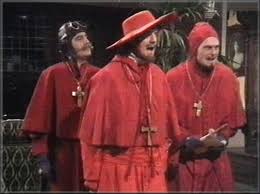
"I didn't expect a Spanish Inquisition"
In the Spring of 2009, after it became clear that the Obama Administration was not going to pursue any meaningful investigation, much less prosecution, of the Bush Administration's use of torture in its war on terror, I was heartened when Spanish Magistrate Baltasar Garzon ordered an inquiry into whether six senior Bush administration officials, the Bush Six, were responsible for "an authorized and systematic plan for torture."  Judge Garzon is a heroic figure who previously ordered the arrest of Chilean dictator Augusto Pinochet.  The torture investigation stemmed from allegations from five Spanish citizens imprisoned at Guantánamo.  (Spain was also investigating other Bush Administration misdeeds:  the death of a Spanish cameraman when Baghdad's Palestine Hotel was shelled and the use of Spanish bases and airfields for CIA extraordinary renditions flight).

We now know, thanks to WikiLeaks, that U.S. officials in the Obama Administration tried to influence Spanish prosecutors and government officials to stop these investigations.  As summarized by Scott Horton, the cables "reveal a large-scale, closely coordinated effort by the State Department to obstruct these criminal investigations."
High-ranking U.S. visitors such as former Republican Party Chair Mel Martinez, Senator Greg Judd, and Homeland Security Secretary Janet Napolitano were corralled into this effort, warning Spanish political leaders that the criminal investigations would “be misunderstood” and would harm bilateral relations. The U.S. diplomats also sought out and communicated directly with judges and prosecutors, attempting to steer the cases into the hands of judges of their choosing. The cables also reflect an absolutely extraordinary rapport between the Madrid embassy and Spanish prosecutors, who repeatedly appear to be doing the embassy’s bidding.
According to the cables, the embassy discussed with Spanish authorities specific judges handling these cases and obtained a promise from prosecutors to have the torture case assigned to a judge they considered friendlier to the United States.  And, lo and behold, the torture investigation has languished.  Garzon has since been suspended after being charged with abusing his powers to investigate Spanish Civil War atrocities, and, as David Corn reports, another judge is now overseeing the case, which has gone nowhere.

President Bush, in touting his new book, proudly admitted that he authorized waterboarding and considered it legal "because the lawyer said it was legal."  These lawyers -- the Bush Six -- provided the legal justification for torture based on what well-respected legal experts have characterized as "embarrassingly weak," "blatantly wrong" and "erroneous legal analysis."  There is little doubt that they conformed their legal opinions to reach the results Bush wanted.  As Georgetown law professor David Cole put it:
They concluded that keeping suspects awake for eleven days straight, stripping them naked, exposing them to cold temperatures, dousing them with water, slamming them into walls, forcing them into cramped boxes and stress positions for hours at a time, and waterboarding them hundreds of times were not torture, not cruel, not inhuman, not even degrading, and therefore perfectly legal. The memos make clear that true accountability . . . must extend up the chain of authority, to the lawyers and Cabinet officers who approved the “enhanced interrogation techniques” in the first place. 
President Obama has stated that since his Administration won't condone torture we can simply move forward.  This is remarkably short-sighted. If we are to remain a nation of laws then when high government officials break the law or cynically bend the law to justify human rights violations there need to be consequences.  As Professor Cole eloquently states:  "Absent a reckoning for those responsible for making torture and cruel, inhuman, and degrading treatment official US policy, the United States’ commitment to the rule of law will remain a hollow shell -- a commitment to be honored only when it is not inconvenient or impolitic to do so."

We have known for some time that this reckoning would not come from the U.S. government, but it did appear that other countries might fill the breach.  What the leaked cables tell us is that the Obama Administration was not only passively refusing to examine the Bush Administration's wrongdoing but actively pressuring other governments to cease their inquiries.  It appears that Obama can be tough when he wants to be.   [Related posts:  Pitfalls of Only Looking Forward, Tortured Logic]

Thursday, November 18, 2010

And Justice For All

'No, no!' said the Queen. 'Sentence first - verdict afterwards.'
 Ahmed Ghailani was convicted of conspiracy for his involvement in the 1998 embassy bombings in Kenya and Tanzania.  Ghailani, the first Guantanamo detainee to be tried in a civilian court, will be sentenced to somewhere between 20 years and life in prison, most likely life. As The New Yorker's Amy Davidson notes, "the verdict came after five days of deliberations, four weeks of trial, a year in a Manhattan jail, three years in Guantánamo, and two in a darker sort of prison, a “black site” run by the C.I.A."

Predictably, as the Times reports, because Ghailani was acquitted of all but one count, including the murder counts, "critics of the Obama administration’s strategy on detainees said the verdict proved that civilian courts could not be trusted to handle the prosecution of Al Qaeda terrorists."  Thus, N.Y. Rep. Peter King contends that "we must treat them as wartime enemies and try them in military commissions at Guantanamo."  Conservatives like King appear to be arguing that our system of justice didn't work because it wasn't rigged to ensure convictions on all counts.  As Davidson states, however, "our legal system is not a machine for producing the maximum number of convictions, regardless of the law."

Or as counsel of the Rule of Law Program at the Constitution Project said, "I don’t think we judge success based on the number of convictions that were received. I think we judge success based on fair prosecutions consistent with the Constitution and the rule of law.”

One argument offered in favor of a military tribunals is the ability to use evidence obtained through torture.  However, in this case, where evidence from a key witness whose identity was obtained through torture was deemed inadmissible, the judge made clear that a military commission judge would have excluded that testimony as well.

The trial proved that our justice system does work.  Greg Sargent asserts that the reality is "Ghailani's trial took a mere month, at the fraction of the cost of flying translators, jurors, lawyers and reporters back and forth from Guantanamo. He will likely spend the rest of his life in prison. There were no opportunities to use the court as a "platform" to preach terrorism, and no security threats that disrupted the lives of New Yorkers. Opponents of the use of civilian trials often argue that civilian courts can't "handle" terrorists. They literally just did."  And Jack Tapper quotes a senior administration official:  "So, we tried a guy (who the Bush Admin tortured and then held at GTMO for 4-plus years with no end game whatsoever) in a federal court before a NY jury with full transparency and international legitimacy and -- despite all of the legacy problems of the case (i.e., evidence getting thrown out because of Bush-Admin torture, etc,) we were STILL able to convict him and INCAPACITATE him for essentially the rest of his natural life, AND there was not one -- not one -- security problem associated with the trial."

Amy Davidson makes a critical point in rebutting the assertion that the use of civilian trials creates significant hurdles for the prosecution -- and conviction -- of terror suspects:  "if time in the extra-judicial limbo of black sites, and the torture that caused some evidence to be excluded, makes prosecutors’ jobs harder, the problem is with the black sites and the torture, and not with the civilian trials that might eventually not work out quite the way everyone likes."  Finally, as Glenn Greenwald says, " When a reviled defendant is acquitted in court, and torture-obtained evidence is excluded, that isn't proof that the justice system is broken; it's proof that it works.  A "justice system" which guarantees convictions -- or which allows the Government to rely on evidence extracted from torture -- isn't a justice system at all, by definition."

Tuesday, November 16, 2010

Crossing the Line

John Adams
I have been representing death row inmates for over 20 years.  My clients have been convicted of committing some pretty despicable acts.  When I reveal to others what I do for a living, I sometimes get a horrified reaction, and am then asked with disgust,“how can you defend those people?”  My answer is multi-fold: (1) I don’t believe in the death penalty; (2) my clients are not the sum total of their bad acts but have a humanity about them that is worth defending; and (3) I believe in the criminal justice system and the right of everyone to a vigorous defense in a court of law. 

Because I have been questioned about the legitimacy of what I do -- representing those despised by society -- I was disheartened to read Andrew Sullivan chastising the ACLU and CCR (Center for Constitutional Rights) for representing Anwar al-Awlaki.  Others, including a law professor who is on the CCR board, have also criticized the legal challenge brought in support of Awlaki.  The Obama Administration has authorized the killing of Awlaki, an American-born cleric tied to Al Qaeda and allegedly hiding in Yemen.  A lawsuit brought by Awlaki’s father, who is represented by the ACLU and CCR, challenges “whether the government has the power to kill any American citizen it labels as a terrorist without review by the courts.”  Shouldn't we be questioning the legality of our government's ability to kill American citizens, and shouldn't we celebrate instead of condemn a justice system that gives us a vehicle to argue the constitutionality of such practices?  Even the federal judge hearing the case pressed the Justice Department "to explain why the government needs a court warrant to eavesdrop on an American overseas but not to kill one."  This does not “cross the line” as Andrew Sullivan asserts.  Indeed, as Glenn Greewald passionately argues:  "How could it ever 'cross a line' for a civil liberties lawyer to represent an American citizen in an American court arguing that the Government is transgressing the limits of the U.S. Constitution?  The only thing that crosses a line is to insinuate that there's something improper about that." 

This controversy is reminiscent of the recent campaign by Liz Cheney and her group, Keep America Safe, which smeared lawyers in Obama's Justice Department as the "Al Qaeda 7," for previously having represented Guantanamo detainees.  I am obviously not objective about this, but I believe that a lawyer's most important role is to represent people who are hated and feared, and to ensure that the government is following the law.  Back in March, a group of former Bush Administration officials and other prominent lawyers published a letter condemning Liz Cheney's ad as shameful.  They rightfully stressed that "the American tradition of zealous representation of unpopular clients is at least as old as John Adams's representation of the British soldiers charged in the Boston massacre."